

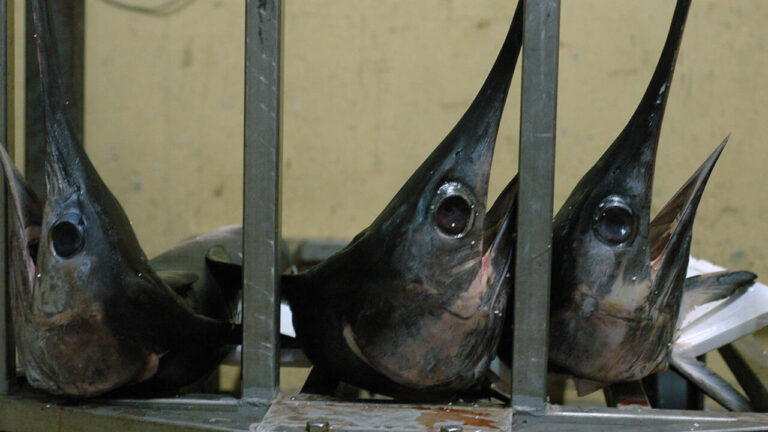
It is one of the protagonists of our summer lunches and dinners. Grilled, in a pan, between two slices of bread, in a roll, in every version. Swordfish abounds on tables from May, when it is cooler, until the end of the hot season, usually frozen. But thanks to the cold chain we can also enjoy it in winter. However, not all that glitters is gold and if we are not careful, even a shark could end up on our plate. Here’s how bad labeling can cause us to eat blue sharks and other underwater predators. What to look for then to recognize a real swordfish?
The turnover
The name of this animal derives from its jaw which extends into a pointed bony rostrum about a third of its body long. Swordfish fishing has very ancient origins, even the Greek historian Polybius spoke about it in the 2nd century BC. Its meat has always been highly appreciated for its taste and versatility. This is why global catches have grown exponentially in contemporary times: they went from just under 20 thousand tonnes in 1951 to over 110 thousand tonnes in 2017. A watershed year.
In that year the European Union adopted a regulation establishing management, conservation and control measures for certain fish according to the directives of the International Convention for the Conservation of Atlantic Tunas (ICCAT). And since 2018, fishing quotas have come into force in order to preserve the swordfish population. In 2017, the estimated Italian catches reached 2,327 tonnes out of the European total of 7,314 in the Mediterranean. With the debut of the total allowable catch, the threshold is set at 10,500 tonnes, falling to 9,017 in 2022 and 2023. Nonetheless, swordfish fishing remains a highly profitable market: revenues in 2023 stood at 22.6 million euros.
Incorrect labeling
As we have seen, the numbers circulating are enormous and are motivated by the equally important demand for swordfish from consumers. A demand which, thanks to the cold supply chain, can be satisfied all year round, but which reaches its peak in summer. At the supermarket, at the restaurant or at the fish shop near your home, swordfish is one of the most requested foods also due to its versatility: to be eaten in a sandwich or in pasta or served as carpaccio. Consumers who are less attentive or less accustomed to cooking fish could, however, fall victim to incorrect labeling that passes off shark steaks as swordfish.
Tuna, cheese and sushi: the invisible danger that triggers a sudden allergy (even if you don’t suffer from it) – by Manlio Pistolesi
The case is known to those who practice fish markets or coastal towns, but is also reflected in scientific publications dealing with food traceability. These episodes of mislabeling, or incorrect labelling, are the subject of the article published in 2019 by some professors and researchers from the University of Catania: “Swordfish or slice of shark?: a quick response…”, by Venera Ferrito, Alessandra Raffa, Luana Rossitto, Concetta Federico and Salvatore Saccone and coordinated by Professor Anna Maria Pappalardo.
In 2010 and 2018, the authors sampled fresh and frozen swordfish steaks in local fishmongers and supermarkets in Southern Italy, for a total of 35 samples. Other species were also added to the dataset, in addition to the swordfish, such as the dogfish (Mustelus mustelus), the pigfish (Oxyntus centrina), the blue shark (Prionace glauca) and the dogfish (Scyliorhinus canicula).
These specimens were used to build an archive of reference DNA sequences useful for validating the labeling of purchased products. The comparison between the DNA sequences of the reference specimens and those purchased in different markets in 2018 highlighted that 15 percent of the steaks labeled as swordfish contained different species. A figure at least double that recorded in 2010.
The same topic had already been addressed in another article from 2011, again signed by Pappalardo and his other colleagues from the University of Catania. In this study, the researchers, again through DNA analysis, highlighted that out of 15 specimens processed, only one was actually a blue shark, or blue shark (Prionace glauca), and all the others were swordfish. Years later, another case of incorrect labelling.
Italy in the top 3 for shark imports
The practice of selling sharks like other fish is widespread. Suffice it to say that in the United States in the 1940s they used to market them as white fish steaks (cod, hake…). The issue has been addressed several times by FAO, the United Nations food and agriculture organisation. A 1999 report from the name already talks about it Shark utilization, marketing and trade in which numerous cases of mako, bull and blue sharks distributed like swordfish are documented.
This data coincides with the increase in the capture of these predators to sell their fins, especially in Asian markets. While the rest of their meat is distributed all over the world. We have gone from accidental shark capture while searching for tuna and swordfish to active fishing. And Italy is one of the main importing countries of shark meat. As documented by the WWF report Safesharks and medbycatchbetween 2009 and 2021 our country was the third largest importer of shark products globally, with around 98 thousand tonnes, including 1,712 tonnes of fins, for a total value of around 377 million dollars (around 9 million from fins alone).
How to recognize swordfish
In our supermarkets shark meat can be sold like swordfish. These are not very frequent cases, but they are documented. This confusion is caused by incorrect labeling applied upstream in the production chain. It is not necessarily food fraud, but the damage to the consumer remains. Furthermore, the end user may be misled by the type of cut he finds in large-scale retail trade. That is, the fish steaks that make the identification of a species more complicated to the untrained eye.
Swordfish, porbeagle shark and blue shark are very different fish. The first is a bony fish, the second and third are cartilaginous. Some external characteristics, especially when it comes to processed products, could make them appear very similar. However, swordfish has meat between pink and red, with compact and clearly visible muscle fibres. The porbeagle and the blue shark, on the other hand, have a grey-white color and a less defined muscular structure. Furthermore, bony fish such as swordfish have ossified vertebrae, which are absent in sharks where the skeletal structure is composed of cartilage.
Have you ever thought why sushi costs so little? The boom in raw fish (and all the health risks) – by Manlio Pistolesi
In addition to the external appearance, our best ally are the labels, if present, that accompany the product. Reading them can help us distinguish a swordfish steak from a shark steak. By law, the mandatory name in Italian, the physical state, the name in Latin (which can also only appear on a sign next to the counter), the origin, the production method, the category of the fishing gear and any ingredients must be reported.
The methods to defend oneself, therefore, exist. If some mistake is made along a supply chain, it can always be remedied by spending a few more seconds on the shopping. Our health, our awareness as consumers and our pockets are at stake given that swordfish has a significantly higher value than shark.
Dossier is the exclusive subscription investigative section of The Vermilion. If you want to support our journalistic work and subscribe, visit our showcase by clicking here.