

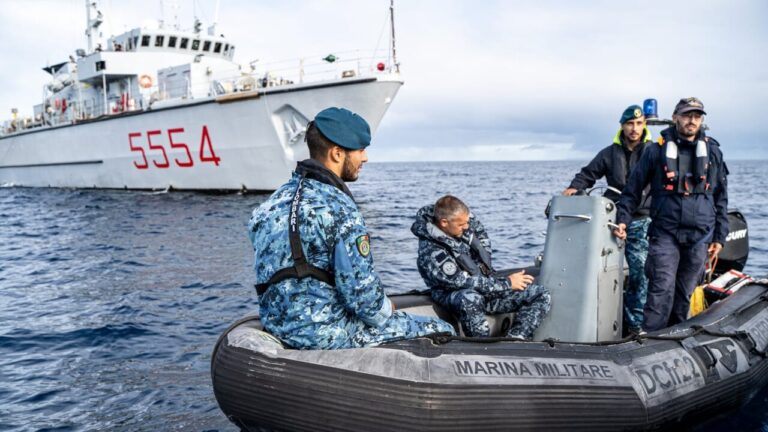
If the Strait of Hormuz must truly become fully navigable again in a reasonable time, Italy can become one of the key countries above all due to a very concrete factor: the technical capabilities of the Italian Navy in mine clearance.
The issue, in fact, is no longer just understanding whether the truce will hold or whether Tehran will keep the passage open. The real problem is transit safety. In the last few hours, Donald Trump has claimed that Iran is removing the bombs scattered in the strait with the help of the United States, while the US Navy has warned that the threat of mines in some areas of Hormuz “is not yet fully understood”. That is, the Iranian Pasdaran threw mines without bothering to map the area. Even after the announcement of the reopening, many companies continued to move with extreme caution: some ships attempted transit, but several stopped or reversed course due to uncertainty about the real safety conditions.
The mines dispersed in the Gulf
According to Iranian emissaries, in addition to the old-style devices – full of contact triggers – drifting in the Gulf, hidden in the seabed of Hormuz there are at least a dozen devices containing 120 kilos of TNT, sensitive to the metallic mass of the ships and the noise of the propellers. Only maritime drones can defuse them without causing them to explode: but weeks of patrols are needed to be sure that ships at sea are not in danger.
This is where Rome comes in. Italy starts from an advantage that not all allies have: it still has specialist expertise in mine countermeasures, i.e. in the identification and neutralization of naval ordnance. In fact, the Navy continues to deploy Gaeta class minehunter units, designed precisely to operate in such scenarios. While the US and British navies scrapped them.
The Colaninno family’s billion-dollar challenge: this is how they can help the Navy reopen Hormuz
It’s not a detail. Because demining a strait like Hormuz doesn’t just mean sending a few ships to patrol the area. If indeed, as various reconstructions claim, the devices were placed irregularly and without a reliable map, the cleanup requires very slow work: reconnaissance of the seabed, identification of targets, intervention with underwater vehicles and only after controlled destruction. It is an operation that can take weeks, perhaps more, and which requires very specialized means, not simple warships. In 1991, to liberate the coastal strip of Kuwait – filled with bombs by the Iraqi invaders – around fifty minesweepers worked for almost six months.
Smart working, fewer flights and car-free Sundays: what Europe will really ask of us if the price of energy worsens
For this reason, in the international summit promoted by France and the United Kingdom, the European contribution is not only imagined as a defensive escort for merchant ships, but also as a possible concrete support for the reopening of the maritime corridor. The French Defense Minister explicitly said that some European countries have the ability to participate in any mine clearance operations. In this group, Italy weighs more than others, because it can combine a presence in the area, an already established chain of command and naval instruments consistent with the type of threat.
What Giorgia Meloni really decided in the meeting with Macron