

The crisis in the Strait of Hormuz does not stop and uncertainty is pushing the price of gas higher. The more time passes, the more the nervousness on the markets increases: the double Iranian and US blockade on ship transit, the damage to the LNG production sites in Qatar and the level of European storage at its lowest level for four years can only create turbulence on prices. And while declarations calling for a return to Russian gas in Italy are bouncing around, the Meloni government has prepared another emergency scenario: reactivating coal plants.
Strait of Hormuz still closed and gas prices rise
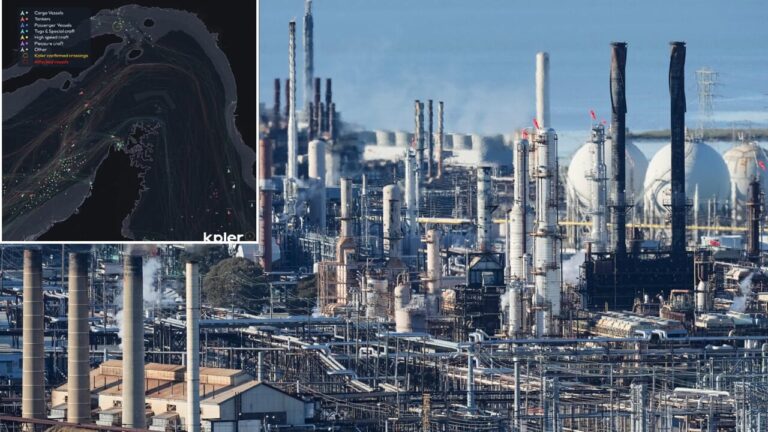
The Tttf index on the Amsterdam stock exchange, a reference for the formation of the price of gas in Europe, has returned to around 40 euros per megawatt hour, rising after the temporary relief following the announcement of a reopening of the maritime passage. The rebound came when tensions began to rise again, especially after the US boarding of an Iranian oil tanker: the Strait is far from safe to navigate and this can also be seen from the latest geospatial data, which shows naval traffic close to zero.
Since the beginning of the closure of the Strait, the index has accumulated an increase of 55 percent. Tensions escalated further after the United States opened fire and disabled an Iranian-flagged merchant ship, prompting Tehran to launch drone strikes against some US naval vessels and threaten to attack ships that attempted to cross the canal. Hormuz is vital for global energy routes: before the crisis, about a fifth of the world’s oil and LNG passed through this strip of sea, with Qatar being a delicate node: shipments of liquefied natural gas are at a standstill and Italy is more interested than others.
The LNG from Qatar that no longer exists: gas in Italy increasingly made in the USA
After the damage to the Ras Laffan sites and the blockade of Hormuz, the European Commission itself had warned that the consequences would be long-lasting. Italy has had to recalibrate supplies given that LNG now accounts for over a third of the total gas requirement and that Qatar is the second most important supplier: Edison – holder of the largest Italian supply contract with Qatar Energy – announced that it had replaced seven of the ten loads that Doha should have sent between mid-April and June on which the force majeure clause was applied.
Trump supplants Putin, he is the new master of Italian gas: here’s how much it costs us
1.4 billion cubic meters of US LNG will arrive at the Rovigo regasification terminal, the main landing terminal for Qatari LNG. Thus the United States is increasing its weight on Italian gas needs, after it has grown in the last two years.
Stocks at 4-year lows in Europe
Like every year, European countries will also have to fill their gas storages during the summer of 2026. Italy currently has them 45.9 percent full, but the European average is 30 percent, the lowest level in the last four years. Some European states, such as the Netherlands and Sweden, have a fill level of less than 10 percent.
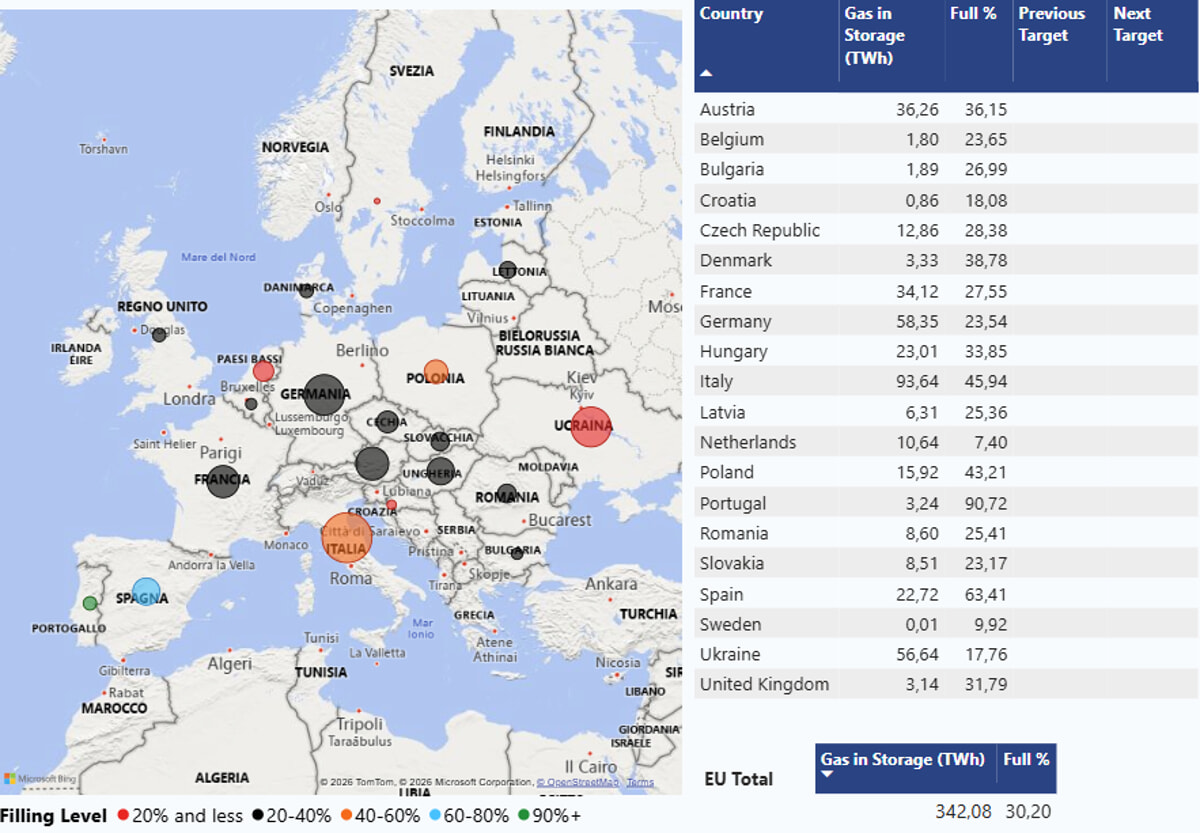
Entsog estimates that to reach 90% filling by the end of the summer, LNG imports of the order of approximately 86 billion cubic meters will be needed in the six months of injection. The Commission confirmed that it sees no immediate risks to supplies, but also called on countries to use regulatory flexibility and move in a coordinated manner to avoid a late summer rush that would push prices even higher.
Coal-fired power plants ready for action
If prices continue to rise, the Meloni government has an emergency solution: coal power plants. “The intention, the determination is that of closure on 31 December 2025, but in reality the coal plants on 31 December 2024 were practically closed on the continental part, unfortunately excluding Sardinia – explained the Minister of the Environment and Energy Security, Gilberto Pichetto Fratin -. What I didn’t do, because I didn’t feel like doing it, was to order the dismantling, because in an emergency and I consider an emergency a situation where the gas exceeds the 70 euros per megawatt hour, at this point it may be necessary to reactivate them. At a high figure, today gas is at 40 euros, the estimate we made before was 28-30 euros, 70 is very high, but that is the drop point”.
How much is Vladimir Putin earning every day thanks to Trump’s war in Iran
In Italy, there are four coal-fired power plants, two of which are shut down but not yet dismantled: three plants managed by Enel in Brindisi, Civitavecchia – shut down since 31 December 2025 – and in Sulcis, and that of Ep Produzione in Fiumesanto, in the province of Sassari. In total they provide 4.7 Gigawatts, of which 1 in Sardinia and 3.7 on the continent.
What happens now
The situation remains tense and uncertain. The Iranian Foreign Ministry’s announcement on the temporary reopening of the Strait of Hormuz was immediately followed by a warning from Iran’s Revolutionary Guards that vessels attempting to cross the vital waterway would be targeted.
Some of the 15 LNG carriers stranded in the Persian Gulf approached the maritime corridor, after news of the reopening, and then retreated. Donald Trump once again threatened to “destroy every single power plant and every single bridge in Iran” if the country’s leaders did not accept peace terms and negotiations in Pakistan continue in fits and starts.
The ceasefire agreed between the two countries almost two weeks ago expires on Wednesday. “The news over the last 48 hours has been extremely volatile,” he said MontelNews Jean-Christian Heintz, founder of consultancy firm Lng.now – “After such inconsistent communication, it would be wise for the market to suspend trading based on major news and focus on fundamentals.”
LIVE: The United States has seized an Iranian ship. Oil prices skyrocketing again
Henning Gloystein, managing director for energy and resources at consultancy Eurasia Group, told MontelNews he did not say he was surprised by the increase in gas prices, “given that expectations of an increase, even a gradual one, in transits through the Strait of Hormuz were disappointed”.
Even with an open Strait, the situation would take time to normalize: Eurasia Group did not expect normal maritime traffic to resume along the important shipping route before the end of May, even if a peace agreement was reached between the United States and Iran. “Putting hundreds of ships through and out of a narrow maritime bottleneck is like pushing the crowd of a full football stadium through a single gate,” Gloystein said.