

Among the genetic diseases of blood most widespread globally, the thalassemia it is characterized by the reduced or absent production of hemoglobin, whose vital function is to transport oxygen from the lungs to all the tissues of the body and, in the opposite path, eliminate carbon dioxide to make it expelled. In Italy it affects around 7,000 patients.
Of these, there are over 5,000 who live with transfusion-dependent forms, forced to undergo regular transfusions throughout their lives and follow daily therapies to eliminate iron which, accumulating in the body, can cause endocrinological, cardiological and hepatic complications. A very complicated everyday life, well outlined in the 2019 docufilm “The dream of an (almost) normal life”, written and directed by Anthony Muroni.
Reimbursability of drugs
A certainly decisive step was the recent reimbursement by the National Health Service of the first gene editing therapy for transfusion-dependent beta-thalassemia and for sickle cell anemia, whose name evokes the characteristic sickle or crescent shape that is assumed by red blood cells, in the demographic range between 12 and 35 years.
In this regard, AIFA, the Italian Medicines Agency, has published the summary table with authorized drugs admitted for reimbursement together with therapeutic indications. The therapy is based on the modification of the patient’s stem cells, which in clinical trials has allowed almost all those suffering from thalassemia, or Mediterranean anemia, to achieve independence from transfusions.
National strategy
Evolve treatment paths by focusing on an integrated national strategy, comparing the experiences of Campania, Sicily, Sardinia and Puglia as part of a shared commitment. This is what emerged from the final meeting of the “Blood & Beyond” project, which took place in the Senate.
The initiative, which brought together institutions, the scientific community and patients, was aimed at promoting appropriate and sustainable management of blood resources and rare haematological diseases, in line with European guidelines on Patient Blood Management; the program, organized by the World Health Organization and promoted in Italy by the National Blood Center, is characterized by guidelines with the aim of preparing “innovative and more effective methods and tools to guarantee the appropriateness of the organizational and clinical management of the blood resource”.
Shared priorities
The meeting summarized the territorial requests in some shared strategic priorities: coordination, strengthening the role of the national table dedicated to thalassemias as a forum for strategic direction and integration between the different levels of the system; the homogeneity of care; the updating of diagnostic-therapeutic care pathways, to guarantee uniform multidisciplinary care across the territory.
And again: access to innovation, accompanying new therapies with appropriate organizational tools. But also the importance of stimulating regional networks, promoting both the consolidation and full operation of regional clinical-care networks and coordination between reference centres, transfusion services and local medicine.
Healthcare challenge
“Despite diagnostic and therapeutic advances in recent decades, thalassemia still represents a public health challenge. Sardinia constitutes the region with the highest prevalence compared to the general population, with approximately 1,000 patients”. This is the comment to The Vermilion by Raffaella Origa, president of the Italian Thalassemia and Haemoglobinopathies Society and by Susanna Barella, representative of the National Thalassemia and Haemoglobinopathies Table and director of the Microcythemia and Rare Anemia Complex Structure of the “Antonio Cao” Microcythemia Hospital (Cagliari).
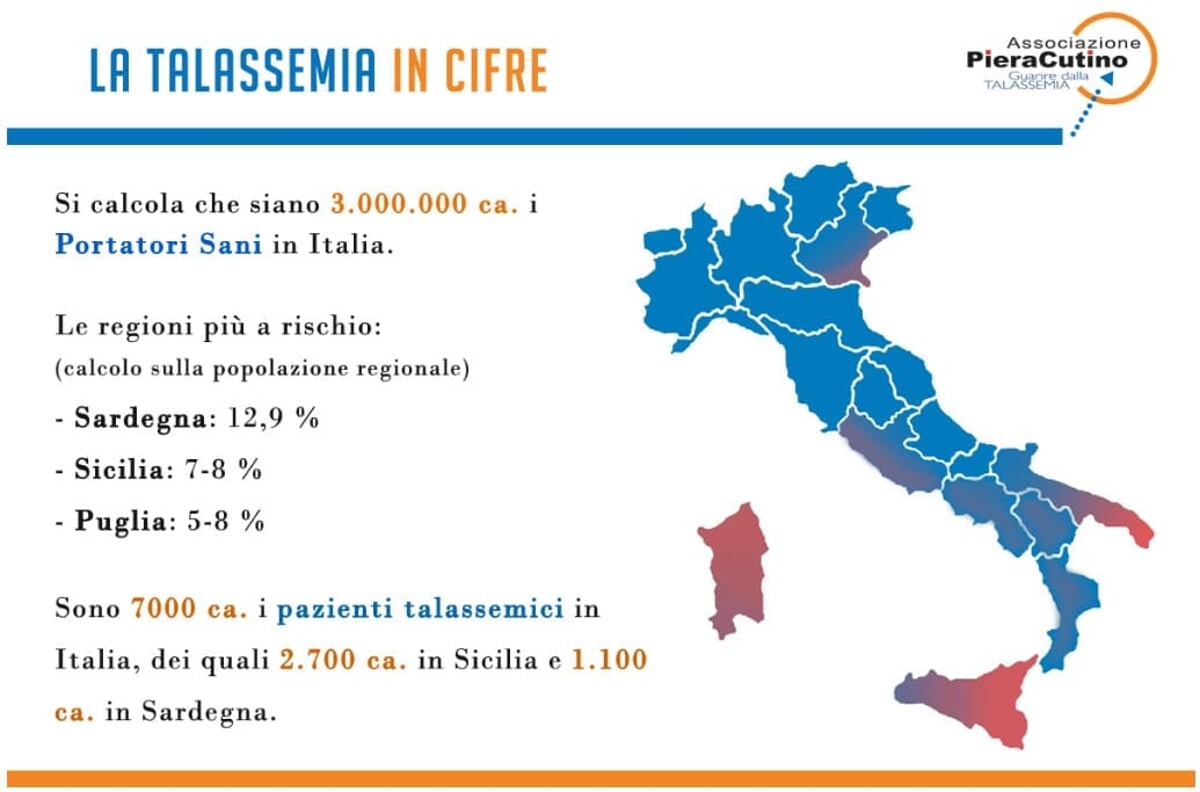
The geographic spread of the disease and the numbers describing its impact, outlined by Franco and Piera Cutino Foundation which supports and develops scientific research projects in partnership with various Italian and foreign research centres, reveal that it is a pathology, classified as rare, but in reality particularly widespread and deep-rooted.
Lights and shadows
Both speaking at the conference in the Senate, Origa and Barella further explain: “Thanks to research developments, largely developed in our country, the disease has gone from early fatal to a manageable but complex chronic condition. The increase inlife expectancy has made care needs more complex and continuous, while the attention on their health and economic impact has progressively reduced”.
Critical issues persist, “such as territorial heterogeneity, non-uniform access to services and the lack of full operation of fundamental governance tools”. And again, “the not always adequate availability of blood for transfusions, the limited involvement of the new generations in donation and the progressive aging of donors”. Then Origa and Barella comment: “The new advanced therapies open up unprecedented perspectives, but require adequate organizational models. The risk is that innovation proceeds at different speeds across the territory, amplifying inequalities”.