

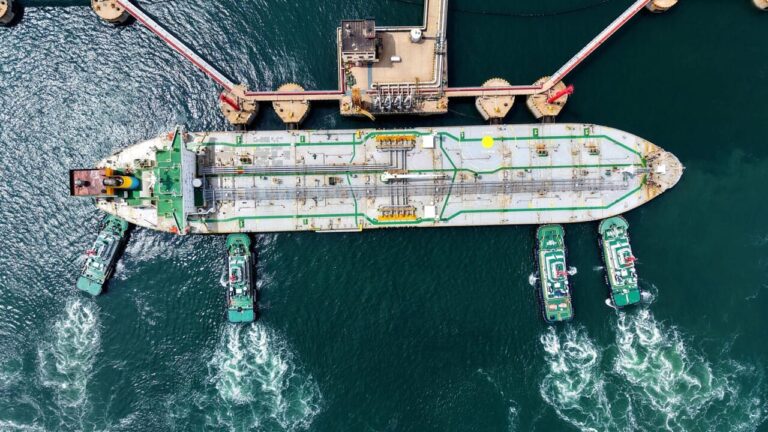
Those who run the global oil tanker fleet are making record profits thanks to the war in Iran. Having a fleet of vessels transporting crude oil by sea opens up serious revenue opportunities, especially if a key transit point such as the Strait of Hormuz is blocked. Who’s behind it? Oil transporters by ship are concentrated in a few companies and certain countries, there is also Italy and their role is more central than ever: the world is at their feet.
Skyrocketing insurance premiums: how much does a cargo cost with the war in Iran
Every day, 79.8 million barrels of crude oil – 76% of the world’s daily production – travel by sea. It is transported by the Very large crude carriers (Vlcc) and the Suezmax: steel giants up to 400 meters long, capable of loading 300,000 tons of black gold.
The blockade of the Strait of Hormuz, first implemented by Iran and now doubled by the United States, has trapped about 400 oil tankers in the Persian Gulf, removing tens of millions of barrels of crude from global shipping. The market is affected by the prices of oil or derivative products such as fuel, and also by rental rates: the surge in freight rates has been disruptive.
South Korean companies like Sinokor, for example, went from earning $50,000 a day for a single supertanker (VLCC) before the crisis, to a staggering $500,000 a day for storing crude oil that the oil majors are unable to export. In this scenario, a single two-month delivery can generate revenues of up to 30 million dollars, paying off the purchase of used ships in record time and rewarding listed companies.
The map of power: where the tankers come from
In terms of total value of naval assets at stake, China and Japan hold the world record. The first company in terms of “value” is the Japanese Mitsui OSK Lines, a giant with 9,000 employees and revenues of 10.6 billion dollars. In China, Cosco and China Merchants are state companies that allow Beijing to import crude oil, which is vital for the economy.
But when it comes to oil tankers, Greece stands out. There is a bloc of Hellenic entrepreneurs who master the global energy routes and hold the oil fleet with the highest absolute commercial value: 69.5 billion dollars.
Among the first operators there are other companies, such as the Danish Maersk Tankers, the Monegasque Scorpio Tankers of the Italian Emanuele Lauro or the Cypriot Frontline of the Norwegian magnate John Fredriksen, known as the “King of the Vikings”. Current profit margins are huge.
The “shadow” importance of Liberia, Panama and the Marshall Islands
Parallel to the legal market, an underground ecosystem operates which is vital to the economic stability of nations under sanctions such as Russia, Iran and Venezuela. Of the 79.8 million barrels of crude oil that travel by sea every day, an estimated 15-20 percent of the world’s total capacity belongs to a “shadow fleet” of more than 3,000 ships.
How much is Vladimir Putin earning every day thanks to Trump’s war in Iran
These vessels, in almost half of the cases, fly three flags: Liberia, Panama and Marshall Islands. This is where companies register oil tankers due to the preferential tax regimes. “Ghost” ships regularly deactivate AIS transponders, making themselves invisible and carrying out ship-to-ship oil transfers in the open sea. Coinciding with the closure of the Hormuz blockade, Russian revenues from maritime exports jumped by 115% in March 2026, almost half of which were transported by shadow or sanctioned ships.
Who is behind the Greek fleet that commands oil (and not only)
In Greece, the power of maritime transport is in the hands of a few family dynasties. Maria Angelicoussis, head of the Angelicoussis Group, is the richest woman in the country, heir to a group of 140 ships that dominates the transport of gas and crude oil.
George Prokopiou (Dynacom) is part of the old school of Greek shipowners and is known for the ever-present baseball cap he wears when visiting shipyards. The choice in the early 2000s to build icebreakers to transport Russian LNG from terminals in the Arctic Circle was pioneering.
Evangelos Marinakis runs his own Capital Maritime, as well as two football clubs – Olympiacos in Greece and Nottingham Forest in the UK – and Greek newspapers. There is also the Kyriakou family, which recently formalized the purchase of a large part of the Gedi group and Repubblica, with Athenian Sea Carriers.

Who is John Fredriksen, the “King of the Vikings”
The Norwegian-Cypriot John Fredriksen with his Frontline is among the market’s protagonists. He laid the foundations of his empire in the 1980s during the “Tanker War” between Iran and Iraq. While other companies fled, he sent his ships to load crude oil from the Iranian island of Kharg under Iraqi bombing fire, taking advantage of the risk premiums.
It also owns Seadrill rigs and a stake in Mowi, which has acquired several competing companies to become the world’s largest fish farmer.
The Italy-Korea plot: the role of Aponte and MSC
There are not many ships that fly the Italian flag, but Italian shipowners are decidedly important on the international scene, even of oil tankers or vessels that transport derivative crude products. Gianluigi Aponte recently passed ownership of the giant MSC to his children Diego and Alexa. The headquarters are in Switzerland and shortly, after authorization from the regulatory authorities, MSC will take over 50 percent of Sinokor Maritime, a Korean oil transport group.
Ip is also leaving: the golden farewell of the last Italian oilmen