

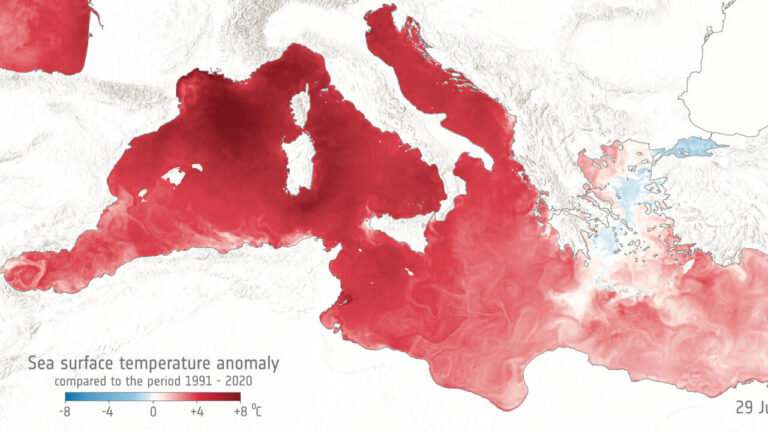
Thirty-three degrees. Not on the beach, but in the sea. On 5 August 2026, the Sa Dragonera buoy, off the west coast of Mallorca, recorded a water temperature of 33.02 °C, with readings during the afternoon indicating values around 33.2 °C. The figure would represent the highest value ever measured offshore in the Spanish Mediterranean and probably in the entire western Mediterranean.
The peculiarity of the measurement lies precisely in the place where it was carried out. This is not a small bay or a shallow lagoon heated by the sun, but open sea, with the sensor placed about three meters deep. The same mark had set the previous record on August 12, 2024, stopping at 31.8 °C.
The Balearic record is the most extreme point of a situation that affects a large part of the basin. Even around Italy the values are exceptional. On August 6, Arpae’s Calipso buoy, positioned 16.5 kilometers off the coast of Lido Adriano, measured 29.5 °C in the Adriatic. In Cesenatico 30°C had already been reached in June. Federico Grazzini, head of the operations room and functional center of Arpae Emilia-Romagna, explained that the Tyrrhenian Sea is also around 30°C. The difference compared to other very hot summers, such as that of 2003, is above all the persistence of these values.
The signal had already appeared very clearly at the beginning of the summer. Copernicus satellite data processed by the European Space Agency showed anomalies up to 8°C above the 1991-2020 average on 29 June 2026, with the largest anomalies off southern France, around Corsica and Sardinia and along the Italian peninsula.
Because the sea continues to warm
The sea reacts more slowly than the atmosphere to changes in temperature, but for this reason it can accumulate enormous quantities of heat. Prolonged periods with high air temperatures, strong solar radiation and little wind limit mixing with colder water layers and allow the surface to warm up more and more.
Because a 30 degree sea is a problem even on land
The first consequence is felt on the coasts. A very warm sea loses part of its ability to mitigate temperatures and continues to transfer heat and humidity to the atmosphere even during the night.
It is one of the mechanisms that favor tropical nights, those in which the temperature does not fall below 20°C, and the so-called torrid nights, with minimum temperatures above 25°C. In Alicante, for example, 20 nights with minimum temperatures above 25°C were recorded in July 2026 alone. On the Romagna coast Arpae detected minimum temperatures close to 25 °C associated with a humidity of 95 percent.
Then there is the chapter of storms. A very hot Mediterranean does not automatically cause floods, hailstorms or storms. For extreme phenomena to develop, certain atmospheric conditions are needed, such as the arrival of colder air at high altitude and a configuration favorable to instability.
When these conditions occur, however, an exceptionally warm sea surface can make more heat and, above all, more water vapor available to the atmosphere, increasing the fuel available for precipitation. This is why experts look carefully at the sea temperatures accumulated during the summer in view of the late summer and autumn disturbances.
The Mediterranean is becoming another sea
Perhaps the most profound consequences occur beneath the surface. Marine heat waves subject Mediterranean organisms to prolonged thermal stress, can reduce available oxygen in the water and affect species that are unable to move quickly to cooler areas.
At the same time, increasingly higher temperatures favor species accustomed to warm waters, including alien species from tropical and subtropical areas. The result is what scientists increasingly define as the “tropicalisation” of the Mediterranean: the species present, the balance of the ecosystems and progressively also the sea to which we are accustomed change.