

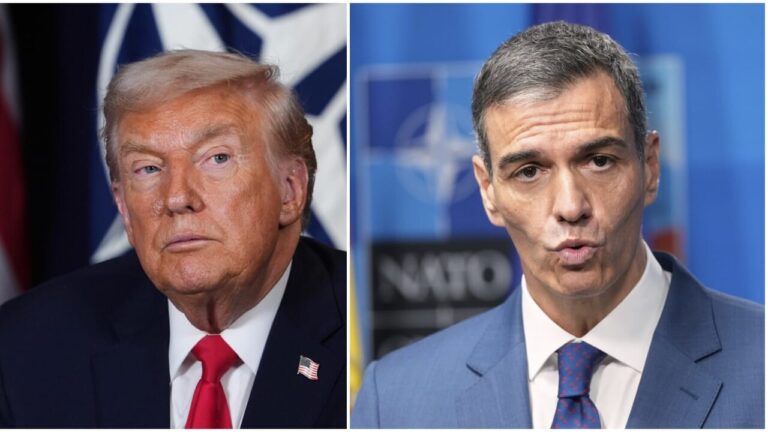
An internal Pentagon email has revealed that the Trump administration has a number of options on the table to “retaliate” against European allies for failing to support US operations in the war against Iran. Among the options on the table would be suspending Spain from the Alliance and reviewing the US position on Britain’s claim to the Falkland Islands.
The possible retaliatory actions emerge in an email exchange between senior officials revealed by Reuters. President Donald Trump has repeatedly criticized NATO allies for having “disengaged” from US military operations in the Strait of Hormuz, going so far as to talk about the United States’ withdrawal from the Alliance.
Spain, in particular, has not granted the USA authorization to use its bases (the two most important, Naval Station Rota and Morón Air Base) and its airspace to attack Iran. Hence the desire to “punish” the socialist government of Pedro Sanchez. In the email exchange, the officials stressed that the option of suspending Spain from the Alliance would have a limited effect on US military operations, but a significant symbolic impact, noting that NATO cannot be “a one-way street”.
What the treaties say
The United States alone cannot really suspend another country from NATO. The general legal framework designed by the treaties, in fact, does not provide for a mechanism for the expulsion or suspension of a member state. Furthermore, no important decision can be made by imposition of a single country (not even if it is the United States). However, it is true that a country with a “specific weight” within the Alliance can apply political or diplomatic pressure, block decisions and reduce bilateral cooperation.
However, they cannot unilaterally expel or suspend an ally. Article 13 of the treaty allows a country to withdraw voluntarily (giving one year’s notice), but the opposite, such as forced expulsion, does not exist.
If a member seriously violates the principles of the Pact, the other members can limit its role in NATO structures and isolate it politically, but always through collective dynamics, not with a unilateral US act. The architecture of NATO is in fact built precisely to prevent a single state, even the most powerful, from deciding the fate of the other members alone.
Political marginalization and de facto exclusion
However, even though there is no formal “suspension”, there may be “de facto”, politically constructed forms of suspension. The North Atlantic Treaty is very essential and says little about internal sanctions, but by looking at some fundamental rules it is possible to better frame the hypothesis of a suspension imposed by the USA.
On the issue, in article 13 (which only provides for voluntary withdrawal) we can add article 10 which regulates the entry of new members, but not the forced exit. Article 4 provides for the use of consultations between allies in the event of a crisis, while Article 9 establishes the North Atlantic Council and states that decisions are taken by mutual agreement (consensus). In short, there is no article that allows formal and unilateral suspension or expulsion.
Even without an explicit basis in the treaty, States can use instruments within the Alliance to reduce the role of a member. Concretely, collectively the allies can effectively exclude a member from operational activities and limit participation in NATO missions or commands. The indirect legal basis is Article 9 which requires collective decisions. According to the same principle, members can reduce access to information, intelligence sharing or military cooperation with a member country; just as they have the ability to prevent officials from that country from taking on key positions
Politically, a country can be marginalized within the North Atlantic Council (the main political decision-making body of NATO). While remaining formally member, with this series of operations a country can actually be severely limited in its concrete participation in joint operations and forms of collaboration of the Alliance. That is, a “functional suspension” is created, which however does not coincide with a change in the legal status of member, as it does not activate any formal procedure provided for by the treaty.
Is there a precedent?
There is no case of official suspension in NATO. The closest case is that of France in 1966, when it left the integrated military command, while remaining a political member of the Alliance. The decision, implemented under the leadership of President Charles de Gaulle, aimed to reaffirm French national sovereignty, rejecting US supremacy within the Alliance and the integration of its armed forces under foreign command.
Only in 2009, under the presidency of Nicolas Sarkozy, did Paris decide to fully rejoin the integrated command, despite never having left the political Alliance as a whole. This shows that participation can be modulated, but formal membership remains intact until the country voluntarily exits.
Pedro Sanchez: “We are a reliable partner”
“Spain is a reliable partner within NATO”, declared the Spanish prime minister, when asked about the possibility of suspension mooted by the US administration. “We are fulfilling our obligations to the Alliance by deploying military capabilities and soldiers on the eastern flank of Europe. So there is no reason to worry.”
“I would say that it would be important if European Allies could share thoughts and information before starting wars, like the one we are suffering now in the Middle East because this part of the world is close to Europe. We must also be aware and have an opinion on the matter”, underlined Sanchez, referring to the military action initiated by the US with Israel against Iran, without prior consultation with the allies.
“From my point of view this war is illegal, it is a serious mistake – reiterated the Spanish Prime Minister – and I hope that in the near future we can see a de-escalation and, of course, a way out, thanks to diplomacy and not thanks to the conflict”.