

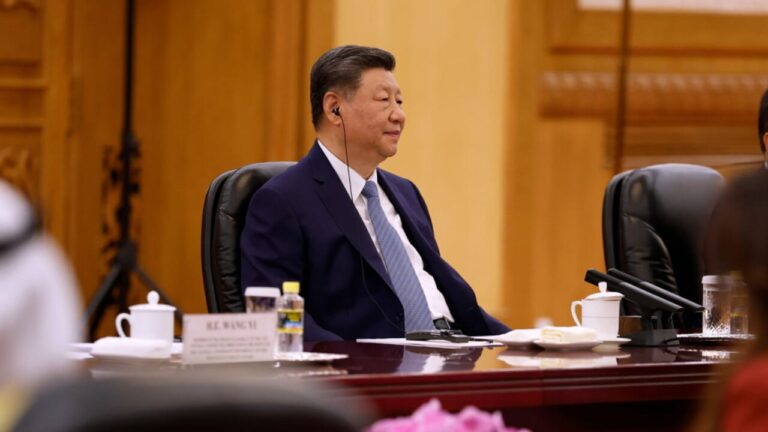
Beijing is raising its profile and trying to carve out a leading role in the Middle Eastern crisis, accrediting itself as a responsible global player and diplomatic alternative to Washington. In the midst of tensions between the United States, Iran and Israel, and while the truce appears increasingly fragile, President Xi Jinping has put a four-point proposal on the table to promote peace and stability in the region. An initiative that is part of the Dragon’s intense diplomatic activity, which is anything but improvised.
The plan was illustrated during the meeting in Beijing with Sheikh Khaled bin Mohamed bin Zayed Al Nahyan, on a day marked by a busy calendar of talks with international leaders and representatives. In the background, the crucial issue of security in the Gulf and, above all, the Strait of Hormuz, a vital hub for global energy and Chinese economic interests.
Beijing’s diplomatic pressure
Xi’s move does not come out of nowhere. In recent weeks, China has already taken action behind the scenes, together with Pakistan, to encourage a dialogue between Washington and Tehran. The negotiations that took place in Islamabad – then collapsed over the weekend – had led to significant progress, with around 80% of a possible agreement already outlined before the stalemate.
At the same time, Beijing has maintained contacts with various international actors, seeking to strengthen its role as mediator. It is no coincidence that in the Chinese capital there have been meetings with leaders such as Pedro Sánchez and the Russian Foreign Minister Sergei Lavrov, confirming a diplomatic activism that aims to build consensus around a multilateral approach.
In this context, China has also raised its tone against the United States, openly criticizing the strengthening of the military presence and the naval blockade in the Strait of Hormuz, defined as “dangerous and irresponsible” because it risks compromising the truce and further aggravating tensions.
The four pillars of the Chinese proposal
Xi’s “recipe” is divided into four directions. More than a detailed operational plan, these are guiding principles designed to create a framework within which to build any agreements. The first point concerns the principle of peaceful coexistence and shared security, recalling the need to strengthen cooperation between the countries of the Middle East, considered “interdependent and inseparable” by Beijing.
The goal is to foster more stable relations and promote the construction of a “common, cooperative and sustainable” regional security architecture. The second pillar focuses on respect for national sovereignty, the key principle of Chinese foreign policy: non-interference. Xi reiterated that the sovereignty, security and territorial integrity of states must be fully respected, especially in a region marked by conflicts and external interference. A message that also sounds like a criticism of Western strategies.
The third point concerns the centrality of international law, i.e. the defense of the rules-based international order, with the United Nations at its centre. Beijing invites us to avoid selective applications of international law, warning of the risk of a return to the “law of the jungle”. Finally, China calls for respect for the balance between development and security, two sides of the same coin. Hence the commitment to “collaborate to create an environment favorable to the development of the countries of the Middle East”.
Energy, economy and strategic interests
Behind the diplomatic initiative there is also a clear strategic interest. China depends significantly on energy supplies from the Gulf: approximately half of imported oil and a significant share of liquefied natural gas pass through the Strait of Hormuz. A possible prolonged closure of the route would have serious repercussions on the country’s industrial production and economic stability.
The tensions are already having effects globally. The International Monetary Fund and the International Energy Agency have warned of the risk of an increase in raw material prices and new inflationary pressures, with particularly serious consequences for the most vulnerable countries. Despite its activism, China’s ability to really influence the balance of the conflict remains to be verified. The four-point plan, for now, is configured more as a platform of principles than as a real binding negotiation path.