

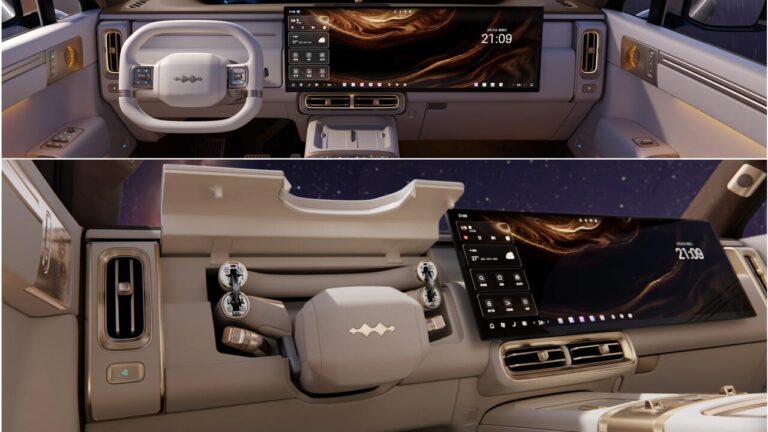
The steering wheel folds on itself, moves back and disappears inside the dashboard. Only the airbag remains in its place, while the driver’s seat can be transformed into an armchair on which to lie down during a break. It is one of the innovations introduced by the Chinese manufacturer BYD on the Fang Cheng Bao Tai 9, a large plug-in hybrid SUV presented in China. A solution which, according to the company, represents an absolute first for a car destined for series production.
Operation is simple, at least for those in the driving seat. When the car is stationary, just activate the mechanism to see the steering wheel rim fold and the column move backwards. A door opens in the dashboard and allows the entire structure to reenter the passenger compartment. The operation takes just ten seconds and frees up the space normally occupied by the steering wheel, allowing the driver to recline the seat further, stretch his legs or use an integrated table.
What makes this transformation possible is steer-by-wire technology, an electronic steering system that eliminates the traditional mechanical connection between the steering wheel and the wheels. The movements imparted by the driver are transmitted via electronic signals, allowing greater freedom in the design of the driving position.
The car with the disappearing steering wheel
The goal, at least for the moment, is not to allow the car to travel without a steering wheel. The system can only be used when the car is stationary and is designed above all to make prolonged stops more comfortable, including those necessary to recharge the battery. Looking ahead, however, similar technology could also find application on fully self-driving cars, allowing the driver to choose between manual and automated driving.
The novelty debuts on a 5.27 meter long SUV, with six seats and a propulsion system that combines a 1.5 liter turbo petrol engine with two electric motors. The overall declared power is 544 horsepower, while the 66.48 kWh battery allows, according to the manufacturer’s data, to travel up to 310 kilometers in exclusively electric mode.
The retractable steering wheel is included in the most expensive version of the range, offered on the Chinese market at 329,900 yuan, equivalent to around 45 thousand euros. Completing the design is a 30-inch panoramic display on the dashboard, a 21.4-inch roof-mounted entertainment screen for rear passengers, Nappa leather upholstery and an integrated 11.5-litre refrigerator. The cabin also offers heated, ventilated and massaging “zero gravity” style seats.