

As energy prices approach the highest point of the last 4 years, lowering the price of bills becomes a question of the market, of agreements, but also of points of view. The solution is to reimburse part of the costs incurred by gas power plants through the revision of the ETS, the European emissions taxation mechanism.
In Italy, it is in fact gas that sets the price of energy and the government wants to act on the “problem” by applying this measure contained in the “Bills Decree”, still waiting to be authorized by Brussels. There is an agreement in principle with the EU Commission, but the consequences on consumers and the costs to be borne are unclear. Who would pay? The risk is to find ourselves in a paradoxical situation.
What is the ETS and why does it affect the price of bills
The ETS, Emissions Trading System, is the European system for trading emissions quotas. Power plants powered by fossil fuels must “return” – by paying – quotas corresponding to the CO2 they emit. A tax on pollution to encourage the energy transition towards renewables.
In the wholesale electricity market, however, the price is determined through a marginal system: the last offer capable of satisfying demand helps determine the price. And, in Italy, most of the time it is gas that sets the price. The cost of ETS quotas can therefore be reflected in the price paid in electricity and gas bills.
The government’s reasoning comes from here: if the cost that a thermoelectric power plant incurs is reduced, it can reduce the wholesale price of energy, giving a benefit to consumers. But the cost does not disappear: it is transferred elsewhere.
How the gas cap would work thanks to ETS
Again, nothing has been put in black and white, but the mechanism closest to the solution under discussion is the tope Iberian, introduced in 2022 by Spain and Portugal during the energy crisis. “It could be a similar mechanism: above a certain gas price level the prices are compensated. The mechanism reimbursed the difference between the prices and the ceiling”, Carlo Stagnaro, research director of the Bruno Leoni Institute, explains to DossierToday.it.
The principle allows power plants to formulate offers on the market by assuming a conventional cost of gas that is lower than the actual one, then receiving compensation for the difference, although in the Italian case the formula could be less direct.
Arera, the state authority that regulates energy, networks and the environment, had proposed two possible systems to determine the ceiling: one based on a predefined initial threshold, with gradual increases before the conclusion of the measure, and another partially indexed to gas prices. In the latter case, the proposal envisages incorporating only a portion of the changes in the expected price into the ceiling.
In its Bill decree, the government envisaged a reimbursement linked to ETS costs, but Arera, recalling European legislation, had clarified that the mechanism cannot translate into a direct or indirect reimbursement of ETS costs: it must preserve environmental obligations and use a different system, based on the price of gas.
Costs: from charges to incentives, what happens
The Ministry of the Environment and Energy Security has assumed an average reimbursement of 30 euros per megawatt hour, applied to a production of 110 TWh per year. Therefore, the cost for the system would be 3.3 billion euros per year from 2027.
The same technical report of the Bill decree estimates a gross benefit of 7.5 billion euros, thanks to the decrease in wholesale prices. However, other items must be subtracted from this figure and not just the reimbursements to producers: 750 million in higher costs for incentives for renewables, 160 million for dispatching (the coordinated and real-time management of electricity flows on the grid) and 400 million in lower revenues from congestion revenues at borders. The result is a theoretical net benefit of 2.89 billion euros per year.
Practical example, with the simulation carried out by Arera: if the mechanism lowered the marginal price by 30 euros per megawatt hour, the gross benefit for buyers would be 30 thousand euros, while the reimbursement to gas producers would amount to 15 thousand euros. The simplified net benefit would therefore be 15 thousand euros, before considering other effects. But this is the ideal scenario.
So how much would you save on your bill?
Arera also specifies that, when the price is determined by other technologies, gas regulation may not produce effects on the market price. And in cases where multiple offers simultaneously contribute to determining the price, the benefit may be less than in the theoretical example.
The result therefore depends on how often gas plants are marginal and how prices change at different times. And the effects on the bill? The government technical report allows us to build an order of magnitude, with all the necessary precautions.
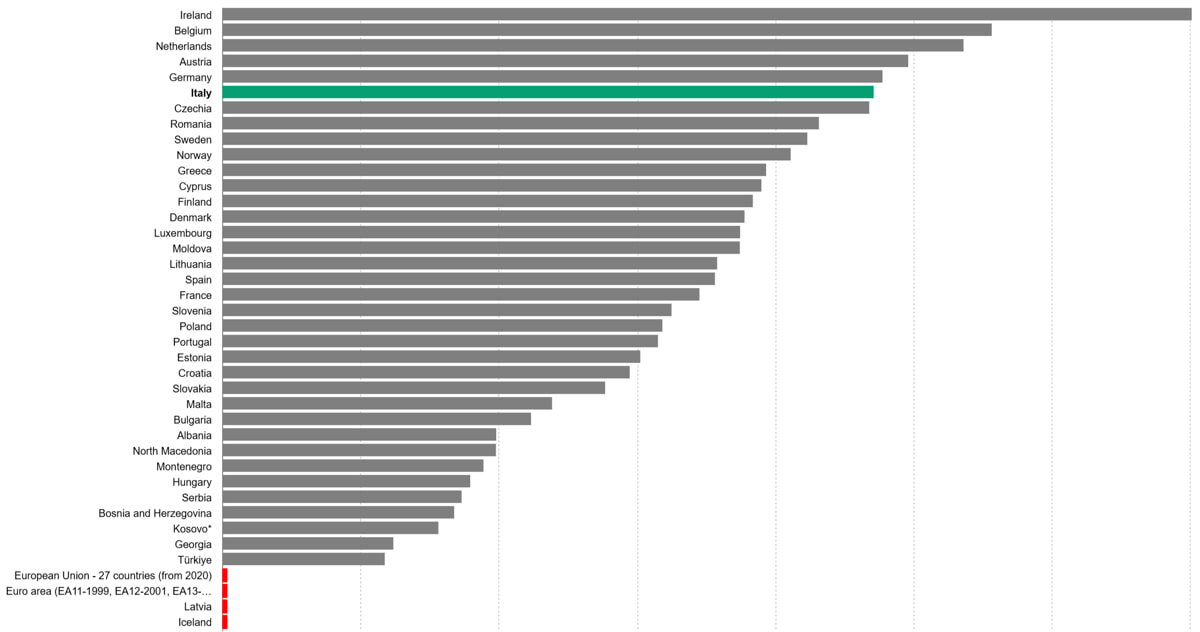
If the estimated net benefit of 2.89 billion were distributed evenly over 250 TWh of electricity consumption, the advantage would be equivalent to approximately 11.6 euros per MWh, i.e. 1.16 cents per kWh. For a family with annual consumption of 2,000 kWh it would mean approximately 23 euros per year.
Why electricity costs 0, but we pay more and more for it: the paradox of high bills – by Cesare Treccarichi
In reality, the distribution of benefits could be very different. In fact, Arera distinguishes between customers with contracts indexed to the Pun – the single national price – who would benefit directly from any reduction in the price of electricity, and fixed price customers, for whom the immediate discount on energy is not automatic.
Because we risk paying the Germans for gas
Of course, the reimbursements are supported by the community. They therefore end up in the bill, and Arera itself expects that the part not covered by congestion revenues will be recovered through a dispatching fee applied to end customers, because it believes that everyone can benefit at least indirectly from the measure. The risk, therefore, is that some consumers will bear the new burden without immediately receiving a corresponding discount on the contractual price of energy.
But we must also consider the relationship with the European electricity markets. “Unlike Spain, Italy is highly interconnected and the risk is that Italy becomes an exporter of energy produced from gas. A paradox would be created: the consumer would pay through bills for energy produced from fossil sources – gas – to sell it to the Germans in a time of scarcity”, warns Stagnaro.
The gas trap: why Italy has full reserves but bills continue to rise – by Alberto Berlini
It is precisely Spain that provides the precedent: the decrease in local prices has favored an increase in exports to France and Morocco. In the Italian case, the regulator analyzed the risk that the new mechanism reduces imports or, under certain conditions, increases exports of energy produced with gas. The problem is that the reimbursement to producers would be financed through the fees of the Italian electricity system. If the subsidized electricity were sold abroad, some of the discount could then go across borders.
Who really pays the bill and what remains to be decided
Finally, the financing remains to be clarified. The government presented a simulation capable of generating almost 3 billion euros in net benefits per year. But authorization from the EU Commission is needed and the benefits are not yet clear. The final conditions of the agreement will in fact establish the level of the ceiling, the duration of the measure, the reimbursement methods and the sharing of the burdens.
Jp Morgan, Benetton and foreign funds: who collects the billions in incentives for renewables – by Cesare Treccarichi
It is on these variables that the convenience of the intervention will depend. Until the threshold and the coverage mechanism are defined, it will not be possible to know how many euros will really come out of families’ bills. The risk to avoid is that the benefit obtained on the price of energy is absorbed by reimbursements to producers and other charges necessary to finance the operation.
Dossier is the exclusive subscription investigative section of The Vermilion. If you would like to support our journalistic work and subscribe, Click here.