

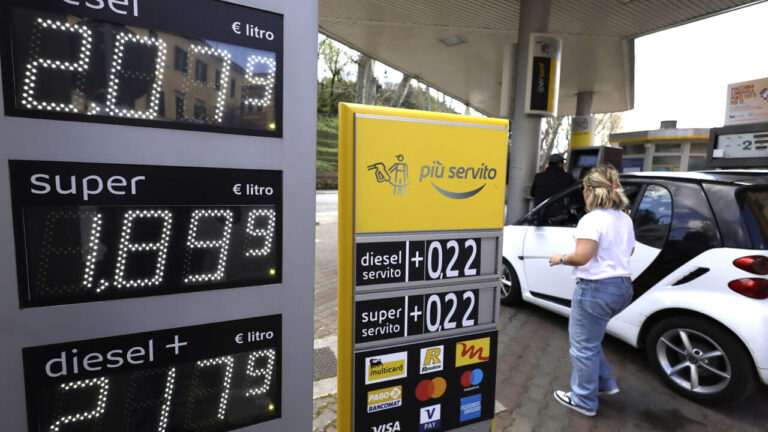
The Meloni government has decided: new mini extension of the discount on diesel
August ends exactly as it began: with the price of diesel skyrocketing, the discount on excise duties expiring (26 August), the shadow of the blow on consumers and the government having to decide what to do, complete with a “last minute” meeting between Prime Minister Meloni and the ministers. And, furthermore, the European Union’s “no” to the request to tax the extra profits of energy companies generated by the surge in prices because it is “the responsibility of the Member States”. Let’s take stock of the situation to understand what awaits us.
Diesel skyrocketing
Let’s start with the data. The price of diesel on the motorway has exceeded the historical record of 2022, with an average of 2.204 euros per litre. And the extension of the excise duty discount is about to expire.
The Ministry of Business and Made in Italy has announced that today 25 August, based on the latest data collected by the Observatory on fuel prices, the average price of fuel in self-service mode along the national road network is equal to 2.015 euros per liter for petrol and 2.136 euros for diesel. On the motorway network, however, the average self-service price is 2.091 euros per liter for petrol and 2.207 euros for diesel.
According to Codacons there is a risk that next weekend “without new interventions it will fly on the roads at an average of over 2.3 per litre, while on the motorway the average price will rise to 2.37”, a blow for motorists returning or leaving for holidays.
What does the Meloni government want to do
What will the government do now? The answer isn’t there. The phrase that floats around is: “Let’s evaluate what happens”. Smoky enough to be everything and nothing. On the possibility of new discounts for fuel excise duties, the Minister of the Environment and Energy Security, Gilberto Pichetto Fratin, did not say too much: “I am not ruling out or confirming anything. We need to make an assessment of the overall budget impact. We can also adopt criteria other than a generalized discount, focusing on discounts for individual sectors or consumption systems”.
Extending the general discount costs around a billion a month: “Mathematics is mathematics”, comments the minister. This hypothesis therefore seems marginal. In recent weeks there has been talk of one-off aid for lower incomes or specific categories of workers. Hypotheses that could come back into play.
So far there are no new Councils of Ministers on the agenda and there is no talk of interministerial decrees. We only learned of a video call, on the morning of today 25 August, with the participation of the Prime Minister Giorgia Meloni, the deputy prime ministers Antonio Tajani and Matteo Salvini and the leader of Noi Moderates Maurizio Lupi.
Frost of the EU
Meanwhile, the European Union has nipped in the bud the hypothesis of a common tax on the extra profits of energy companies, which was instead supported by Italy, Germany, Austria, Portugal, Spain and Poland. “The taxation of extra profits is the responsibility of the member countries”, clarified a spokeswoman for the European Commission. The Twenty-Seven, Ursula von der Leyen’s executive recalled, “can already make use of their national tax powers” and, if they wish, tax extra profits in compliance with EU law. Brussels will remain on its side of the field, offering “assistance and good practices” and monitoring the effects on the single market.
The EU’s position is supported by PD secretary Schlein, who insists: “Meloni and Giorgetti have no alibi. They must get a move on and act” in the face of a crisis that “hits families and businesses hard”. Carlo Calenda returns to propose to finance a structural cut in excise duties on fuel by increasing those on tobacco, spirits and gaming. If it is not done, accuses the leader of Action, it is due to the “degree of control” that public monopolies and large producers exercise over Italian politics.