

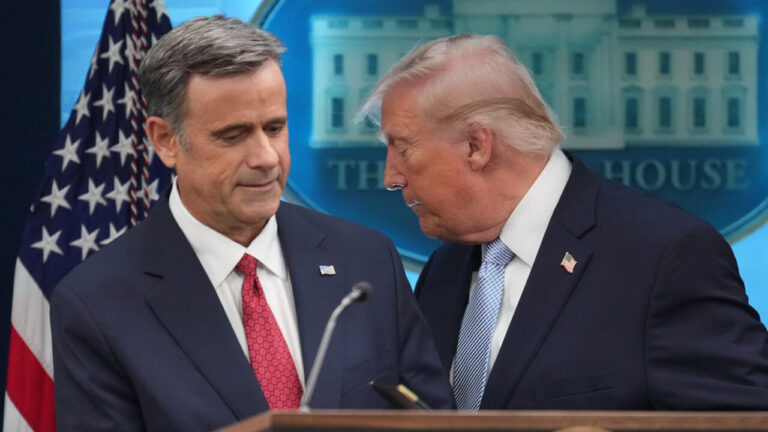
A confidential mission in the heart of Moscow to deliver a very precise message to the Kremlin: do not try to attack a NATO country. This would have been one of the objectives of the surprise trip in Russia by CIA director John Ratcliffe, as revealed by the Wall Street Journal and confirmed by other sources at CBS and to ABC.
Behind the unusual mission there would be new American intelligence assessments of Vladimir Putin’s intentions. US analysts believe it is possible that in the coming years Moscow could try to test the strength of the Atlantic Alliance with limited action, serious enough to provoke a crisis, but designed to make an immediate and united military response from allied countries more difficult.
The hypothesis of a Russian attack on NATO
The scenarios taken into consideration by the American apparatus range from a large cyber attack or other hybrid operations up to a limited land incursion against a NATO country. The Baltic republics – Estonia, Latvia and Lithuania – would be considered among the most exposed territories.
It does not mean that Washington has information that Putin has already decided to attack NATO. This is an intelligence risk assessment, which however represents a change compared to previous analyses: until recently the United States considered it unlikely that Moscow could directly provoke the Alliance while it was still engaged in the war in Ukraine.
The objective of a possible limited action, according to this interpretation, could be precisely to verify to what extent the allies are willing to apply the principle of collective defense envisaged by Article 5 of the Atlantic Treaty.
The problem of American ammunition
There is also a second element that worries Washington: military escorts. The Wall Street Journal reports that the United States has severely reduced the availability of some munitions considered decisive in a possible high-intensity conflict with Russia or China, after years of supplies to Ukraine and for the use of weapons in the war with Iran. Among the systems indicated by the American newspaper are the Atacms tactical missiles, the long-range Precision strike missile and the Stinger portable anti-aircraft missiles.
A vulnerability which, according to American officials quoted by the newspaper, could enter into the Kremlin’s calculations.
Ratcliffe did not meet Putin
Then there is an important detail. Contrary to some initial reconstructions, Ratcliffe did not meet Vladimir Putin directly. At least according to Moscow. Kremlin spokesman Dmitry Peskov confirmed the presence of the CIA director in Moscow and his talks with representatives of the Russian intelligence services. Putin, Peskov explained, was subsequently informed of the content of the meetings.
However, it is an exceptional visit. The last known trip to the Russian capital by a CIA director was in November 2021, when then-agency head William Burns traveled to Moscow to warn the Kremlin of the consequences of an invasion of Ukraine. Three months later, on February 24, 2022, Putin ordered the attack.
Trump denies: “A semi-routine visit”
The White House version, however, is different. Donald Trump, when asked about Ratcliffe’s trip, called it a “semi-routine” mission and denied that the CIA chief had gone to Moscow to discuss a possible Russian attack on NATO or American pressure on Iran. “We are working very hard to end the war,” Trump said, referring to Ukraine, adding that “something could still come of the mission.”