
The cost of your electricity bill may change depending on the region you live in. Families and businesses in areas that produce more energy from renewable sources would pay less, through a discount on system charges. This is the prospect opened up by the approval today 25 November, in the Senate Finance Committee, of a agenda presented by Forza Italia senators Antonio Trevisi and Claudio Lotito al bill on economic, fiscal and consumer protection matters. A proposal that reignites the confrontation between North and South on the distribution of costs and benefits of the energy transition.
What changes
The agenda commits the government “to evaluate, in compliance with public finance constraints, adopting provisions aimed at making the zonal price mechanism effective by providing for a reduction in system charges in proportion to the energy density of renewable sources”. However, it is worth remembering that this is not an immediately operational measure, but a political commitment that could translate into a revision of the tariff system.
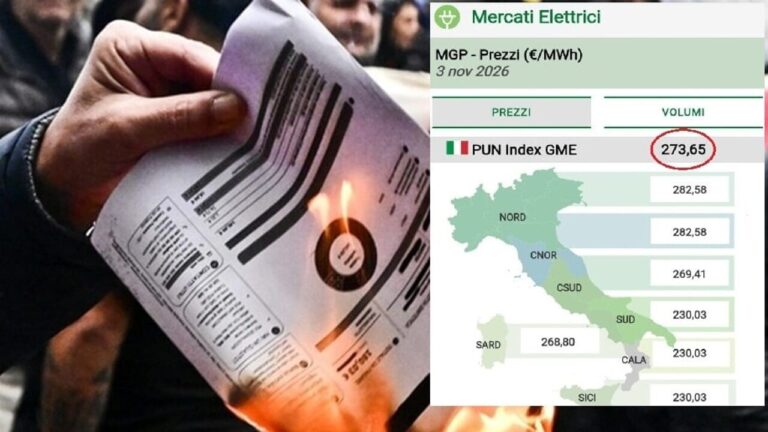
Since January 1, 2025, the Italian electricity market has surpassed the single national price (Pun) as a mechanism for valorising purchases on the day-ahead market, introducing zonal prices. However, a transitional equalization system was maintained to compensate for territorial differences. Italy is divided into seven market areas (North, Centre-North, Centre-South, South, Calabria, Sicily and Sardinia) in which the price of electricity varies according to demand, supply and the capacity of the networks to transport energy.
Forza Italia’s proposal goes further, intervening on system charges, i.e. that part of the bill intended to finance, among other things, incentives for renewable sources. The objective is to recognize an economic advantage for the communities that host the plants, thus encouraging new investments.
The question of the 170 billion in incentives
The issue had already sparked a conflict between Calabria, in favor of overcoming the single national price, and Lombardy. In an intervention published in the Corriere della Sera on 11 July, the Lombard councilor for Energy Resources Massimo Sertori contested the hypothesis of territorializing the benefits of renewables by continuing to share the costs among all Italians. Not only those of the incentives (equal to approximately 170 billion in total commitments for renewables) but also those of the infrastructure necessary for the transport of electricity and the stability of the grid.
“If you intend to apply the zonal price, then the Asos component should also be calculated on a zonal basis,” Sertori wrote, also asking to review the boundaries of the current electricity zones. The consequences would be direct not only on domestic bills but also on industrial policy: a lower zonal price could represent an incentive to locate new industrial activities in the South.
The issue remains that of roofing. If system charges were reduced in some territories, given the same overall costs to be financed and in the absence of alternative resources, the bill could be transferred to the bills of other users. It is not certain, however, that only the southern regions would benefit from it (Puglia, Sicily, Sardinia and Basilicata), also considering the important hydroelectric production of the North (Lombardy, Piedmont, Trentino-Alto Adige, Valle d’Aosta). Everything will depend on the criteria with which the government eventually decides to measure renewable production and distribute discounts.