

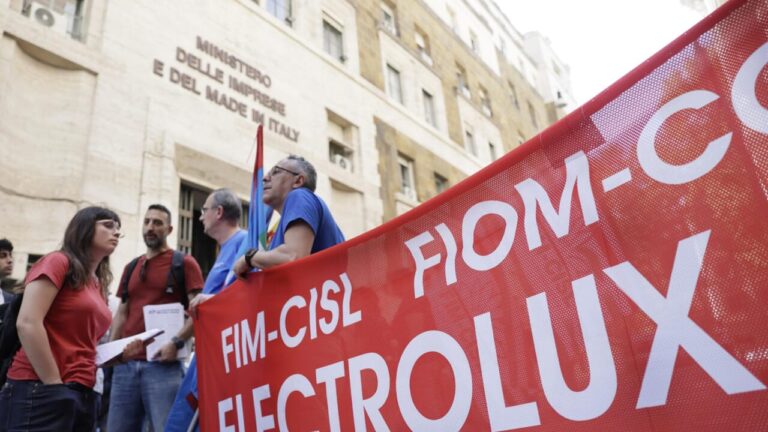
Withdrawal of unilateral layoffs and reindustrialization for Cerreto d’Esi. These are the key points of the new plan presented by Electrolux during the meeting at the Ministry of Business and Made in Italy (Mimit). The new plan provides for the withdrawal of unilateral dismissals, with an incentive for voluntary exit which would concern up to 600 employees and 650 workers in 3 years, in addition to the project of reindustrialization and retraining of personnel for Cerreto d’Esi, with the support of the institutions and the social partners through the creation of a working group, with 90 million euros of investments.
Urso: “A new phase opens”
Elements confirmed by Mimit in a note: “No closed factories, a reindustrialization path for the Cerreto d’Esi site, the withdrawal of unilateral dismissals, an incentive plan for voluntary exits over three years, the use of social safety nets and a new investment proposal to support the industrial transition”.
The Minister of Business and Made in Italy, Adolfo Urso, also participated in the table: “A new phase is finally opening. What we have taken today is a step in the right direction. Now everyone’s responsibility is needed to improve and define a shared solution by the next final table on 29 October, capable of ensuring a clear and lasting perspective for the future of all production sites and guaranteeing the protection of workers”.
During the discussion, the minister recalled that the dispute is part of “the government’s broader commitment in Europe aimed at strengthening the competitiveness of the household appliances sector, combating unfair competition, especially Asian, and supporting European production and investments”. An action which has seen a concrete opening from Brussels in the last few hours: “The Vice President of the European Commission Stéphane Séjourné has in fact confirmed in writing to the minister his willingness to act on the basis of the indications contained in the non-paper promoted by Italy and also supported by Germany, France, Spain, Poland and Slovakia”. The next meeting at Mimit is scheduled for the end of the month, October 29th.
Ciriani: “Remarkable step forward”
Luca Ciriani, Minister for Relations with Parliament, was also present at the table: “During today’s table a notable step forward was recorded on the Electrolux affair. Thanks to the work of the government, the first thing the company withdrew the plan which envisaged more than 1700 layoffs and in prospect a very high risk of relocation or even worse of sale of the factories, including that of Porcia. This for us was unacceptable because it constituted a social disaster. The new plan, which for the moment we welcome with favor, instead focuses on voluntary and incentivized exits to be carried out in three years. My personal commitment, like that of the government, is to keep Porcia central in the prospects of Electrolux. The next objective is to close the agreement with the company by the end of October, the attention however remains very high to best protect the workers and the industrial prospect of white goods”.
The reaction of the unions
The unions are also positive, as evidenced by the words of Michele De Palma, general secretary of Fiom-Cgil, and Barbara Tibaldi, national secretary of Fiom-Cgil and head of the household appliances sector: “The fight we have waged in recent months with workers has achieved the objective of respecting dignity. The withdrawal of unilateral dismissals by Electrolux is certainly an important change of pace, replaced by incentivized and voluntary exits over the next three years in the new plan proposed by the company. The company has presented a new plan proposal which provides for incentivized and voluntary exits for a maximum of 600 employees and 650 workers in three years, therefore 1,250 in total. While, on Cerreto d’Esi a reindustrialization process will be started without interrupting production on the site”.
For Fiom-Cgil, the essential elements to be able to reach a possible agreement with the company and the Government are: the maintenance of Electrolux’s employment, research and development and manufacturing structure. For Cerreto d’Esi it is therefore essential to guarantee employment and production continuity in the reorganization and reindustrialization phase. Furthermore, it is necessary to use new tools such as development contracts or support for the reduction of working hours and training for workers. The transition process must also include a process of employment regeneration, replacing those who leave voluntarily with new hires. Electrolux’s plan for Italy must also include the strengthening of investments. “The positive resolution of the Electrolux dispute is important for guaranteeing employment in the household appliance sector and the industrial system of our country as a whole. In the next meeting on 29 October we will delve deeper into the elements of the plan proposed by Electrolux starting from our observations”.
“Save the Cerreto d’Esi factory”
Also along the same lines are the comments of the confederal secretary of Uil, Vera Buonomo, the general secretary of Uilm, Davide Sperti, and the national secretary of Uilm, responsible for the household appliances sector, Gianluca Ficco: “It may be true that they have withdrawn the threat of unilateral dismissals, but to reach an agreement we need to save the Cerreto d’Esi factory and reduce the number of redundancies which, on closer inspection, still amount to 1,385. To hope in an agreement, a Government contribution to the competitiveness of a sector, that of household appliances, which objectively is in a state of great difficulty will be decisive”.
“Electrolux has partially modified its plan, bringing the overall expected production to 3.1 million per year of household appliances, and reducing the redundancies to 1,250, of which 650 workers and 600 employees, to which however must be added the 135 fixed-term workers whose contract would be allowed to expire, as well as the 90 who have already expired and the 80 who have left of their own volition in the meantime. Electrolux is willing to dispose of the redundancies in three years with layoffs and with voluntary incentivized exits, or more precisely – as Buonomo, Sperti and Ficco specified – based on the principle of non-opposition. As for the Cerreto d’Esi plant, Electrolux unfortunately confirms the closure decision, with a currently generic willingness to favor a reindustrialization process. Finally, the tough discussion on the organization of work and the schedule seems to have been set aside, or perhaps postponed to a later date the multinational’s claim to reach an agreement by October”.