

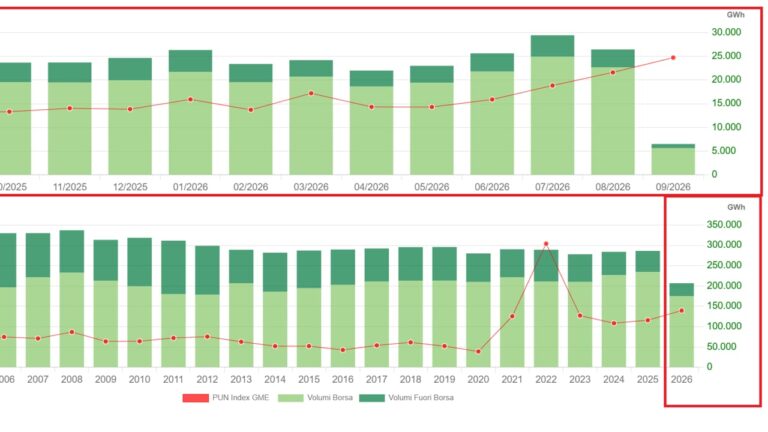
New record of the year for the price of electricity in Italy today Monday 7 September with the main reference of the wholesale electricity market reaching an average of 218.93 euros per megawatt hour, exceeding the previous high of 2026, the 207.84 euros recorded on 5 August. And in the most expensive hours the price of electricity reaches up to 321.04 euros/MWh.
You have to go back to the end of 2022, in the midst of the European energy crisis, to find higher prices.
Behind the new record there is first and foremost gas. The TTF, the main European reference, rose to around 74.5 euros/MWh, while the Italian index travels even higher, to around 77.7 euros. The new surge comes as the crisis in the Middle East continues to put pressure on energy markets.
Because light costs so much
Oil and gas prices are back on the rise following the new escalation between the United States and Iran in the Persian Gulf. Brent rose this morning to the area of 97 dollars per barrel, while European TTF gas travels around 74-75 euros per megawatt hour, at the highest levels since 2023. The markets are frightened by the US attacks against Iranian oil tankers and Tehran’s response, which in turn struck ships and tankers linked to the United States and announced the establishment of a new restricted maritime zone in the area of the Strait of Hormuz.
The escalation risks worsening the difficulties of energy traffic in the Gulf and, in particular, further delaying Qatar’s LNG supplies to Europe. A problem that comes at the worst time: the continent is approaching winter with gas stocks much lower than normal. As of September 1, they were approximately 65.6% full, more than 20 percentage points below the average of the last five years.
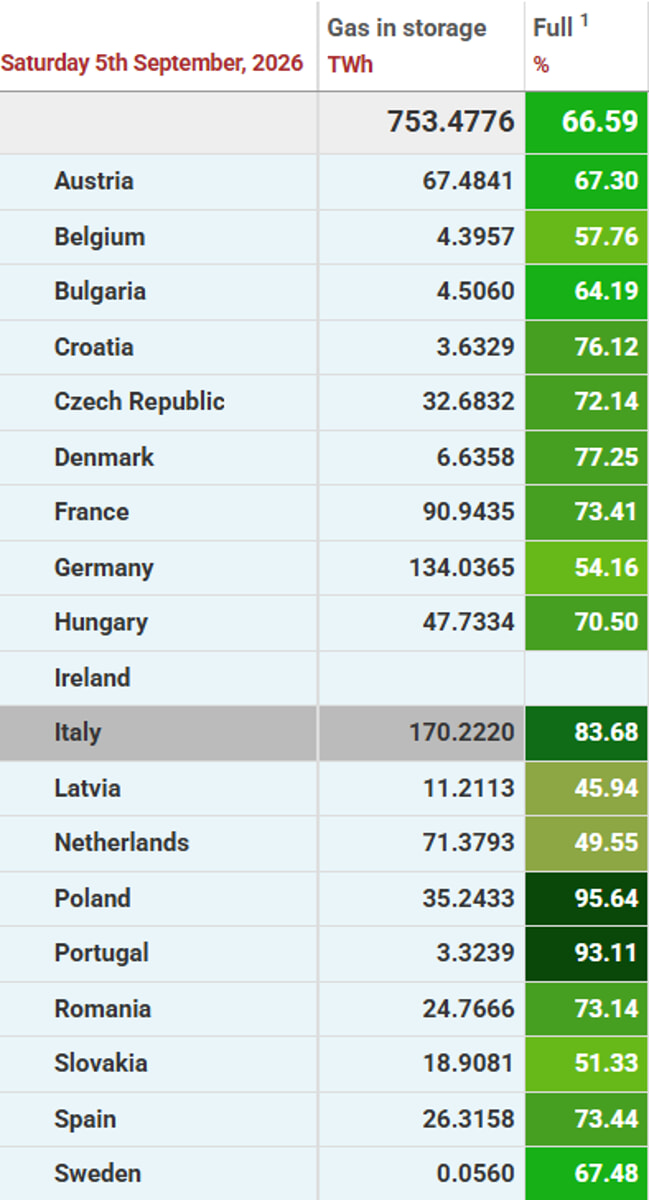
The combination of reduced inventories, lower supplies from the Gulf and growing international competition for LNG cargoes therefore makes Europe more exposed to new price increases if the crisis in the Strait of Hormuz were to be prolonged.
Tensions on supplies are thus quickly reflected in European prices. For Italy it is a particularly serious problem. In fact, our electricity system continues to rely on gas power plants to cover an important part of demand and, above all, these power plants frequently end up determining the price of electricity during the most difficult hours.
Just do some math. With gas around 78 euros/MWh, a modern combined cycle power plant with an efficiency of 55-58% can spend around 135-142 euros just for the fuel needed to produce one MWh of electricity. To this we must add the cost of CO2 emissions, currently higher than 80 euros per ton, which can be worth another 30 euros per electrical MWh. Even before considering the other costs and the producer’s margins, we are therefore already in the order of 165-175 euros/MWh.
There’s a new huge energy tax coming
But the price of gas alone does not explain why in some hours of the day we end up paying more than 300 euros per megawatt hour for energy.
The most difficult moment comes when the sun sets
The Italian electricity day now presents a characteristic trend. In the central hours, photovoltaic produces a lot of energy and helps to lower the price. On Sunday, the last day for which complete data is available, solar had met almost 24% of national electricity demand. Then comes the evening.
Between 5pm and 8pm, photovoltaic production drops rapidly, while families, shops, services and part of industry continue to consume energy. If there is little wind at the same time, the system must find several gigawatts of alternative production in a few hours.
And this is exactly what is happening these days: yesterday, Sunday 6 September, despite the low demand on a public holiday, wind energy had covered just 2.9% of demand. At that point thermoelectric power plants, hydroelectricity and imports come into play more. And to meet the last megawatts needed, the market may be forced to accept increasingly expensive offers.
This is how the PUN can exceed 300 euros/MWh in the evening hours, even if producing an average megawatt hour in Italy certainly doesn’t cost that amount.
How record prices are formed
In fact, the electricity market works, in simple terms, with a marginal mechanism: first the plants that offer energy at lower prices are called and then, as more electricity is needed to satisfy demand, the more expensive ones. The price of the last system needed to cover consumption helps determine the market price of that hour. Let’s imagine, for example, that at 8pm we need 40,000 MW. Part of it can come from renewables and other plants that produce at much lower costs; another from efficient gas power plants. But if to cover the last 1,000 MW it is necessary to switch on or increase the production of plants that offer energy at 300 euros/MWh, the market price can rise towards that figure even if much of the electricity injected into the system was produced at much lower costs. This is why a few hours of high demand, little renewable production and very expensive gas can cause huge peaks: it is not the average cost of all the plants that determines the price, but how much it costs to satisfy the last bit of demand needed to keep the system in balance.
Italy pays 60% more than Germany
But why on the same day in which the Italian price reaches 218.93 euros/MWh, in Germany electricity costs on average around 137 euros, in France 163 and in Spain 172? Or rather, why the Italian price is approximately 60% higher than the German one, 34% higher than the French one and 27% higher than the Spanish one.
Each country naturally has a different energy mix, demand, availability of plants and interconnections. But the comparison highlights one of Italy’s structural weaknesses: when gas becomes very expensive, our electricity market tends to be heavily affected.
And it is also here that the paradox of the Italian energy transition emerges. We have installed an increasing amount of photovoltaic, which in central hours can now cover a very significant share of consumption and push prices down. But we still don’t have enough low-emission storage, grids and other programmable sources to move enough of that energy to the hours when it’s needed most.
So, when the sun goes down, the system starts needing thermoelectric power plants again. And if at that moment gas costs almost 80 euros per megawatt hour, the bill becomes very high.