

A debut with mind-boggling numbers for Unitree Robotics. The Chinese manufacturer of humanoid and quadruped robots entered the Star Market, the technological list of the Shanghai Stock Exchange, with a leap that initially reached 629% compared to the IPO price. The shares reached up to 1,100 yuan, bringing the company’s capitalization for a few hours to around 445 billion yuan, equivalent to 66 billion dollars.
The race then slowed down during the session. After the initial high, the stock fell below 900 yuan and ended the day at 845 yuan, still 460% above the 150.8 yuan set for the initial public offering.
A rush to purchase securities
The debut photographs the enthusiasm of Chinese investors for one of the sectors considered most promising in the economy of the future: that of the so-called “embodied AI”, artificial intelligence incorporated into machines capable of moving and interacting with the real environment.
With the IPO, Unitree placed approximately 40.45 million shares, equal to 10% of the capital after the operation, raising approximately 6.1 billion yuan, just over 900 million dollars. At the placement price, the entire company was valued at around 61 billion yuan: a figure multiplied several times within a few hours of the market.
The demand was enormous. Nearly 9.8 million investors participated in the retail offering and, according to the Wall Street Journal, demand exceeded the shares available to this category of investors by more than 5,500 times. Other findings, based on the structure of the retail tranche, indicate an oversubscription of more than 8 thousand times.
Unitree thus becomes the first manufacturer specializing in humanoid robots to list on a stock exchange in mainland China. UBTech, another important name in Chinese robotics, is already present in Hong Kong.
Robots that dance, run and do kung fu
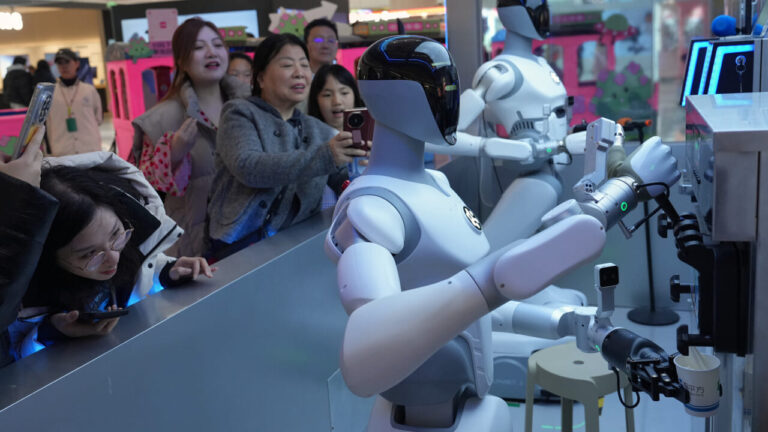
Founded in 2016 in Hangzhou, Unitree has become in just a few years one of the symbols of the Chinese race for robotics. She is best known to the general public for her videos, which have gone viral, in which her humanoids run, dance, jump and practice martial arts.
The media consecration also came through the television gala for the Lunar New Year, followed every year by hundreds of millions of people. The company’s robots performed choreographed and kung fu demonstrations, becoming a showcase of Beijing’s technological ambitions. By 2025, Unitree would have delivered over 5,500 humanoid robots, a quantity higher than that achieved by its main US competitors.
Meanwhile, the company continues to raise the bar. In recent days he presented the new humanoid called “SuperMan Robot”, designed to achieve particularly high athletic performance. Behind the spectacular demonstrations, however, there is a much broader industrial challenge: developing machines capable not only of repeating programmed movements, but of using artificial intelligence to understand the environment, make decisions and carry out tasks autonomously.
China is focusing on robots
Unitree’s boom comes as Beijing considers robotics and “physical” artificial intelligence as strategic sectors for its industry. The debut on the stock exchange also coincides with the World Robot Conference in Beijing, one of the most important events in the sector.
China can count on a vast industrial supply chain of motors, batteries, sensors and electronics and is trying to transform this manufacturing advantage into leadership in advanced robotics too. Unitree is also supported by leading investors: among the entities that have participated in its growth are Chinese technological and financial groups, while DeepSeek has invested 141 million yuan in the company and has signed an agreement to collaborate on the development of artificial intelligence and embodied intelligence models.
The sector, however, remains young and many of the most spectacular applications shown so far are mainly of a demonstrative nature. Unitree recorded revenues of around 1.7 billion yuan in 2025, with over 40% coming from abroad, numbers still relatively low compared to the valuation achieved on the stock exchange.