

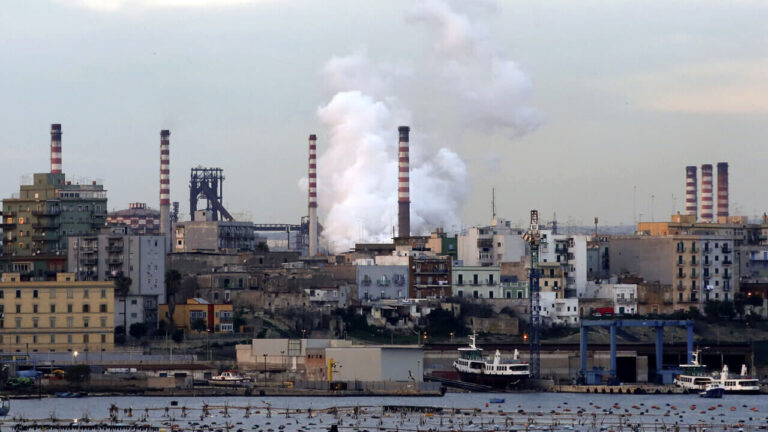
The Court of Cassation confirms the stop to the hot area of the former Ilva in Taranto. The Supreme Court rejected all the appeals presented by Ilva, Acciaierie d’Italia and Acciaierie d’Italia Holding, all in extraordinary administration, against the provision with which the Milan Court of Appeal, on 27 July, ordered the suspension of the plants.
In the reasons, contained in a 70-page ruling, the judges address the issue that has accompanied the steel industry affair for years: the relationship between employment protection, health and the environment. And they reject the idea that job preservation could justify dangerous working conditions.
With the filing of the sentence of the United Sections of Cassation, which confirmed the verdict of the Court of Civil Appeal of Milan, the former Ilva of Taranto must turn off the blast furnaces and cease hot production activity. The deadline of 15 December 2026 required by law to turn off the blast furnaces (now in the pre-heating phase) referred to the wait for the Supreme Court ruling to be filed, which occurred today. Now it is up to the commissioners to decide, in detail, the technical steps and timing of the shutdown. Since it has always been maintained that, once turned off, the blast furnaces are no longer usable, it is widely conceivable that the end has come for the hot iron and steel industry in Taranto.
The decision on the facilities and the government decree
The Court of Appeal’s provision had assigned 90 days to complete the suspension operations of the hot area. However, the systems remained in preheating after the government’s intervention: a decree allowed the commissioners to keep them in this condition until the Supreme Court’s ruling and, in any case, no later than December 15th.
With the rejection of the appeals, the decision of the Milanese judges remains confirmed. The ruling concerns the hot area of the plant, not a provision to close the entire steel complex.
The United Sections believe that the findings of the judges of merit on the existence of “serious and significant” dangers are well founded, such as to require the suspension of the activity pursuant to the European directive on industrial emissions. According to the Court of Cassation, the conclusions reached are based on the findings of the investigation and respect the precautionary principle.
Furthermore, the measure is not considered disproportionate. The continuation of the matter also plays a role in the evaluation: the protection of health and the environment must be effective, according to the indications of the European legal system and the Court of Justice of the EU.
“The right to work must be healthy and safe”
The central passage of the motivations concerns the contrast between employment and health. For the Court of Cassation, “the right to life and health (as well as to a healthy environment) and the right to work cannot be opposed and must not come into conflict”.
The State, the judges explain, must promote “healthy and safe” work, without making its preservation dependent on the acceptance of degrading or dangerous conditions. Maintaining employment remains an objective to be pursued, but through appropriate economic and social policies.
The conflict, in the Court’s reading, instead concerns the limits of entrepreneurial activity. In fact, freedom of economic initiative meets the constraints set by the Constitution: it cannot conflict with social utility or damage health, environment, safety, freedom and human dignity.
Constitutional limits and European rules
The Supreme Court recalls articles 2 and 32 of the Constitution and the reform of articles 9 and 41, which strengthened the reference to the protection of the environment and the limits of economic initiative. At the same time, it recalls the Republic’s commitment to recognizing the right to work and promoting the conditions that make it effective.
In light of these principles, the balancing carried out by the judges of merit is judged correct and reasonable. An evaluation that takes into account the long industrial, regulatory and judicial history of the former Ilva, its environmental impact and the public interventions adopted to guarantee its continuity.
The reasons also refer to EU Directive 2024/2881 on air quality, which provides stricter parameters for PM10 and PM2.5 particulate matter (the finest particulate particles). The European framework thus joins the constitutional one in the reasoning with which the Supreme Court confirms the sentence.
And the first comments from the trade union world also arrive on the sentence. ”The ruling of the joint sections of the Court of Cassation imposes an acceleration of the plan shared with the Government and the extraordinary commissioners at Palazzo Chigi thanks to the workers’ struggle”. This was declared by Loris Scarpa, national steelworks coordinator for Fiom CGIL. For Scarpa, “it is necessary to invest extraordinary resources to plan the decarbonisation of the plants and at the same time purchase slabs and coils to ensure continuity in production and employment. We need to start maintenance and reclamation but above all the verticalisation of all the plants from Taranto to Genoa up to Novi Ligure and Racconigi” concludes Scarpa.