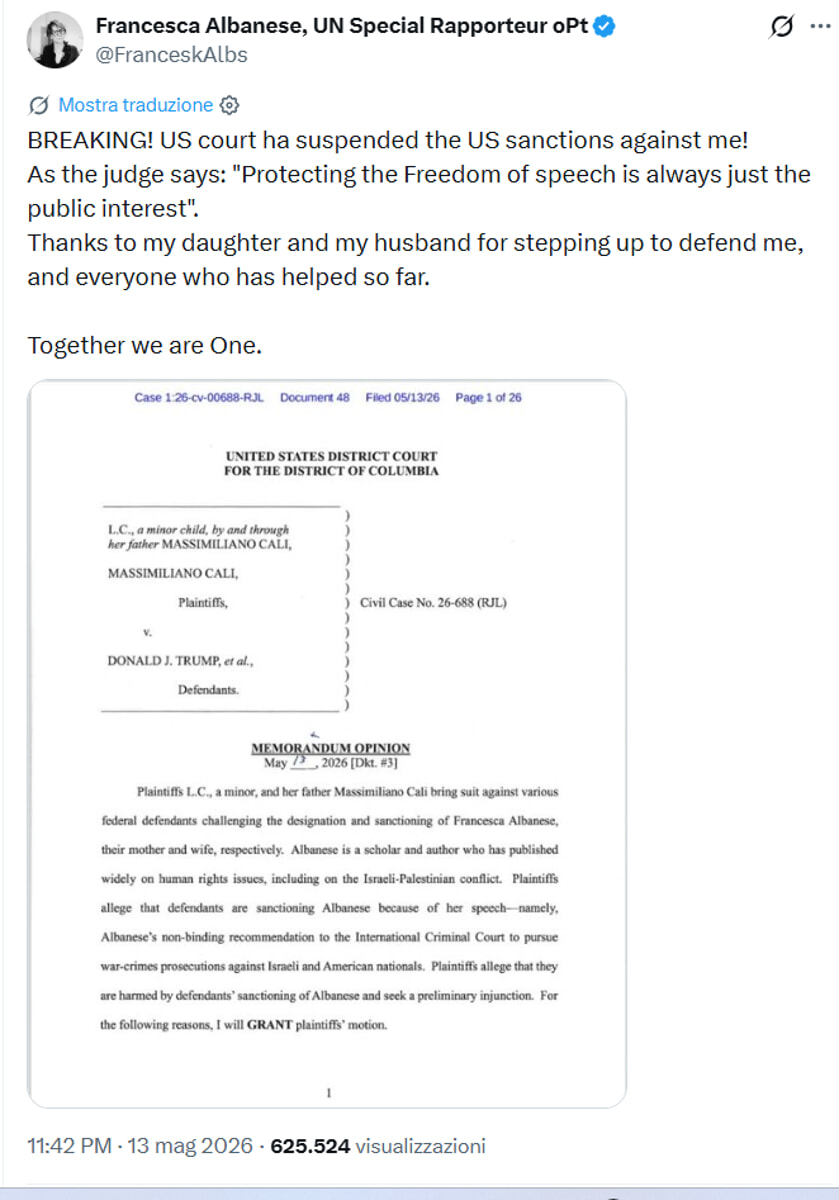
A Washington district court has suspended sanctions against Francesca Albanese, questioning the legitimacy of the measure taken by the Trump administration against the United Nations special rapporteur on the Palestinian territories.
The reason for the sanctions against Francesca Albanese
Albanese was sanctioned in July 2025 for her support of the International Criminal Court’s investigation into Israeli and US officials. In her report “From the Economy of Occupation to the Economy of Genocide” the rapporteur accused, among other things, major US technology companies of providing crucial support to Israeli military operations in the Palestinian territories.
Albanese had been accused of having a position hostile to US interests, hoping for a conviction by the Hague Tribunal. US Secretary of State Marco Rubio had spoken of “illegitimate and shameful efforts to solicit ICC action against US and Israeli officials, companies and executives”, adding that Albanese’s “political and economic war campaign against the United States and Israel will no longer be tolerated”.
The consequences of the sanctions: “Forced to turn to cash”
Since then, Albanese has been barred from entering US territory and has no access to bank accounts. The UN rapporteur has repeatedly denounced that she no longer has a credit card and that she is “forced to travel with cash”, defining the measure as punitive and persecutory.
Albanese’s husband and daughter sued the Trump administration in February, arguing that sanctions would make it “nearly impossible to meet the demands of daily life.” In the appeal it was highlighted that the rapporteur’s words could not have “any binding effect on the actions of the International Criminal Court” and were nothing more than “her opinion”.
Because the judge suspended the provision
The court judge, Richard Leon, ruled that the White House measure in fact violates the First Amendment of the US Constitution which protects the fundamental freedoms of the individual. In other words, Albanese would have been sanctioned only for her ideas “or for the message expressed” and the fact that she is resident outside the United States cannot undermine the principle that establishes freedom of speech.
“Protecting freedom of expression is always in the public interest,” Albanese wrote on social media, quoting the words of the court. “Thank you to my daughter and my husband for coming forward to defend me” we read in the UN rapporteur’s post, “and to all those who have helped us so far”.