

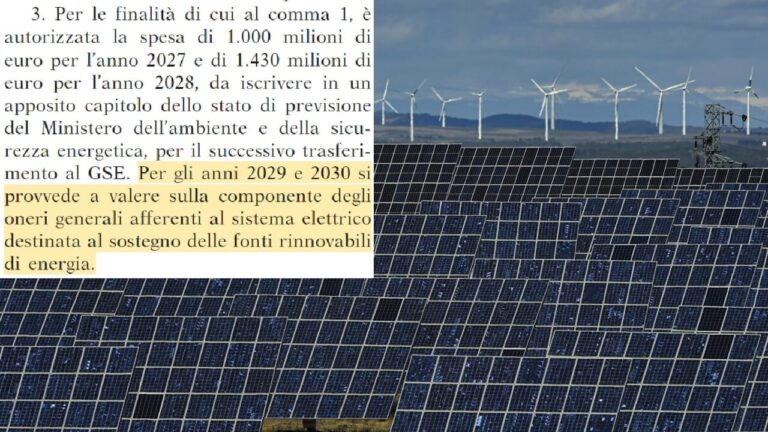
There are many ways to finance financial operations. Giorgia Meloni’s government also plans to do so through bills. In the budget bill for 2027 approved by the Council of Ministers and stamped by the State General Accounting Office, the coverage provided for a series of articles is based on the costs of electricity and gas bills. These are taxes that we already pay in our invoices: the cost is billions of euros and concerns various supports and incentives, especially dedicated to businesses. At a time of extraordinary increases in energy prices, the government has decided to finance and help businesses. But how much does it cost us?
The 3.6 billion in maneuver to be financed with bills
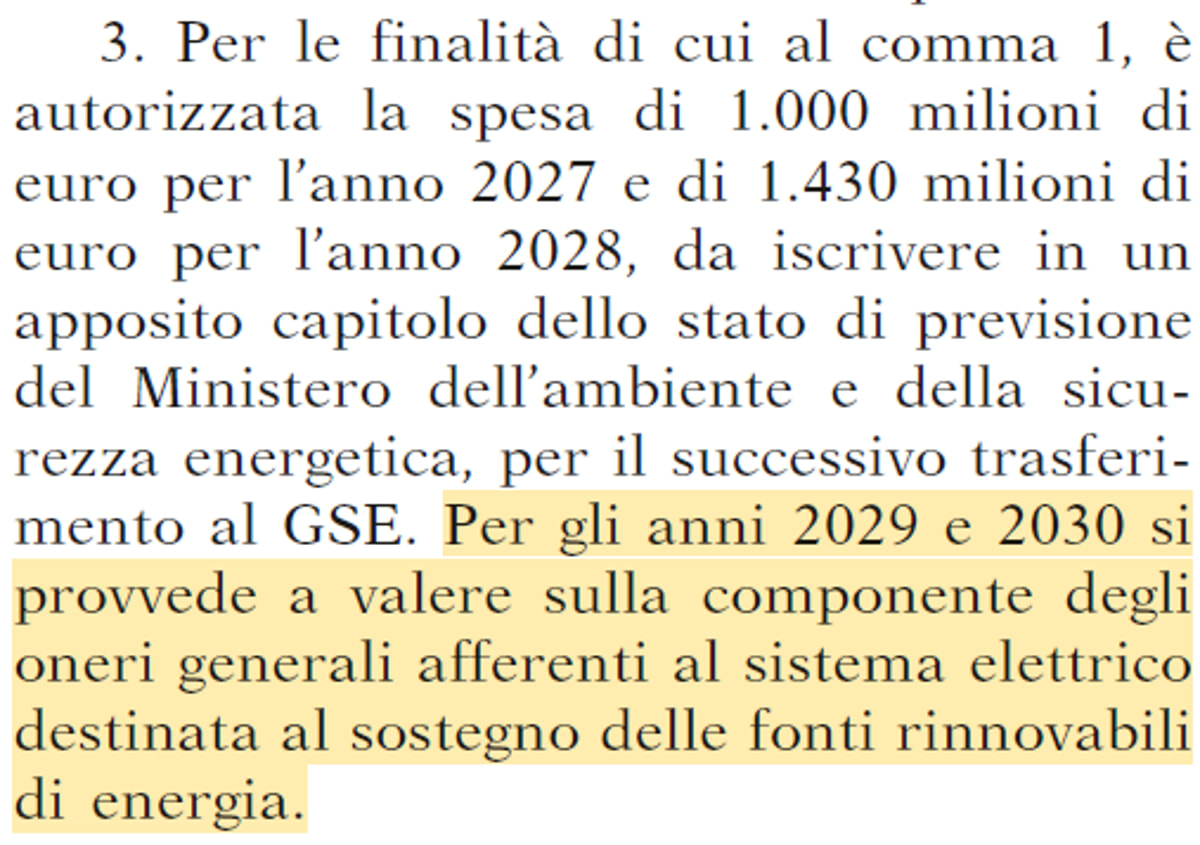
Overall, the financial package covers multiple measures through the costs of electricity and gas bills. The bill is 3.6 billion euros. The offending articles of the 2027 budget bill are four. They have different recipients and purposes, but they share the same choice: to use, for the two-year period 2029-2030, resources from the tariff system.
| Measure | 2029 | 2030 |
| Aid for energy-intensive businesses | 800 million | 700 million |
| Aid to non-energy-intensive SMEs | 600 million | 500 million |
| Contributions for new photovoltaic systems | 200 million | 200 million |
| Contributions to investments in biomethane | 300 million | 300 million |
| Total | 1.9 billion | 1.7 billion |
These are items found on the invoices and the bulk of the financing will come from a specific item. Of the total 3.6 billion, 3 billion will in fact be financed by the Asos component of electricity bills (general system charges to support renewable energy and cogeneration), while 600 million will come from the gas tariff components. For 2027 and 2028, however, these same measures provide for allocations from the budget of the Ministry of the Environment and Energy Security.
What is the Asos component and how much does it already cost in the bill
The “general system” charges – a part of the final price on the bill – include the Asos component. From here come the resources that are mainly used to finance support for renewable energy and energy-intensive companies. The component is applied, with different methods and amounts, to domestic and non-domestic users.
According to Arera’s annual report, in 2025 over 8 billion euros came from the Asos component of electricity bills, of which 6.5 billion referred to support for renewables and cogeneration and 1.47 billion to subsidies for energy-intensive companies. The system, therefore, already finances programs of considerable size. And furthermore, as we will see, today the collection is not enough to cover the financing lines provided for renewables and businesses. But how much does this item weigh on the bill?
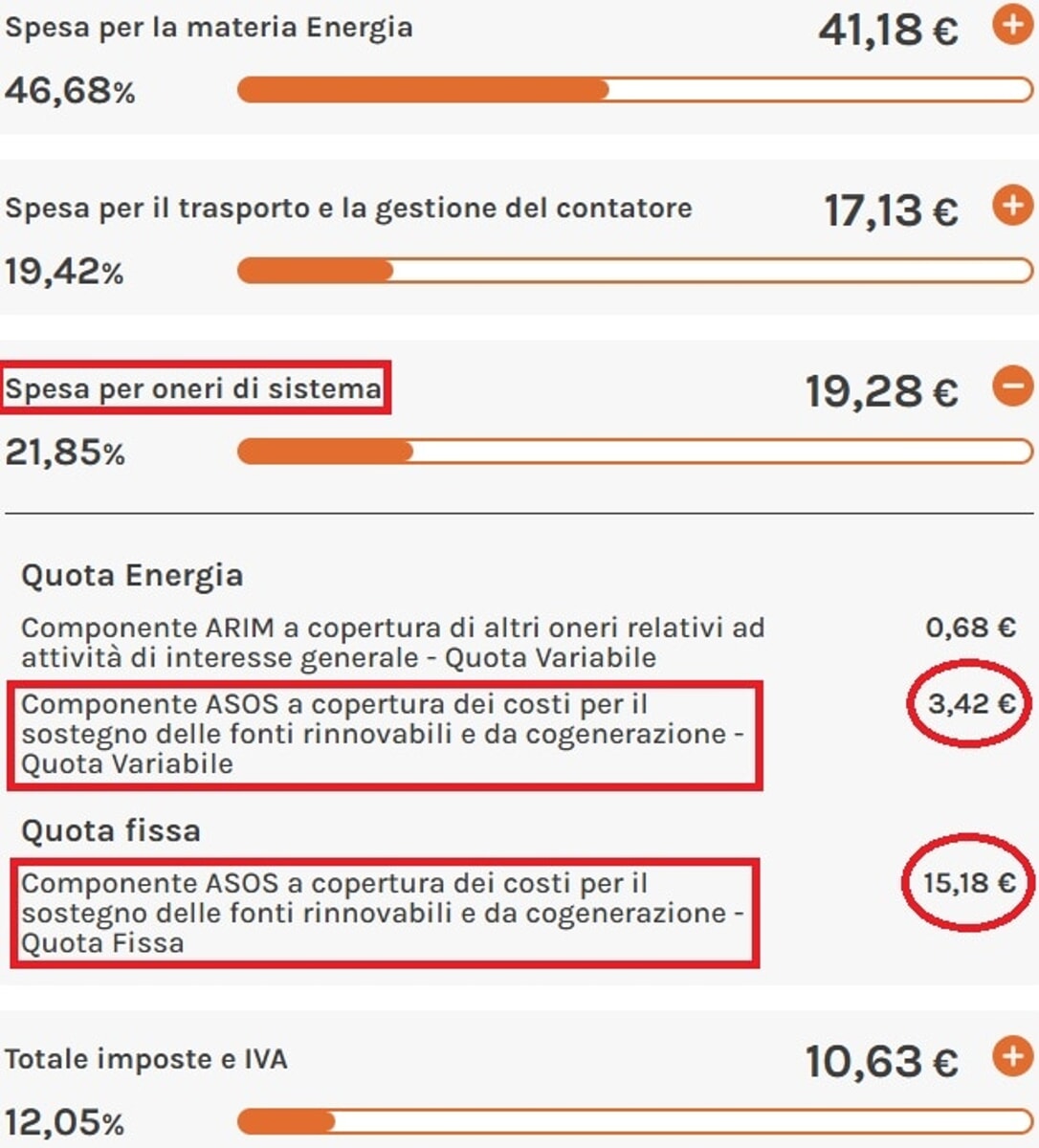
It depends on consumption and the type of user. Example: in the invoices of a non-resident domestic user, Asos charges can represent even more than 20 percent of the final price, also considering VAT and a fixed amount that is charged even in the absence of consumption. For a residential home, however, the fixed rate does not apply and taking the Arera tariffs for the second half of 2026 as a reference, a family with an annual consumption of 2,700 kilowatt hours pays around 93.60 euros.
Electricity discounts to businesses paid by consumers
The new measures designed by the government will therefore further burden the Asos component. The largest portion concerns aid to businesses against high energy prices, provided for by articles 82 and 83 of the budget bill. The available ceiling is over 6 billion euros between 2027 and 2030. Of these, 2.6 billion will be covered through the Asos component in the final two years.
The first measure concerns so-called energy-intensive companies, i.e. those with particularly high electricity consumption and in possession of the requirements established by the law. 2.5 billion are available for them between 2028 and 2030. The second is aimed at micro, small and medium-sized enterprises not included in the list of energy consumers of the Fund for Energy and Environmental Services (Csea). In this case the total allocation reaches 3.53 billion.
Both measures provide support for the cost of electricity, calculated within the limit of 50% of the average wholesale price and on a quantity not exceeding half of the annual consumption eligible for the subsidy. But on one condition: that the beneficiary companies invest resources in the energy transition equal to at least 100% of the aid received. Eligible interventions include self-production from renewable sources, storage systems, energy efficiency and the electrification of production processes.
Even the new photovoltaic panels and biomethane on the bill
The use of electricity charges to cover the new incentives is recurring in the text of the budget bill. Article 79 provides for non-repayable contributions of up to 40% of the eligible costs for the construction of newly built photovoltaic systems, with a power not exceeding one megawatt. The total allocation is 1.2 billion: 800 million in 2028 and 200 million for each of the following two years.
“Manipulated prices, increased bills”: what is behind Calenda’s accusation against the energy big names
Also in this case, while the 2028 allocation is included in the ministry’s budget, the 400 million expected for 2029 and 2030 will be financed through the general charges of electricity bills. Article 81 instead introduces new supports for the sustainable production of biomethane, intended for the conversion of biogas-fueled plants, the upgrading of existing ones and the construction of new structures.

A non-repayable contribution of up to 40% of eligible investments is envisaged, with an allocation of 100 million in 2028 and 300 million for each of the years 2029 and 2030. For the last two years the text establishes that coverage takes place through the “tariff components of the gas system”.
Arera’s alarm: the system is in deficit
The State withdraws a quota from bills to finance some lines of intervention and, as seen, will do so even more in the coming years. But what was collected is not enough. In fact, the real need already exceeds the collection of charges coming from bills: in the same reference period – 2025 – the 8 billion collected were unable to cover the interventions which reached 10.9 billion.
The mockery of the bills: we pay 9 billion for already old photovoltaic systems (and we waste energy)
Arera itself had reported in a March 2026 report a “significant imbalance” in the account fueled by the Asos component, which grew precisely due to the entry into force of new incentive systems. And the same criticality is reported by the Gas User Authority.
The new weight of the incentives on the costs remains to be quantified and, furthermore, everything will have to be examined by the European Commission to avoid it being configured as state aid, as well as being approved by Parliament. So our bills could increasingly resemble an ATM rather than a bill for energy consumed.
Dossier is the exclusive subscription investigative section of The Vermilion. If you want to support our journalistic work and subscribe, Click here.