

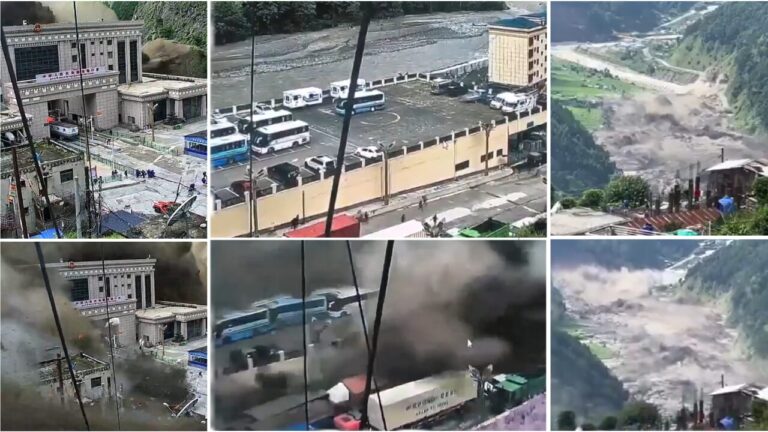
A gigantic mass of water, mud and debris overwhelmed the Himalayan region on the border between Nepal and Tibet on Wednesday 26 August, sweeping away houses, roads, bridges and hydroelectric plants. The toll is still provisional and could worsen. According to an initial reconstruction, a magnitude 4.1 earthquake would have caused the collapse of a glacial lake that swept the valleys.
The Farnesina Crisis Unit is working in conjunction with the General Consulate of Italy in Calcutta, the Prior Consulate in Kathmandu and the Italian Embassy in Beijing to verify the possible involvement of Italian citizens and ensure, where necessary, assistance to compatriots present in the area.
In the area 90 Italians
Based on the records on “Where we are in the world”, there are around 90 compatriots present between Nepal and Tibet. Two tourists with their guide were stuck upstream from a landslide that blocked a road, but they are in contact with the Ministry.
In Nepal, at least eight bodies have been recovered, while on the Chinese side the authorities speak of “serious human losses” and people missing without providing a precise number for now.
The images and the first testimonies tell of a sudden and very violent flood. Among the most affected areas are Timure and Syabrubesi, in the Nepalese district of Rasuwa, a mountainous region of around 50 thousand inhabitants. Villages and construction sites were hit by water while the population of the areas further downstream were invited to leave the river banks and reach higher areas.
The flood arrived suddenly
The alarm went off around 9 am local Nepali time. The Bhote Koshi river, which originates on the Tibetan plateau and crosses the border before flowing into the Trishuli, swelled within minutes. The mass of water swept away vehicles, goods and structures and damaged several energy projects. Second Reutersapproximately 430 megawatts of hydroelectric capacity, more than 12 percent of Nepal’s, would be affected by the disaster.
The water also destroyed the approximately 42 kilometer long road that connects Betrawati with the Rasuwagadhi crossing in several places, also taking away several concrete bridges.
Conditions on the ground are complicating rescue operations. The Nepalese army mobilized helicopters, but in some of the most affected areas the water level initially prevented the vehicles from landing. Police, armed forces and emergency teams were sent to the region, while Prime Minister Balendra Shah ordered the evacuation of the inhabitants of the most exposed areas.
The disaster also on the Chinese side
The emergency does not only concern Nepal. On the other side of the border, the flood hit the land port of Gyirong, in Gyirong county, Shigatse prefecture, in the Tibet Autonomous Region.
The Chinese state agency Xinhua reports that the event occurred around 10:30 am Chinese time and resulted in numerous casualties and missing persons. The connecting roads, communications and electricity supply to the crossing were interrupted. Chinese President Xi Jinping has ordered all available resources to be used in the search for the missing, in the evacuation of people still exposed to danger and in providing assistance to the injured, also asking to strengthen monitoring to avoid further victims in the event of new collapses or floods.
Where did the flood come from?
Above all, it remains to be understood what caused such an enormous quantity of water in such a short time. And it is precisely on this point that the first reconstructions coming from the two sides of the border seem to diverge.
Xinhua claims that Gyirong was hit by the effects of a debris flow that occurred on the Nepalese side. The Nepalese authorities, however, claim that the wave that overwhelmed Rasuwa entered the Bhote Koshi from Tibet.
One thing seems quite clear: the rain that fell directly in the Nepalese area would not be sufficient to explain the phenomenon. The Nepal Meteorological Service is therefore evaluating various scenarios, including the sudden collapse of a glacial lake or the formation and subsequent rupture of a natural barrier.
The first assessments by some Nepalese and Chinese researchers also indicate the possibility that an ice avalanche temporarily blocked a watercourse, forming a sort of natural dam which then collapsed under the pressure of the water. However, this is still a hypothesis and not a definitively established cause.
Another disaster after the one in 2025
The region had already experienced a similar tragedy just a year ago. In July 2025, a sudden flood of the Bhote Koshi caused nine deaths and left 24 people missing, also destroying the Friendship Bridge, one of the main trade links between Nepal and China. Subsequent analyzes had traced that flood to the sudden emptying of a supraglacial lake in Tibet.
This is also why experts are paying particular attention to the glaciers and high-altitude basins of the Himalayas. For the moment, however, the priority remains finding the missing. The toll of the new flood on August 26 is still evolving and the authorities fear that the number of victims could increase as rescuers manage to reach the isolated villages.