

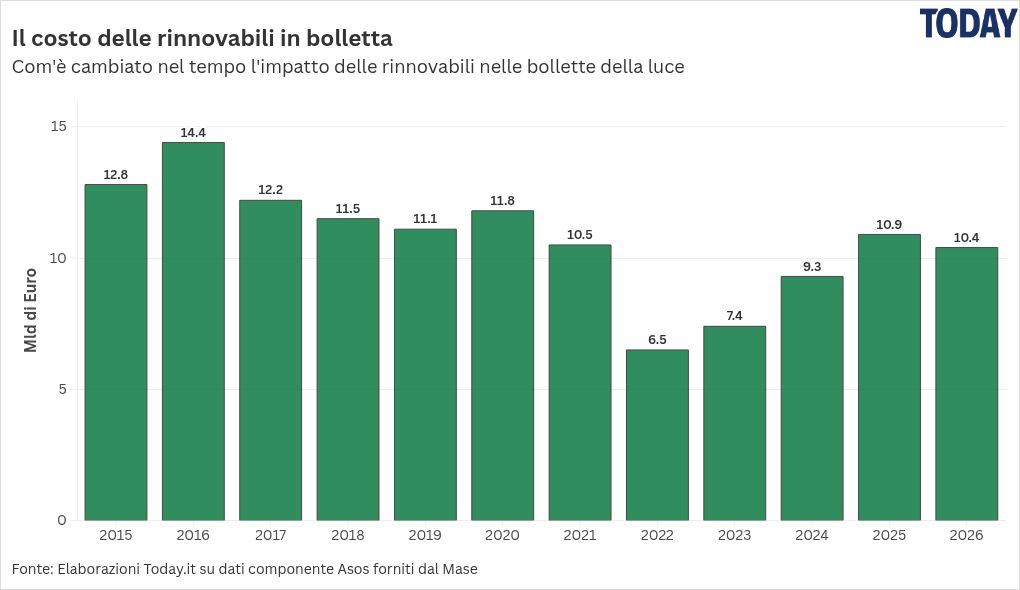
The net cost of renewables in Italy is nine billion, two hundred and seventy-two million euros. The figure represents the expenditure incurred by the community to incentivize electricity produced from clean sources and is contained in the latest Arera report on the tools to support renewables relating to 2025. It is not just photovoltaic, even if solar, the “old” one, accounts for over 60 percent due to generous past incentives. But there are more mechanisms at play, all financed by electricity bills.
Where do the 9.3 billion go to renewables?
Of the 9.272 billion, 5.635 go to the owners of 447,658 photovoltaic systems included in the first four “Energy Accounts”, the incentive systems launched between 2005 and 2011. Alone they absorb 60.8% of the overall cost. The incentive has no longer financed new plants since 6 July 2013, when the ceiling of 6.7 billion euros per year was reached, but continues to pay the agreements already signed, generally for twenty years.
The financing is generous and has been criticized for some time: for the plants admitted to the first four Energy Accounts, the support is a fixed premium recognized on the entire production, independent of the price of electricity and additional to the value of the energy sold, self-consumed or exchanged. In 2025, the owners of these plants received on average approximately 319 euros in incentives for each megawatt hour produced, equal to 31.9 cents per kilowatt hour.
Arera expects this item to remain close to 6 billion at least until 2028: incentivized production will begin to reduce slightly after 2026, then much more markedly after 2030, until it reaches zero in 2033.
The leap in bioliquids: from 753 million to 1.2 billion
The second largest item is made up of the minimum guaranteed prices for plants powered by bioenergy: 1.712 billion in 2025. The majority goes to bioliquids, with an impact of 1.232 billion; followed by biomass with 424 million and biogas with 55 million.
The burden of bioliquids rose from 752.6 million to 1.232 billion, almost 480 million more in one year. That of biomass went from 377.9 to 424 million and that of biogas from 47 to 55 million. The guaranteed minimum prices cover the difference when the market remuneration does not reach the established level: for bioliquids they can also integrate other incentives already received.
The 2026 legislation introduced a trend spending cap for these bioenergies. For this reason, Arera expects a progressive reduction in the burden starting from the current year.
Where do the billions for renewables come from?
The “account” for renewables is powered by the Asos component, present in our electricity bills among the “system charges”. It has a variable weight depending on the user and can even exceed 22 percent of the total. For example, in the image below, it is worth around 19 euros out of a total electricity bill of 88.
In 2025, the Energy Services Manager incurred costs of 10.393 billion and obtained 1.121 billion in revenues, mainly by reselling the withdrawn energy on the market: the difference is precisely 9.272 billion. Approximately 520 million must also be added to the total for special commercial regimes, especially on-site exchange. Considering these too, the burden rises to approximately 9.792 billion. However, the entire requirement of the Asos account is higher because Arera specifies that the revenue necessary for Energy release is excluded. Counting all measures, the 2025 bill is close to 11 billion.
Dear bills, how much do Terna and Arera weigh on our expenses
Energy-intensive companies pay a reduced amount for the element intended for renewables; the difference is covered by other users through the appropriate tariff element. For renewables on the smaller, non-interconnected islands, coverage passes through the Arim component.
Power outages, wasted energy: what’s not working
For 2026 Arera estimates a drop in the cost of incentives to around 8.5 billion, plus another 286 million for special commercial regimes. The expected increase in wholesale prices, the progressive expiry of the older mechanisms and the new spending limit for bioenergy have a bearing. Until 2031, in the absence of further instruments, the Authority indicates an annual requirement in the order of 7-8 billion.
Why electricity costs 0, but we pay more and more for it: the paradox of high bills (even in summer)
But the Arera report highlighted other critical issues present on the network due to renewables and their characteristics, including diffusion. The most obvious concerns the ability to absorb and transport renewable energy during the hours of greatest production. In 2025, Terna had to limit over 906 gigawatt hours of wind, photovoltaic and hydroelectric generation due to congestion, work on the networks and excess production compared to absorption capacity. The problem is concentrated above all in the South and Central-South and continues into 2026: in the spring alone, according to preliminary data, another 518 gigawatt hours were cut.
On eight holiday or pre-holiday days in 2025 it was also necessary to disconnect plants connected to medium voltage networks, in the face of what Arera defines as “systemic critical issues that cannot be managed with ordinary dispatching tools alone”. The Authority indicates storage, more flexible consumption and smart meters as necessary tools to use excess energy during daytime hours and cover evening needs, when photovoltaic production decreases and prices tend to rise. New investments will be needed on the network.