

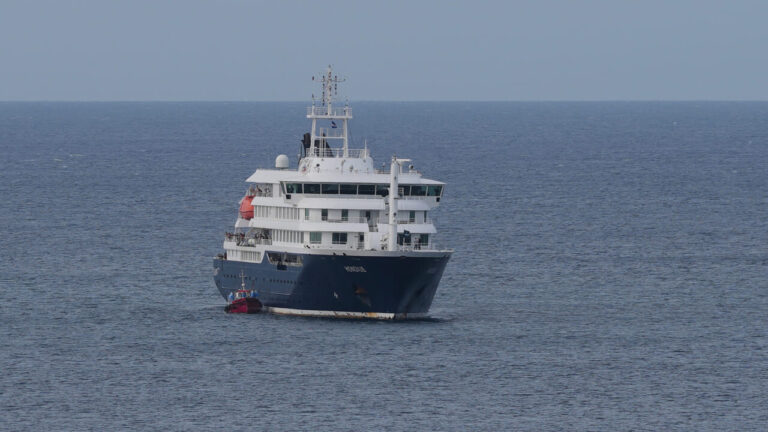
Investigations into the case of the Dutch couple who first showed hantavirus symptoms on board the Mv Hondius ship, where an outbreak broke out, continue unabated. According to the Argentine authorities investigating the matter, the itinerary of the two passengers, husband and wife, would be compatible with an infection contracted in one of the endemic areas of the Andean strain.
The journey of the Dutch couple
The couple had in fact traveled to three countries – Chile, Uruguay and Argentina – before boarding the cruise ship. The couple arrived in Argentina on November 27, 2025, traveled to Chile and Uruguay and returned to Argentina again on March 27. Then, on April 1st, she boarded the Mv Hondius.
“According to what has emerged so far, their entry and exit from Argentina are known and it has been confirmed that they arrived in the country on November 27 last year and traveled by car for forty days before entering Chile on January 7 this year”, reads a note from the Argentine Ministry of Health. Once there, “they continued their journey by car for another 24 days.”
According to what the health authorities report, the itinerary also included entry on January 31st into the province of Neuquén, one of the endemic areas of the Andean strain, and another visit to Chile twelve days later. “From there they crossed the border with Mendoza, where they began a twenty-day car journey to reach Misiones. Finally, on March 13, they crossed the border with Uruguay by land and on March 27 they returned to the country to head towards Ushuaia, from where they had left on April 1”, the statement continues.
The Argentine Ministry of Health then explained that “technical teams from the Malbrán institute will travel to Ushuaia to conduct rodent capture and analysis operations in the areas linked to the movement of cases and to detect the possible presence of the virus in natural reservoirs”. For the country’s health authorities “it is important to underline that, although it is not confirmed that the infection occurred in Argentina, Tierra del Fuego has not recorded any case of hantavirus since mandatory reporting of the event began in 1996”.
Self-isolation
Meanwhile, two people who returned to the UK after being on board the MV Hondius have been asked to self-isolate. This was announced by the British Health Security Agency (Ukhsa). These are “two individuals who independently returned to the UK after being on board the ship”, the agency said, specifying that “neither of them is currently showing symptoms”. Both “are receiving advice and support from Ukhsa and have been asked to self-isolate”.
The agency is also providing support to a “small number” of people identified as being in close contact with the ship’s passengers: these asymptomatic people have also been asked to self-isolate and receive support. As Ukhsa specified, the risk to the general population “remains very low”. Finally, other British citizens on board could be repatriated once the ship reaches its next destination, provided they do not develop any symptoms.
The evacuation of passengers
Meanwhile, the Spanish government has declared that the ship will reach the Spanish island of Tenerife within three days and the evacuation of passengers will begin on Monday 11 May, with European Union countries repatriating their citizens. The Spanish Minister of Health, Monica Garcia, announced that the MV Hondius will arrive in Granadilla, Tenerife, where “a joint health assessment and evacuation system will be set up to repatriate all passengers, unless their medical conditions prevent it”.
According to some sources, the European Commission will intervene if a country is unable to repatriate its citizens, while the evacuation of non-EU countries is still in the planning phase. “All passengers will remain on board the cruise ship until their planes arrive,” they concluded. The 14 Spanish citizens on board the MV Hondius, including a crew member, will be transferred to the Gomez Ulla military hospital in Madrid, Garcia said at a press conference.
The EU meeting for health security
The European Commission, meanwhile, is reportedly organizing a follow-up meeting of the Health Security Committee with the member countries whose citizens are on board the ship and are expected to be repatriated. This was announced by the spokesperson of the Health Commission, Eva Hrncirova. “The situation is being carefully monitored and the current preliminary assessment indicates a low risk to the general population. Safeguarding public health remains our top priority,” the spokeswoman reiterated.
“We remain vigilant, monitor the situation closely and work in close coordination with all authorities of the Member States concerned, the WHO and the European Center for Disease Prevention and Control (ECDC), to ensure a rapid and effective response at every stage.” The Commission has been in close contact with the Spanish authorities, who activated the EU Civil Protection Mechanism. “We remain in contact to assess needs and possible support,” he added. Meanwhile, the ECDC has sent “an expert from the Union health task force to board the ship” and “currently assesses the risk as very low for the EU”.