“For centuries, Christianity has been the most widespread religion in the world. But things could soon change.” This is what we read in the incipit of the survey on the future of world religions carried out by the Pew Research Center, an authoritative US study center based in Washington. According to projections, by 2035 the number of Muslims globally will exceed that of Christians, although both groups are growing. As for Italy, the percentage of Muslims will triple, however remaining much lower than the number of Christians.
How religious groups will change
But let’s go in order. And let’s start by drawing a global picture. Scholars predict a 29% increase in the world population between 2020 and 2070. A growth of 30% is estimated for Christians, and 80% for Muslims. “If recent trends continue”, explain the authors of the research, “by 2070 there will be over 3.6 billion Muslims and just under 3 billion Christians worldwide”.
The share of people who profess other faiths is however decreasing, as is the percentage of non-believers which according to estimates will fall from 24% in 2020 to 17% in 2070, a figure influenced by the sharp demographic decline in China where the majority of people without religious affiliation now live.
The study highlights that in the period 2020-2025, the total fertility rate for Muslims was 3.1 children per woman, compared to 2.5 for Christians. In this period of time, we read, approximately 252 million children were born to Muslim mothers, compared to 208 million children born to Christian mothers. Added to this is the fact that the Muslim population has an average age of 24 compared to 33 for non-Muslims, another key factor for demographic growth.
The number of Christians, however, will increase especially in sub-Saharan Africa where in 2070 over a quarter of humanity and more than half of the Christians on the planet will live, with the Democratic Republic of Congo surpassing the USA in terms of number of faithful. Precisely the growth of Christians on the African continent will compensate for their decline elsewhere.
The focus on Europe
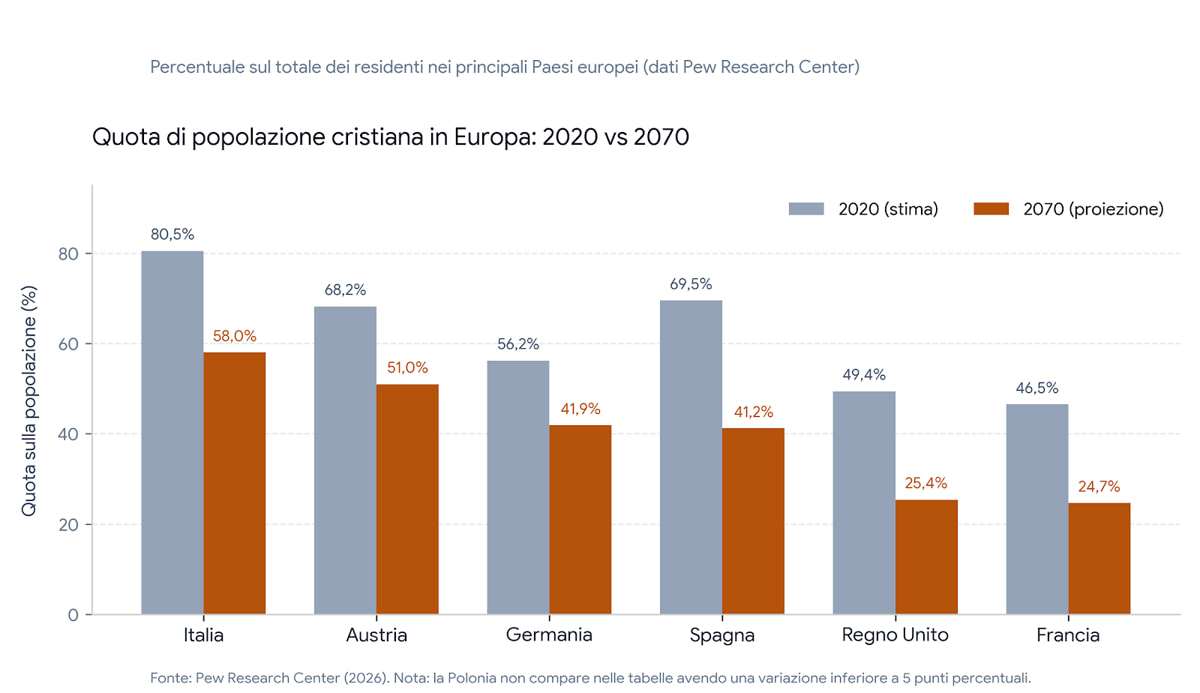
We now come to Europe, the only macro-region in the world destined to lose inhabitants (with the exception of China which however is included in the Asian continent). According to the Pew Research Center, by 2070 the continent’s population will decline by 17%, from 753 to 628 million. As for the number of Christians, if current demographic trends continue, their percentage in the population will reduce from 67% in 2020 to 52% in 2070. The reasons are to be found in the low birth rates, the high average age and the rate of abandonment of the faith.
Experts predict that immigration will increase the number of Christians in Europe, but not enough to offset the losses. In 2070, the second largest category in Europe will continue to be religiously unaffiliated people, whose share will rise from 25% to around 33%. In France (53%) and the United Kingdom (52%) non-believers will become the absolute majority of the population.
How much the Muslim population will grow in Europe and Italy
As for Muslims, they will go from 6% to 13% of the European population (from 46 to 80 million), remaining behind the “without religion” but becoming the second largest religious community on the continent obviously behind the Christians. Their increase in Europe is driven above all by immigration, but also by a younger median age and a higher fertility rate than other European groups (1.9 children per woman, still below the replacement threshold of 2.1). In short, the number of Muslims in Europe is on the rise, but we are still far from seeing an Islamic-based Europe as is often feared.
Having said that, scholars still predict constant growth:
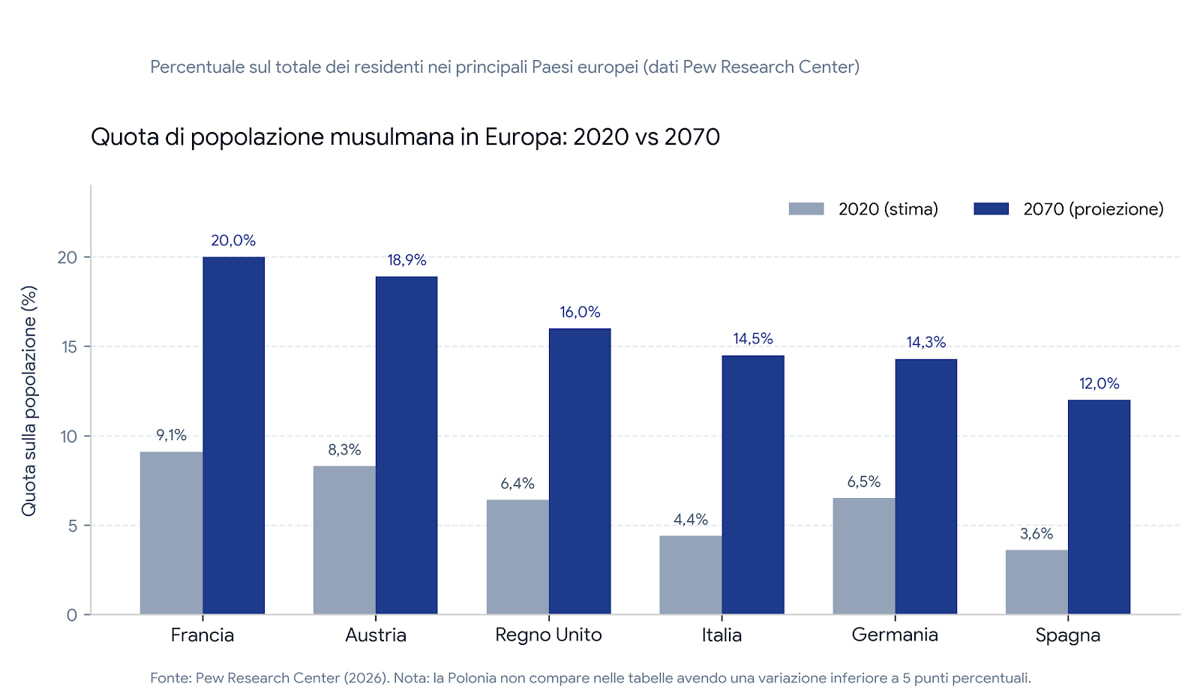
- The share of Muslims in the population will increase by at least 10 percentage points in eight European countries.
- In France, a percentage of 20% is estimated in 2070, compared to 9.1% in 2020.
- In Germany, an increase from 6.5% to 14.3% is expected over the same period.
As regards Italy, a growth in the Muslim population is estimated from 4.4% in 2020 to 14.5% in 2070, with an increase of 10.1 percentage points; non-believers will increase from 13.3% to 23.5% by 2070, while Christians will drop from 80.5% in 2020 to 58%.