

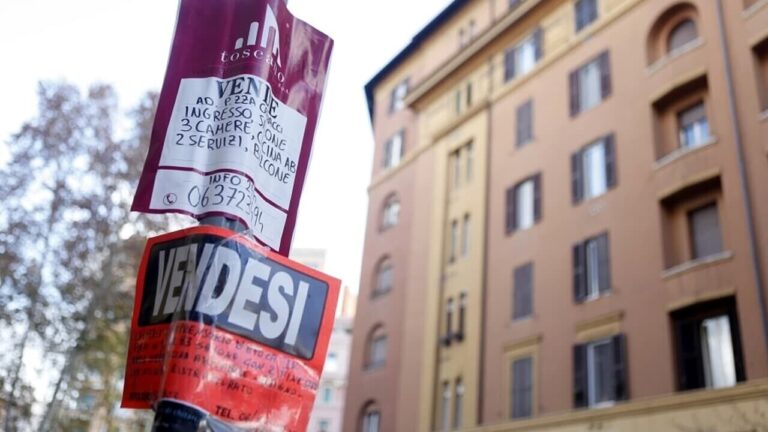
Homes are increasingly expensive, both for rent and for the purchase price. This is an economic issue capable of turning into a social emergency, with serious implications also on the political balance. A perfect example of this is Spain where, after weeks of street protests and camps in the cities, Parliament rejected the emergency housing decrees proposed by the socialist government, triggering Sanchez’s resignation and the consequent dissolution of the Chambers. In Italy, where evictions are tens of thousands every year, the issue represents one of the key issues of the next economic maneuver, with the Meloni government committed to studying some measures to be included, especially to facilitate young people.
Data in Europe
The problem affects all of Europe, as demonstrated by the latest Eurostat data relating to the second quarter of 2026: housing prices in the EU recorded an increase of 4.7%, while rents grew by 3% compared to the same period in 2025. The Italian figure remains in line with the European average. On a quarterly basis, compared to the first quarter of 2026, house prices rose by 1.2% and rents by 0.7%.
Extending the comparison between 2025 and the second quarter of 2026, prices in the EU grow by 4.1% and rents by 2.6%. At a national level, comparing the second quarter of 2026 with the annual average of 2025, house prices are increasing faster than rents in 18 EU countries. Sales are also growing: in 2025, compared to 2024, home sales will increase in most EU countries for which data are available, even if the phenomenon, in times of high interest rates, is destined to suffer a notable decline.
The real estate market in Italy
In Italy, according to the findings of the Idealista real estate portal, the residential market closes the third quarter of 2026 with a cyclical decline in prices of 1.1%, settling at an average of 2,031 euros per square meter. On an annual basis, the balance remains positive, with +3.3% compared to September 2025, while on a monthly level the prices remain stable.
The measures to be included in the maneuver
The Meloni government is studying various measures to include in the next budget law: moves that aim to defuse the housing emergency, avoiding the tensions seen in the rest of Europe. The intention is to allocate concessions for rent and for the purchase of the first home especially to younger groups.
Some details have been anticipated in recent days by the Deputy Minister of Economy, Maurizio Leo, who explains that, financial resources permitting, incentives are being studied for the purchase of the first home dedicated to under 36s, the extension of the possibility of applying VAT on the sale and rental of homes carried out by real estate sales and management companies, the reduction of the VAT rate from 10 to 5% for the rental of residential buildings (with the obvious exclusion of luxury properties) and the assimilation of residential properties rented by construction companies to instrumental buildings to overcome the current regulatory distinction.
There is also a 5% flat rate tax on the table for long-term rentals. “We need quality training – declared Prime Minister Giorgia Meloni -, a safe and stable job, adequate pay, a house at a fair price. Everything that creates the conditions for starting a family”.
The numbers on evictions
These proposals are part of a national context in which thousands of families are forced to leave the homes in which they live because they cannot afford the expenses. According to the survey conducted by the SoloAffitti Research Office, in 2024 evictions exceeded 40 thousand, of which three out of four were triggered due to non-payment. In the same year, the enforcement requests presented to bailiffs, including the decisions accumulated in previous years, reached 81,054, compared to 21,337 evictions actually carried out. In the annual comparison, the overall measures recorded a growth of approximately 2%, while those specific for arrears suffered a slight decrease of 2.2%. On the contrary, enforcement requests increase by approximately 10%, despite a number of evictions carried out that remains substantially stable.
The survey on rentals provides a clear picture of the economic difficulties linked to living, highlighting that 37% of tenants indicate the presence of rents higher than their budget as the main obstacle in finding accommodation. On the opposite front, 74% of owners declare that they have accrued credits for unpaid rent during their rental experiences. When a default occurs, 43% of landlords initiate a formal eviction procedure, 33% opt for a direct agreement with the tenant to vacate the property and 17% accept a spontaneous return of the keys with the rent still outstanding, while the remaining 7% activate a guarantee or protection policy. The return of the keys therefore does not coincide with the settlement of the debt, confirming the existence of a vast dimension of insolvency that judicial counts alone cannot fully describe.
The times of judicial procedures
According to the study, the process includes an extrajudicial phase, in which a conciliation is attempted between the parties, a judicial phase to obtain validation of the eviction and, when necessary, an executive phase for the release of the property. In the cases analysed, the extrajudicial phase lasts from two to four months. For the judicial one, SoloAffitti notes a median duration of 6.5 months, with a minimum of three months and an exceptional maximum of fourteen. Even after the judge’s order, release requires further steps and access from the judicial officer. 78% of landlords select the tenant based on income capacity, but the initial verification does not eliminate the risk of subsequent difficulties.
65% eco bonus
Finally, still remaining among the topics of housing and economic maneuver, among the hypotheses under consideration there are also some innovations regarding construction deductions, with the government committed to redesigning the bonus package in view of the end-of-year deadlines. To avoid the drastic automatic cut of the renovation bonus, destined to fall to 36% for first homes and 30% for second homes, the executive is evaluating a remodulation of the incentives. The main proposal on the table involves the introduction of a single Ecobonus stabilized at 65%, reserved exclusively for the most significant and structural energy efficiency interventions, with the aim of concentrating the available resources on sustainability and giving certainty to the construction sector. The economic maneuver is starting to take shape, with the house which could be the real “pillar” of the document, the last of the Meloni government before returning to the polls.