

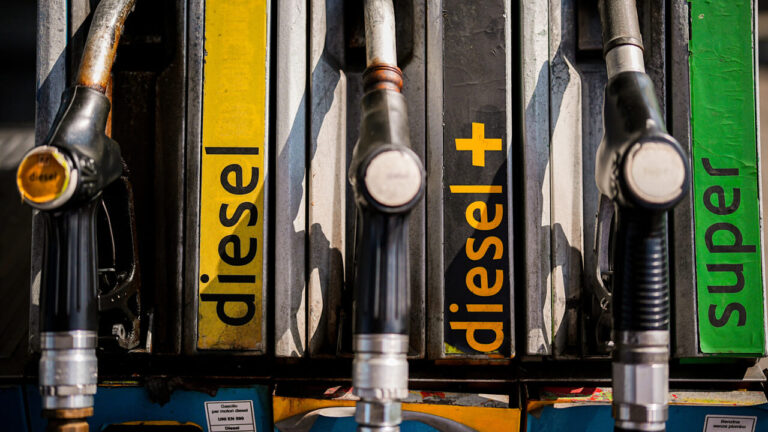
Last hours for the discount on diesel excise duties. From Tuesday 6 October the tax reduction of 6.1 cents per liter applied to diesel ends. Thus, we will move on to the so-called mobile excise duties, a different mechanism that uses the extra VAT revenue produced by the increase in oil prices to finance new cuts in fuel taxes. The difference is important especially for those wondering how much diesel will cost now.
How much can the price of diesel increase from 6 October: the cost of a full tank
The latest intervention was approved by the government in September. From 26 September and until 5 October including the excise duty on diesel fuel it was set at 622.90 euros per thousand litres. Compared to the ordinary rate of 672.90 euros per thousand litres, the current discount is therefore 5 cents of excise duty per litre, which with VAT becomes 6.1 cents on the final price.
The average price of self-service diesel on the Italian road network has fallen in recent days to around 2.24 euros per litre, after exceeding 2.37 euros at the end of September. If the 6.1 cent discount disappeared completely and the entire tax increase was passed on to the pump, all other components being equal, a price of 2.242 euros would theoretically rise to around 2.303 euros per litre.
On a 50 liter tank it would mean 3.05 euros more. But this is only the theoretical scenario in the absence of a new intervention. The government announced that from 6 October support should continue through mobile excise duties. To know the actual price you therefore need to know how significant the new discount will be and when it will start.
The decree on mobile excise duties still does not exist: the alarm from UNC
“It is very serious that in today’s Official Journal, which has just been published, there is no interministerial decree for the extension of the tax discount of 6.1 cents per liter on diesel”, says Massimiliano Dona, president of the National Consumers Union. Dona also disputes the price trend recorded in the last few hours.
“Already today the discount was imperceptible, amounting to just 2 thousandths, 10 cents for a 50 liter tank, a sign that the price cap effect is over”, claims the president of the UNC, who concludes by attacking the executive: “The Government, therefore, must not and cannot wash its hands of it like Pontius Pilate”. Without a decree determining a new reduction, in fact, from 6 October the predetermined tax cut of 6.1 cents per liter currently in force will cease.
The brands that offer discounts at the pump: the prices of Eni, Tamoil, Ip and Q8
In the meantime, prices at the pump have recorded a significant drop compared to the highs reached at the end of September, coinciding with the introduction of commercial initiatives by the large oil companies. On 27 September self-service petrol on ordinary roads had reached 2.159 euros per liter and diesel at 2.377 euros. On 5 October the averages indicated dropped to around 2.048 and 2.242 euros respectively.
In just over a week it means a reduction of around 11 cents on petrol and 13.5 cents on diesel. It was Eni who kicked off the season of commercial caps, announcing from 28 September for 30 days a limit of 2.19 euros per liter on diesel and 1.99 euros on petrol in its network.
In the following days, initiatives also arrived from Socar-IP, Q8 and Tamoil. Socar-IP has progressively started a regulatory intervention on its network: 1.99 euros for petrol and 2.19 for diesel, even if the company has not formalized a single national ceiling valid without distinction for all plants. Q8 instead applies from 1 October and for 30 days, therefore until 30 October, a price cap defined by the company itself with a “modular approach”: in the first few days the price lists of some plants dropped to around 1.994 euros for petrol and 2.194 for diesel.
Finally, Tamoil announced containment measures on petrol and diesel until 31 October, but without communicating a fixed discount amount or a single ceiling for its entire network.
What are mobile excise duties and how do they work
Mobile excise taxes are not a new tax. The system allows you to temporarily reduce excise duties on fuel by using the increased VAT revenue generated by the increase in oil prices. The mechanism is provided for by law 244 of 2007: when the international price of crude oil increases compared to the reference values, VAT revenue also increases. A portion of that increased revenue can be used to temporarily lower excise taxes.
Dear energy and bonuses, how much do municipalities that host gas and oil wells earn
The advantage for public finances is that the new cut does not have to be financed through further budget allocations: it uses the extra revenue already produced by the increase in prices. The limit is that the amount available depends on the VAT actually collected, and therefore the cut can be smaller than that guaranteed with public resources.