

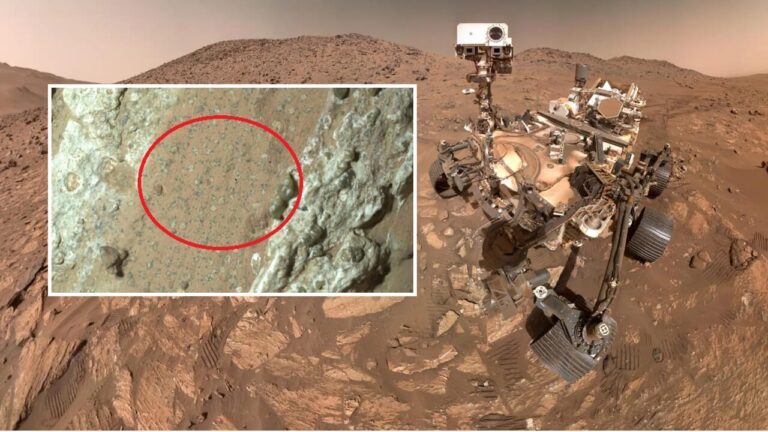
For five years now, the NASA Perseverance probe explores the barred Martian plains in search of clues that help to reveal the remote past of the red planet. With his contribution, the scientists have already confirmed that the area of the Jezero crater, on which the rover moves, is what remains of an ancient river delta. An environment that millions of years ago was rich in liquid water. And who knows, maybe even of extraterrestrial forms of life.
https://www.youtube.com/watch?v=iejkwww8sp2a
A possibility that perhaps is closer than ever: in a new study published on Naturean international research team analyzed a rock sample identified by Perseverances in July last year, concluding that it is not to be excluded that some characteristics found on its surface represent a biofirish left by an ancient microbial life form.
A revolutionary discovery?
The possible discovery was presented with considerable emphasis during a press conference of the American space agency. But given the air that brings to the United States in recent months, the doubt comes that it was a more political than scientific choice: the study does not exclude several alternative explanations for the characteristics observed in the sample, and in the past NASA had always been careful to avoid excessively triumphalistic tones in announcing its successes.
A mysterious rock
The sample, renamed Sapphire Canyon, was taken from a rocky formation known as Bright Angel Rock. Since NASA’s scientists had been intrigued by some characteristics of the rock.
In particular, the presence of mineral formations composed of brick and iron sulphide on its surface, with a specific “leopard spot” shape, very similar to those that are produced on earth by microorganisms that feed on organic matter, leaving behind mineral traces.
The possible biofirma
The analyzes carried out with the tools with which the rover has not allowed to demonstrate the origin of the formations on the sample. But not even to exclude the contribution of some form of microbial life. For this reason, in the last year the authors of the study published in Nature have deepened the analysis of the information available, confirming that at the moment it is impossible to exclude that it is the biophilia of a form of alien life, lived on Mars billion years ago.
Many alternative explanations
This does not mean, unfortunately, that we have finally found proof that we are not alone in the universe. In fact, the authors of the study underline that there are several alternative explanations for the formation of minerals present on the sample Sapphire Canyon, who do not require calling forms of biological life. To have a definitive response, the only possibility would be to study the champions in the workshops on our planet. And that’s what Nasa intends to do: the Mars Sample Return Mission includes a multi -phase mission, which should send a certain number of samples collected in these years by Perseverances on Earth. The bad news, unfortunately, is that it will probably take decades before the project goes through.