

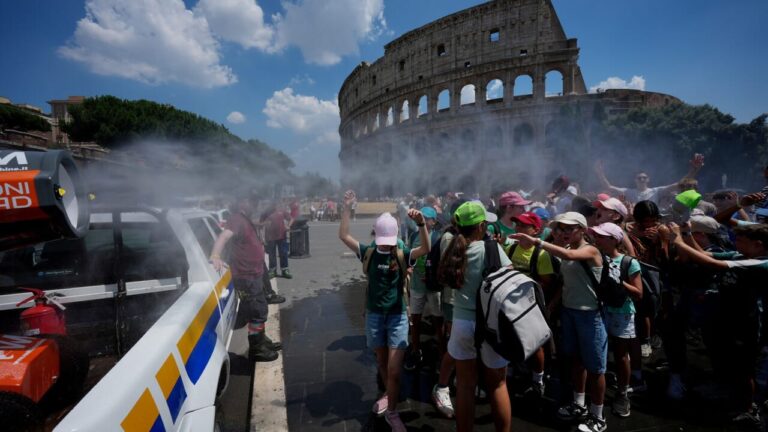
A thermometer that rises and never falls, not even at night. The Italian summer, which has always been synonymous with holidays, holidays and outdoor activities, has changed profoundly in recent decades and the effects are already very serious. We compared data from four large cities, analyzing the maximum and minimum temperatures recorded in the months of July and August in three different years. The picture that emerges? It’s not comforting at all.
The real change: the boom in tropical nights
When analyzing data, it is often the most striking numbers that are striking. For example, the peak of 43 degrees reached in Palermo this year or the long sequence of highs above 35 degrees in Rome and Milan. However, to tell how much summer has changed in the big Italian cities there is a fact that is perhaps less flashy, but even more significant: temperatures no longer drop as they used to, especially during the night. This is what emerges by comparing the daily highs and lows recorded by 3B Meteo in Rome, Milan, Naples and Palermo in three distant summers: 2008, 2016 and 2026.
In all four cities, 2026 is clearly above the two years taken as reference, especially in terms of minimum temperatures.
Before continuing, however, a premise is necessary: the comparison must be read with some caution and it is not an exhaustive climatological study. Three single years do not constitute a sufficiently long historical series and do not, on their own, allow us to measure the extent of climate change in each city. 2008 and 2016 may have been cooler or warmer than average, just as 2026 may represent a particularly anomalous year. But the photograph obtained is still impressive and is part of a long-term trend that has already been widely documented.
According to Ispra (the Higher Institute for Environmental Protection and Research), from 2000 onwards almost all years in Italy have recorded temperatures above the 1991-2020 average. Already in the previous year, i.e. 2025, the national average temperature anomaly was +1.03 °C and the summer, with +1.46 °C, was the fourth warmest since 1961. But by narrowing the lens to individual daily temperatures it is possible to observe more closely how the heat manifests itself in large cities.
The summer will be increasingly longer: how long can we resist in the trap of the “wet bulb” – by Simone Valesini
To make the comparison homogeneous with 2026, still in progress, we considered the same period for all years: from July 1st to August 21st, 52 days in four different cities distributed along various latitudes of the country. And, as we will see, more than the daytime temperatures, it is the nighttime temperatures that show the distance between the summer of 2026 and those taken as reference.
In Milan minimum temperatures increased by over 5 degrees
The most significant case is Milan. In the 52 days considered, in 2008 the average daily minimum temperature was around 18.8 degrees. In 2016 it had risen to 19.8, while in 2026 we are at 24.2 degrees: 5.3 more than 2008 and 4.4 compared to 2016.
Naturally, it does not mean that the Milanese climate has warmed by as many degrees in eighteen years. As mentioned, climatological analyzes require much longer time series and must take numerous variables into account. However, it means that the summer experienced by the Milanese this year is radically different from that of 2008. This can be seen even better by counting the so-called tropical nights, those in which the minimum temperature does not drop below 20 degrees. In the 52 days examined there were 23 in 2008 and 32 in 2016. In 2026 they were 51 out of 52. Until August 20th there was not a single day with a minimum lower than 20 degrees.
Heat waves: what risks the environment if the heat continues – by Simone Valesini
Below you can observe the graph with the daily temperature trend: 2026 is in black, while the dotted line refers to the maximum temperatures which have also changed.
The average maximum goes from 29 degrees in 2008 to 30.8 in 2016, up to 33.4 in 2026. Even more evident is the comparison of days with at least 35 degrees: absent in the analyzed period of 2008, they become three in 2016 and 19 this year. A figure that reflects the dimension of a particularly critical summer, especially for those who, in the warmer months, are forced to stay in the city.
In Rome 50 tropical nights out of 52
The picture is similar in the capital. The average minimum temperature goes from 19.3 degrees in 2008 to 19.5 in 2016, reaching 24.3 degrees in 2026: five degrees higher than in 2008.
In the summer of 18 years ago, between July 1st and August 21st, Rome recorded 28 days with a minimum of at least 20 degrees; in 2016 there were 25. This year there are 51 out of 52 and in 27 days the minimum reached or exceeded 25 degrees, a record among records.
The daytime heat also increased at the same time. The average maximum goes from 31.2 degrees in 2008 to 32.1 in 2016, up to 34.5 in 2026. Even more telling is the number of days with at least 35 degrees: none in the analyzed period of 2008, six in 2016 and 28 this year. A very clear increase compared to the two years taken as reference.
The result is a summer in which the body has many fewer hours to recover from the heat accumulated during the day. And this is precisely one of the most critical aspects of the increase in temperatures in urban areas.
The city that lowered the heat by two degrees with just 6 euros per inhabitant – by Alberto Berlini
Moving south the differences are equally evident, even if we naturally start from already higher night temperatures.
In the South the record was also achieved during the day
In Naples the average minimum for the period analyzed went from 21.8 degrees in 2008 and from 22 in 2016 to 26.5 degrees in 2026. The difference compared to the other two years therefore exceeds four degrees. But even more impressive is another number: this year, 46 days out of 52 the minimum did not drop below 25 degrees. In 2008 it hadn’t happened even once and in 2016 only once.
The gap is also evident during daylight hours. The average maximum went from 28.9 degrees in 2008 and from 28.7 in 2016 to 32.9 in 2026, more than four degrees higher than in both years taken as reference. The days with at least 35 degrees, absent in both 2008 and 2016, were 13 this year.
Palermo presents a somewhat different trend. Already in 2008, all 52 days considered had recorded minimums of at least 20 degrees. But it is the 25 degree threshold that shows the distance of 2026 from the two years taken as reference. In 2008 it was achieved only once and in 2016 eight. This year it happened on 49 days out of 52.
The average minimum in Palermo thus goes from 22.8 degrees in 2008 and from 23.5 in 2016 to 27 in 2026: 4.2 degrees higher than in 2008 and 3.5 compared to 2016. And there was no shortage of daytime extremes: on 20 July 43 degrees were recorded, while on 21, 22 and 26 July the thermometer reached 39.
Because Europe is the continent most at risk
The fact that the greater distance often emerges in the minimum temperatures is not secondary. Cities are particularly vulnerable to night-time heat due to the urban heat island phenomenon. Asphalt, concrete and buildings absorb energy during the day and slowly release it after sunset; the lack of vegetation reduces the cooling produced by evaporation and transpiration. Added to these factors is the heat produced by human activities.
Which are the Italian cities where temperatures have increased the most in the last 30 years – by Daniele Tempera
The World Health Organization highlights how the urban structure can aggravate exposure to heat, especially during the night, when buildings and surfaces release accumulated heat. The effect can lead to very significant night-time differences in large cities compared to surrounding rural areas.
Global warming and the heat island are two distinct phenomena, but in cities they end up overlapping. The first shifts the background temperature upwards; the second can locally amplify the population’s exposure, especially in more densely built and less green areas.
And it is a problem destined to become increasingly central. Europe is the continent that is warming most rapidly: according to Copernicus (the European Earth observation and monitoring programme), over the last thirty years European temperatures have increased by around 0.56 degrees per decade, more than double the global average.
New African flare-up over Italy: up to 40 degrees, then everything changes – by Alberto Berlini
A phenomenon that also closely concerns Italy and, in particular, the summer months. According to Ispra, in fact, summer is the season that is warming most rapidly, with an average increase of 0.60 °C every ten years, compared to the 0.36 °C per decade recorded in winter.
The data from the four cities therefore suggests a change also in the way we are used to describing the heat. Attention tends to focus on the absolute record: 40 degrees, the hottest day of the year, the arrival of the African anticyclone. But for those who live in large urban areas, the persistence of heat is equally important, i.e. the impossibility of finding refreshment after sunset. A characteristic that calls into question multiple factors. From public health to urban planning, because one thing is certain: the “climate hands” are unlikely to go back.
Dossier is the exclusive subscription investigative section of The Vermilion. If you want to support our journalistic work and subscribe, Click here.