

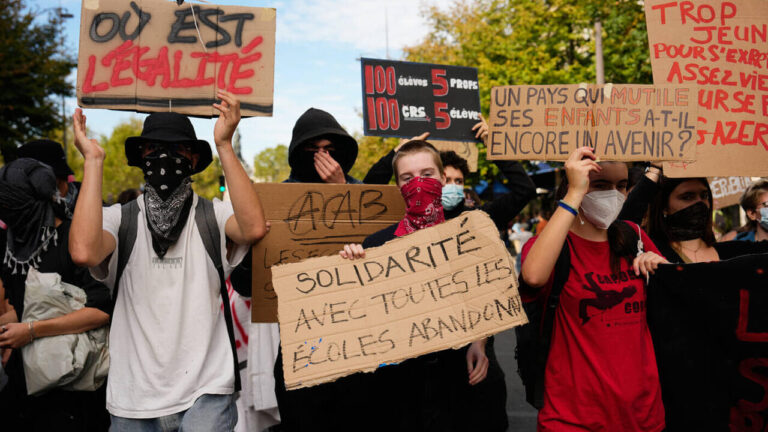
Italy at risk of contagion: home, health, school, the origins of the protest in France and Spain
The street riots in France on the issue of school, the Spanish government’s crisis on housing, the offensive of the Italian opposition on healthcare are three parts of a single problem which, not surprisingly, re-emerge almost simultaneously. School, home, healthcare were the cornerstones of the social pact based on universalistic welfare that shaped the great European democracies from the 1960s onwards, of any political orientation. Whoever was in the government pro tempore at a certain time ended up pursuing the same standards.
The welfare model under pressure
The explosion of these protest movements therefore leads us to ask ourselves whether that model still exists, whether it is current, whether it is economically sustainable, whether we can do without it or what the social costs would be if all together we were to realize that it is no longer possible to carry on as we have done so far, and perhaps we must imitate the United States, where universalistic protection in terms of school, home and above all healthcare is not at the levels to which we Europeans are accustomed.
Without delving too deeply into the sea of public finance data, in which we risk first getting bored and then getting lost, it is clear that if the welfare issue explodes in three of the most important European nations, the first consideration to make is that the State is finding it increasingly difficult to guarantee what it has guaranteed so far. Focusing more on Italy, we talk about public health (the National Health Service was established in 1978), social security which after years of trouble has been brought under control by resorting to the progressive increase in the pension age, public education, protection of the labor market (redundancy fund).
How we spend 28% of gross domestic product
A complex of things which in Italy represents almost a third of the GDP produced (precisely 28.8%, compared to the European average of 27.8) for an overall expenditure which has gradually grown over time (in 1960 it amounted to 13.3% of the GDP, in 1970 to 22.7) and which now, with the current socio-demographic changes, presents us with the bill.
The first significant change is demographic. The population has aged considerably, and we all know that caring for someone over sixty costs much more than caring for someone in their twenties, in addition to the fact that pension costs inevitably grow, both because there are more elderly people and because there are fewer young people who work and produce income. Among those “responsible” for this dynamic there is also medicine, which fortunately has made notable progress but it has been expensive progress, because the new treatments are as effective as they are expensive.
Thus resources are no longer a national asset
Obviously we are all happy with the progress made in science and no one hopes to go back, but it is clear that from an economic point of view the situation has changed. Relationships in the world of work have also changed profoundly, with that capital/labour compromise at the basis of the social pact that gave rise to welfare. In periods of great growth it was in fact quite easy to foresee wage increases, productivity incentives and a consequent expansion of welfare, but this is no longer the case.
Western countries with a large welfare state are growing less and the “distribution” of resources that previously took place within the national perimeter must now take place on a large scale: it is as if globalization, delocalization, international competition and automation had forced the same cake to be divided into several pieces. Work has also become more precarious, more part-time, creating problems for a system largely based on the contributions of employees. The paradox we have arrived at is therefore that the demand for welfare has grown and at the same time the resources to deal with it have decreased.
The breaking point that favors extreme populism
Hence the breaking point we are witnessing, which requires a paradigm shift on the part of politics, which is not seen at the moment. The forces riding the protest (understandably, from their point of view) do little or nothing to advance recipes capable of creating a new social and development model. In fact, if the answer to those who complain about high rents is only “more public housing”, i.e. the State building apartments and then renting them out at controlled prices, we are really not going far. We could say the same thing for school and healthcare.
By dint of just distributing, the money runs out and in fact has already run out. There are no magic solutions, so much so that in the programs currently announced by the Italian opposition forces there is a lot of talk about more funding for healthcare and schools but no one, Schlein or Conte, has spent a few words to explain where they intend to recover the resources to finance the new interventions. But since we are witnessing a historic change in the paradigm of the economic and social development model, the political class is called to take a leap forward, or perhaps upwards. Otherwise the doors will open wide to populism of the right and left, to those who propose solutions that are as easy as they are fallacious. Promises which then fall on deaf ears but which in the meantime, by radicalizing the debate, have already caused their damage.
Read the other editorials by Pierfrancesco De Robertis