

Incentives for renewables cost us around 10 billion euros a year. Who do they go to? It is normal for the state to finance the green transition away from oil and gas: the problem may be the way in which it is happening. Renewables are increasing their presence, but with major difficulties and paradoxes, such as sometimes generous and inefficient incentives that require billions of dollars in investments to adapt the electricity grid. All the spending ends up in bills, eroding the “promise” of renewables: lower energy costs. Who is pushing this transition? Isolating the major recipients of state incentives for solar and wind energy – but not only – one figure stands out: 60 percent of the sums go to giants such as JP Morgan, Benetton, banks and foreign investment funds.
The 9.2 billion euros for renewables: what incentives are we talking about
The cost of incentives for renewables in Italy is over 9.2 billion euros. The figure refers to 2025 and represents the expenditure incurred by the community to incentivize electricity produced from clean sources. Photovoltaic, wind and bioenergy stand out from the other sources, even if solar, the “old” one, accounts for over 60 percent of the total due to the “Energy Accounts”, incentive systems launched between 2005 and 2011.
But there are more mechanisms at play, all financed by electricity bills. Next in overall amount is the “All-inclusive Tariff”, which absorbs approximately 1.8 billion euros. It is aimed at small, predominantly biogas and biomass plants: paying a single, fixed price for each kilowatt hour fed into the grid.
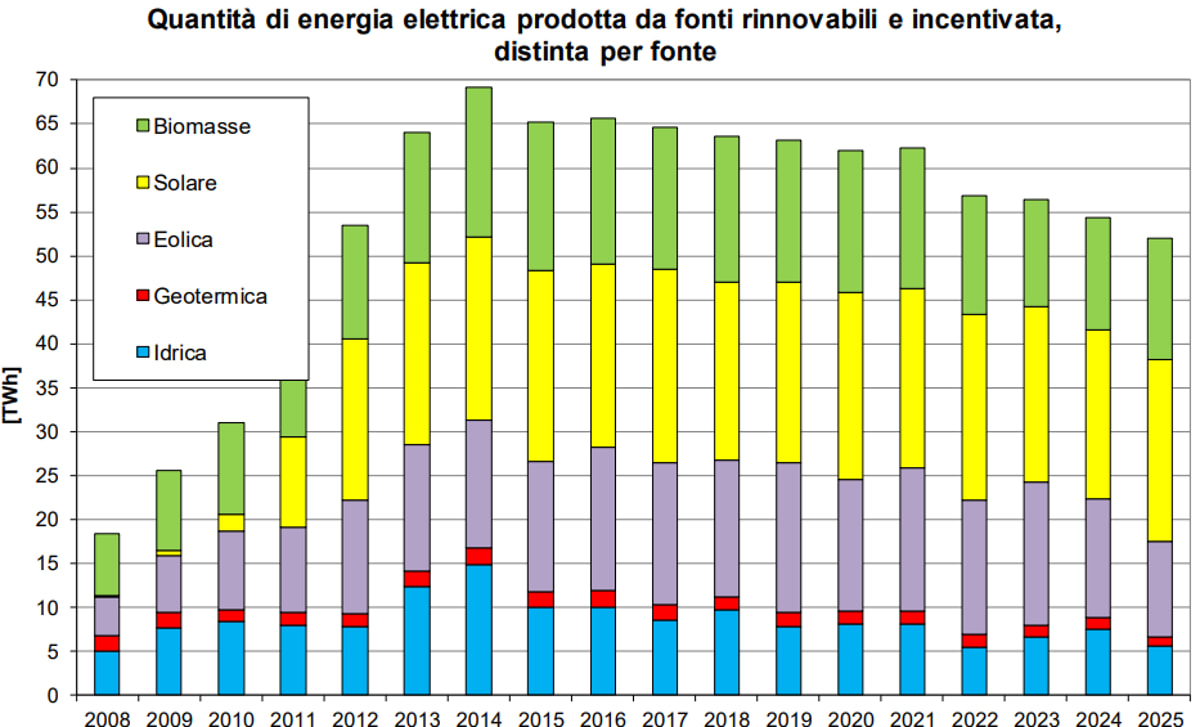
Then there is the “Grin” system (Incentive reconversion management), with an audience largely made up of large energy companies and historic industrial players in the wind and hydroelectric sectors. The framework is closed by the measure dedicated to electric RES aimed at developers of onshore and offshore wind, hydroelectric, geothermal and biomass plants admitted through auctions and competitive registers, with all-inclusive tariffs or differential incentives compared to market prices.
In 2025, the Energy Services Manager incurred costs of 10.393 billion and obtained 1.121 billion in revenues, mainly by reselling the withdrawn energy on the market: the difference is precisely 9.272 billion. Approximately 520 million must also be added to the total for special commercial regimes, especially on-site exchange.
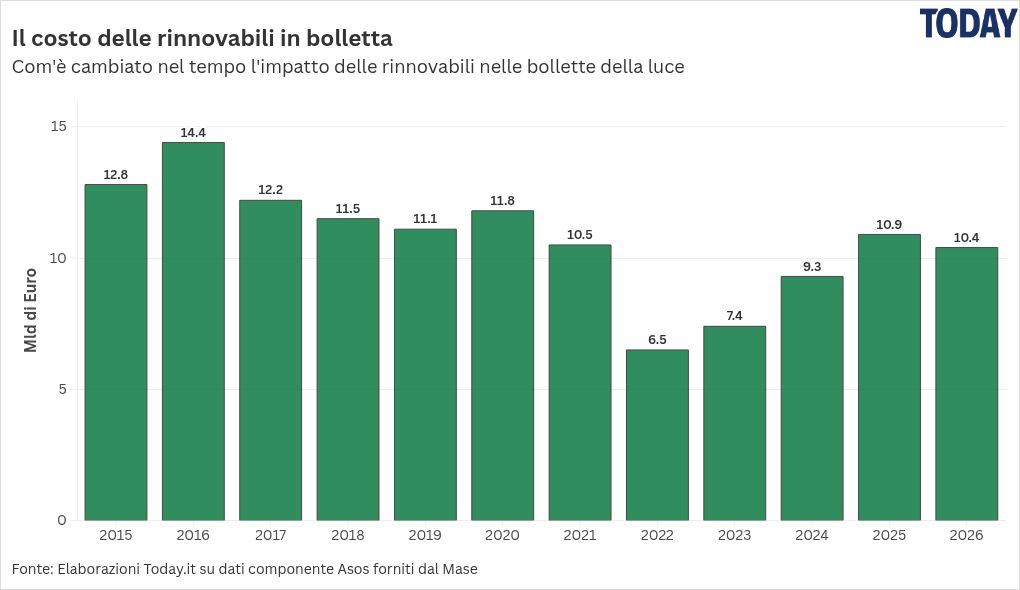
Considering these too, the figure rises to approximately 9.792 billion. However, the entire requirement of the Asos account is higher because Arera specifies that the revenue necessary for Energy release is excluded. Counting all measures, the 2025 bill is close to 11 billion.
Who gets incentives for renewables: the top 100
A large amount of incentives is concentrated in a few hands. From the analysis that Dossier carried out on the open data of the Energy Services Manager, it emerges that out of a total of 439,182 beneficiaries, 2,621 receive incentives ranging from half a million euros and up. This fraction of the sample alone absorbs 59.84% of the entire ceiling and exceeds a total of 4.84 billion euros.
In the first 100 beneficiaries – remember, out of a total of 439,182 – 1.413 billion are concentrated. Here everyone receives incentives ranging from 5 to 65 million euros. Among the top 100, 51 are financial vehicles attributable to investment funds, including foreign ones, asset managers, pension funds, insurance companies and platforms built to acquire plant portfolios.
Around 30 are also large companies in the energy sector, such as Edison, Eni Plenitude, Enel, A2A, Snam and Iren. Net of subsidiaries, the presence of the State is reduced to a minimum. Broadening our gaze to the complete audience of beneficiaries, there is then a plethora of special purpose vehicles, agricultural companies and cooperatives that are difficult to attribute. But who gets the highest incentives?
The large funds on renewables
Finance dominates the top block of this ranking. Dossier has reconstructed over 800 million in incentives and related beneficiaries. In the GSE data, in fact, financial vehicles are mentioned – often with names not attributable to the ownership structure – and srl with related tax codes, but not the final beneficiaries.
F2i and Sorgenia dominate this high range with 266.5 million euros. F2i is an Italian infrastructure manager with over ninety institutional investors, including pension funds, insurance companies, asset managers, banking foundations, sovereign funds, banks and public institutions. Among these is Cassa Depositi e Prestiti for 14 percent. F2i holds 62 percent of Sorgenia which manages the energy part with various projects between Italy and Spain. In Italy it has over 300 photovoltaic parks in 17 regions, wind farms between Sicily and Calabria as well as three large biomass power plants which are located in Argenta, Finale Emilia and in the Mercure valley.
Five companies controlled by Ef Kosmos and Ef Vega, also attributable to Sorgenia, declare 52 photovoltaic plants in ten regions, linked to 92.1 million euros of GSE payments in 2025. Twenty-one sites are located in Puglia, ten in Lazio and seven in Sicily
The green revolution with the stars and stripes and with Canadian pension funds
Then there are Sonnedix and Nadara who together are worth 112.6 million. Sonnedix is a renewable producer that acquires, develops, builds and operates solar, wind and storage facilities. In March 2026 it exceeded one operational gigawatt in Italy thanks to acquisitions in Lazio and obtained contracts for over 800 megawatts through the Fer X and Energy Release incentive mechanisms. Nadara, on the other hand, is a large independent producer born from the union of Renantis and Ventient. Sonnesix and Nadara are owned by institutional investors whose capital is managed or assisted by JP Morgan asset management, a section of the large US investment bank.
The American presence does not stop there. In our top 100, the Kkr fund weighs 52.7 million through Encavis and ContourGlobal. The fund recently invested 3.5 billion for 30% of the energy company Enilive and led the consortium that bought Tim’s Fibercop network for 22 billion. Cubico is controlled by Canadian pension funds and is worth 34.7 million, slightly more than the French investment company Ardian (32.9 million) which, with its one billion euro Clean Energy Evergreen Fund, invests in already operational plants: in June 2025 it purchased 117 operational photovoltaic plants still entitled to Energy Account tariffs.
Who is behind the mega wind farms in the Italian seas
Specialist platforms, banks and insurance companies also appear. Italian solar company is a platform owned by Green arrow assets selection and Swiss life asset managers, owner of 17 large ground-mounted photovoltaic systems, all connected and operational since 2011. It is worth 21 million in incentives. Followed by Munich Re, among the main reinsurance companies in the world (20.4 million), Emmessenne Solar of Banca Finint at 13.1, Plenium Partners at 10.8, Bee Energia solar Italia holding at 9.5, Allianz at 6.7 and NextEnergy solar fund at 5.7.
The large Italian industrial families also participate
The second most important financial center in our top 100 is “21 Tages” with 213.7 million distributed among 21 beneficiaries. This includes companies such as Ortigia Power 62, Apulia Renewable Energy, Ortigia Power 21, Enersol, Phenix Renewables and the other companies of the Helios and Global solar funds. On 3 September 2026, 21 Tages passed 55 percent to Edizione, one of the main European industrial and financial holding companies chaired by Alessandro Benetton.
Through Helios, Helios II and Helios Net Zero it manages over 500 renewable plants for approximately 1 gigawatt, numbers that make it one of the largest Italian photovoltaic investors. Maccarese Spa is also included in the Benetton perimeter with 2.9 million euros of incentives in 2025.
Who is behind the thousands of panels that are covering the Italian countryside
Erg, of the Garrone-Mondini family, is the first onshore wind operator in Italy. Also in the ranking is Fri-E of the Gostner family of Bolzano with 10.7 million, Cereal Docks of the Fanin family – a well-known entrepreneurial dynasty from the Vicenza area – with 8.4, Bio Energia Guarcino attributable to the Valentini group with 5.8 and Italmobiliare-Pesenti with Italgen at 3.1.
Crumbs to the public
The public has little left. They are mainly Municipalities, 73, which receive 102.2 million, in addition to six reclamation consortia (8.2 million), a mountain community (2.1), two metropolitan cities 1.6, the Autonomous Province of Bolzano 0.8, and 600,000 euros to a local health company 0.6. The main beneficiaries are the municipalities of Celano with 11.2 million, Salerno 8.8, Cavriglia 4.5, Valmontone 3.2, Gualdo Tadino 3.1, Tolve 2.9, Collarmele 2.8, Cerchio 2.7 and San Lorenzo Nuovo 2.5, as well as the Piave Reclamation Consortium with 2.8.
This is the overview of the highest denomination incentives. After decades of state interventions, the positive effect on bill prices is still not visible. We will need to understand what we want to finance, whether more clean and usable energy or financial income. The point is not to question the need to support the energy transition. Without incentives, especially in the initial stages, much of the renewable capacity installed today would probably never have been created. The challenge will be to progressively shift public support from the old subsidies to the construction of the energy system that is still missing to make tomorrow’s energy more abundant and cheaper.
Dossier is the exclusive subscription investigative section of The Vermilion. If you want to support our journalistic work and subscribe, Click here.