

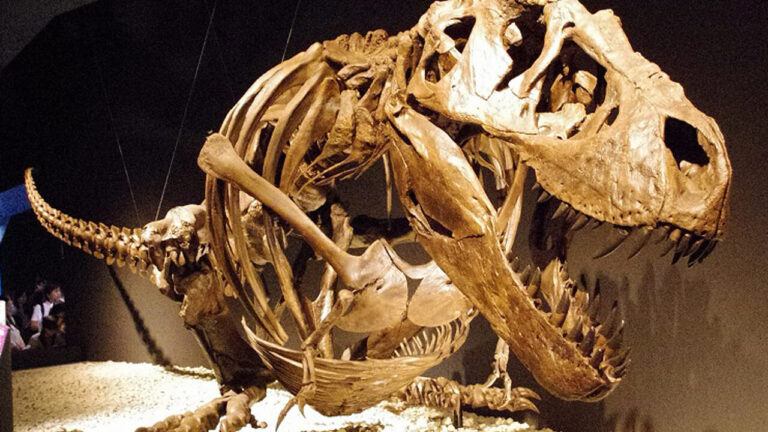
The T. Rex owes its fame to its colossal size and two unique anatomical characteristics: the gigantic skull and the tiny arms. Two almost vestigial limbs, which give a touch of comedy to what was otherwise the most terrifying predator of the Cretaceous. How are they born? This is explained by research from University College London and the University of Cambridge, which analyzed the biological and biomechanical factors that over the course of evolution have reduced the size of the forelimbs of T. Rex, and at least five other groups of ancient prehistoric reptiles.
The correlation between skull and limbs
The research examined data relating to 82 species of theropods, including several members of the tyrannosaurid family (which also includes T. Rex). The results, published in the Proceedings of the Royal Society B Biological Sciences, highlight a direct link between the shortening of the forelimbs and the increasing size of the skull. “It’s a case of ‘use it or lose it’ – explains Charlie Scherer, paleontologist at University College London – because the head has taken the place of the arms as a method of attachment”.
The hypothesis is therefore that the progressive strengthening of the cranial structures in these ancient reptiles, combined with a growing increase in the size of their prey, gradually made the front legs obsolete for the subjugation of prey, creating an evolutionary feedback that pushed towards jaws capable of exerting destructive pressures, while at the same time miniaturizing the forelimbs, which are increasingly less used for hunting and useless for locomotion.
A new analysis method
The conclusions reached by the authors of the study arise from a new system for evaluating the “robustness” of dinosaur skulls, based on parameters such as its size, the degree of fusion of the cranial bones and the intensity of the bite force. The analyzes revealed that Tyrannosaurus rex holds the record for bite power, followed by Tyrannotitan, a large theropod that lived in what is now Argentina during the Lower Cretaceous, about thirty million years before T. rex. In each of the examples analysed, however, the greater size and robustness of the skull was associated with the increasing size of their prey. “Trying to grab and drag a 30-meter sauropod with your claws is not exactly ideal – underlines Scherer – attacking it and holding it with your jaws was probably much more effective”.
It’s not just a question of size
Research shows that the correlation between skull strength and reduction in forelimb size is independent of the overall size of the animal. The phenomenon is in fact visible even in small-sized species, such as the Majungasaurus, a predator that populated Madagascar seventy million years ago: with an estimated weight of around 1.75 tons, equal to a fifth of that of a T. rex, the Majungasaurus still had atrophied forelimbs.
The study also highlights that the bone reduction occurred in different ways depending on the families: abelisaurids, such as Majungasaurus, show a marked shortening of the forearm and hand, while in tyrannosaurids the decrease was proportional, also affecting the upper part of the arms. Finally, if we look for a record holder, the maximum level of atrophy was recorded in the Carnotaurus: “It had ridiculously small arms – confirms Scherer – even smaller than those of the T. rex”.