

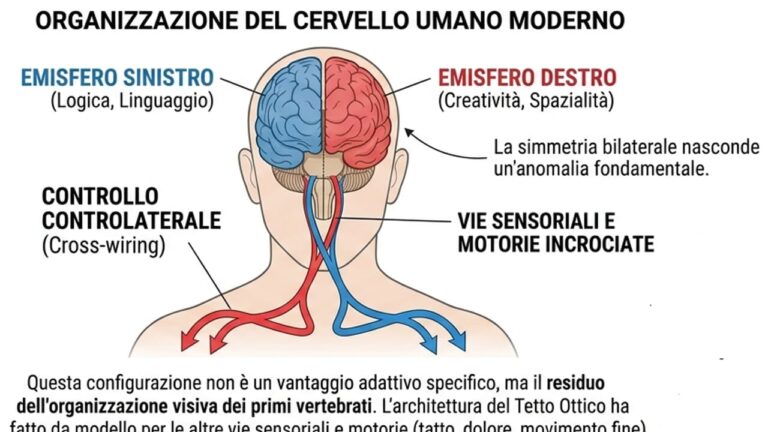
The bilateral symmetry of the human body (the fact that the left and right sides are mirror-image) hides a fundamental anomaly in the brain: cross-wiring, or contralateral control, or the fact that sensory and motor signals between the central nervous system and the body cross along the midline. The right side of the brain receives information and controls the limbs of the left half, and the same happens, in a mirror-like way, for the left hemisphere. For decades, neuroscientists have wondered about the functional reasons for this cross-organization. And today a study published in the journal Frontiers in Neuroanatomy proposes an answer: that this configuration was not created to offer a specific adaptive advantage, but represents the structural residue of evolutionary adaptations that occurred over 500 million years ago in the visual systems of the first vertebrates.
From the retina to the brainstem circuits
The investigation starts from the way in which the nervous system processes visual stimuli. When light hits the retina, the image is inverted: objects located on the right project photons onto the left portion of the retina, and vice versa. Through the optic chiasm, nerve bundles distribute information so that the right visual field reaches the left hemisphere of the brain.
Most of these signals are directed towards an ancestral area of the midbrain, the optic tectum (known in mammals as the superior colliculus), responsible for rapid responses to environmental stimuli. This structure, common to all existing vertebrates, has maps organized in a contralateral manner. According to the researchers, the original architecture of the optic roof would have acted as a structural model for the subsequent development of other sensory and motor pathways, imposing a crossed symmetry to which the circuits that appeared in subsequent periods also conformed.
The spinal and motor pathways
Analysis of neural pathways in tetrapods – the group that includes amphibians, reptiles, birds and mammals – shows that the same crossover logic characterizes pathways responsible for touch and proprioception, such as the dorsal column system, and bundles associated with pain perception, such as the spinothalamic tract.
The same pattern is observed in circuits that control skeletal muscles, including the tectospinal tract and the rubrospinal system. In the case of the corticospinal tract, which in primates and humans manages the fine control of movements and fingers, evolution would have re-adapted a pre-existing neural pathway created to regulate sensory input. Instead of designing a system from scratch, evolution would have exploited a wiring infrastructure already established in the visual circuits of the first fish born during the Cambrian.
The persistence of this mirrored organization demonstrates how biological systems tend to conserve and modify the structural solutions already present in their progenitors rather than reorganizing their anatomy from scratch. The mystery of the backwards wired brain would thus find its answer not in a refined adaptation strategy, but in the profound history of marine organisms that lived half a billion years ago.