

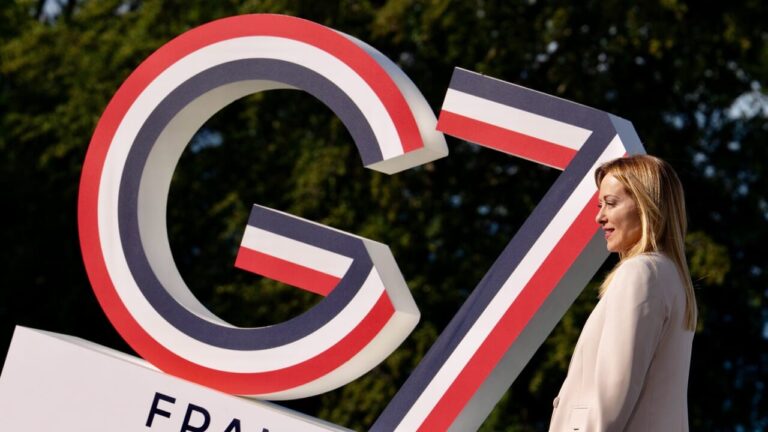
Donald Trump takes the stage at the G7 in Evian les Bains, France, starting today, Monday 15 June. Arriving in the French town on Lake Geneva, the President of the United States met the host Emmanuel Macron before the official opening of the summit and presented the memorandum reached with Iran to the allies. There is also Giorgia Meloni, who will see Trump in person for the first time since the Sharm el Sheikh summit last October and, above all, after the recent criticism received by the US president: the two were among the first to be welcomed by Macron and his wife Brigitte for the ritual photo.
“The Strait of Hormuz reopens on Friday”
“The Strait of Hormuz will be completely open on Friday,” Trump assured, claiming that the passage of ships will take place without tolls and that some merchant ships have already started moving again. The American president also linked the agreement to the drop in oil prices and the positive reaction of the stock markets, adding that he now wants to concentrate diplomatic efforts on Ukraine and Lebanon. However, the agreement is not yet black and white: the formal signature is scheduled for Friday 19 June in Geneva.
Trump told Évian that the agreement does not currently provide for an automatic easing of sanctions: any openings would depend on Tehran’s behavior. The United States has also indicated that it will maintain the current military posture during the next phase of negotiations. On the Iranian side, President Masoud Pezeshkian called the memorandum potentially “honorable”, but only if all provisions are implemented correctly.
Macron responded by offering a very concrete French military contribution: reconnaissance planes available from the next few hours, frigates deployable within 48 hours and, subsequently, also the aircraft carrier. The French president had already announced a maritime mission led by France and the United Kingdom, with the support of, among others, Italy and the Netherlands, intended to accompany the securing of the route. “I don’t think we will need much help”, specified Trump while answering journalists’ questions in front of Macron – who he defined as a “special friend” – because we have an agreement that provides that the passage is open”.
Meloni on mission, the 500-man naval team is ready
Giorgia Meloni arrived at the Hotel Royal in Evian after Trump and participated in the inaugural dinner dedicated to the main international crises. The Italian position had already been defined in the morning: Palazzo Chigi expressed “strong appreciation” for the US-Iran memorandum, thanking Qatar and Pakistan in particular for their mediation work.
“This is an opportunity for peace that must be seized,” said Meloni. For the Prime Minister, there are two indispensable principles: “Iran cannot acquire a nuclear weapon” and “freedom of navigation must be guaranteed”. Hence the openness to Italy’s direct involvement in the naval mission to clear mines from the Strait, which would bring around 500 Italian sailors to the Gulf: “We are ready, together with the other partners and without prejudice to the necessary parliamentary authorisation, to contribute to an international naval presence to accompany the full reopening of the Strait of Hormuz”.
Meloni’s mission in the Strait, the bottled ships and the blocked gas: what is happening now in the Strait of Hormuz
The government has not yet publicly indicated which Navy units would be employed, with which operational rules and within which command. Italy already has experience in protecting merchant traffic through the European operation Aspides, active between the Red Sea, the Gulf of Aden and the Persian Gulf with defensive tasks.
Volodymyr Zelensky is expected to participate in the session dedicated to peace and security of Ukraine and Europe on Tuesday. Trump said he had spoken with both Zelensky and Vladimir Putin and that he considered both open to a possible initiative, without however indicating a concrete proposal. Meloni condemned Russian aggression as “unacceptable” and reiterated that support for Kiev will remain central in the work of the G7: for the Prime Minister, negotiation remains “the only path” capable of bringing the conflict to an end.