

Meloni’s fool on Ceuta
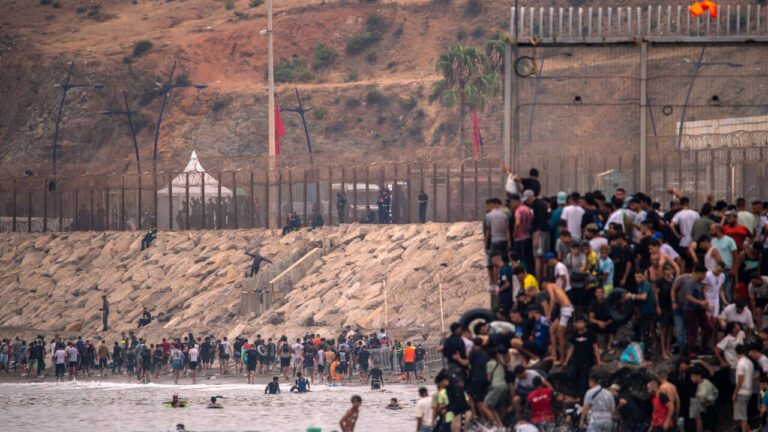
The drama (85 deaths) that occurred in Ceuta in the last two days highlights the inability of many European leaders, and perhaps of the EU itself, to address the migratory crisis in its entirety by framing it in its broader geopolitical dimension. And it produces a chain of bad impressions. The most obvious are from the Italian government, the Spanish government and the European Union. Let’s try to line them up.
Meloni’s hypocrisy (who isolates himself even more)
In pole position of this singular reverse grand prix is Palazzo Chigi, which decides to suspend the Schengen treaty for a month not only when the immigrants who entered Ceuta irregularly have almost all already returned to Morocco, but above all despite the fact that the Spanish enclave in Africa enjoys an autonomous regime which already makes it a “no-Schengen” area.
What happened in Ceuta had essentially already been foreseen (on the other hand, it was not the first time it had happened), so much so that there was a countermeasure. It is clear that the Italian government knew this aspect, but Palazzo Chigi wanted to throw a punch in any case. Partly out of contempt for the socialist Sanchez, partly to show off one’s muscles, in reality we don’t know who against (Morocco? the other EU countries? Libya, through which much of the irregular immigration arriving in Italy transits?), partly for propaganda, whether the right-right (Vannacci) decides to mount the issue and make it a workhorse, like a Roggero-due.
The practical purpose of this, which is only a move for internal use, is null, but the political purpose is evident, except that it is a punch in the air. If anything, the only effect is that of having broken up, no one knows how definitively, with Spain, and given that Giorgia Meloni doesn’t have so many friends in Europe (it’s not like things are much better with Macron…) one wonders the meaning of all this uproar.
Sanchez’s myopia
The second to come out of the affair in pieces is Pedro Sanchez, who was already not doing very well for numerous other reasons. In fact, it is not enough to say that almost all of the illegal immigrants have returned home, and it would be sufficient to count the almost one hundred victims of these two days of madness to highlight how the crisis has produced very serious repercussions.
The assault on Ceuta has in fact shown enormous flaws in the Madrid government’s ability to defend the border, and it is not clear why the 500 meter net that has only now been stretched in the water along the maritime border to prevent the Moroccans from swimming could not have been put in place sooner.
The Ceuta crisis was, in fact, very predictable. Partly because 50 thousand people crowding together at a border cannot escape even the slightest intelligence control (a few drones like those you buy at the supermarket were enough), and partly because after the latest disagreements with Morocco over the age-old Western Sahara affair, a “revenge” from Rabat towards Madrid was in the cards.
And yet nothing. Sanchez didn’t see, and when he saw, he acted late. Now he takes it out on the world, but if he had done what a normal government should do, without attracting attention, we wouldn’t be here arguing and above all there wouldn’t be almost a hundred innocent people dead on the ground.
European inaction
The latest bad impression belongs to the European Union, which is now beating its chest over what happened, is scandalized, decides to convene a video call (never have to delay the holidays…) and to respond to the letter from the Italian Prime Minister.
Well, one might say that the European Union is looking for a common position on a drama that concerns it in its entirety. It’s a shame that for years, many years, everyone looked the other way. Calling Italian governments of various colors who have always had doors slammed in their faces when they asked for the solidarity essential to stem an epochal phenomenon in the face of which the commitment of a single state ended up being little.
We don’t have to go into the history of the various Dublin treaties here, but we all remember the effort of our prime ministers when they had to go to Brussels to negotiate with the others. Perhaps now we realize that with the rise of populist movements and parties that make a flag of irregular and uncontrolled immigration, and with key states going to the vote soon (above all Italy and France), it is time to get moving.
Here, to close, in the face of all this, we are once again overcome by despair. From those who show the usual tendency to face crises emotionally, from those who don’t prove to be up to par, from those who bark at the moon. Until the next crisis.