

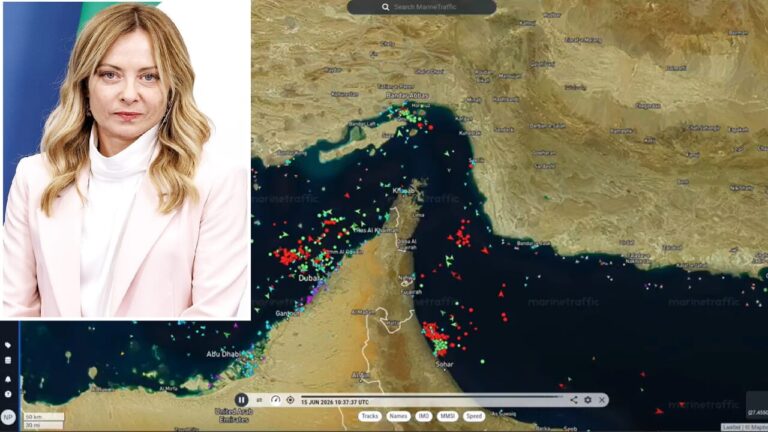
In words, there is a preliminary agreement between the United States and Iran, but naval traffic in the Strait of Hormuz remains far from pre-war levels. We know that this is a problem for the energy balances of half the world, between oil and gas. As regards LNG, liquefied natural gas, Italy is one of the most exposed countries in Europe. The Italian government itself could be a protagonist in the phase that is about to open: Giorgia Meloni is preparing a naval mission to escort Italian minehunters into the Strait to clear it of Pasdaran bombs.
Who passes through the Strait of Hormuz today
One day after the announcement of the United States-Iran agreement, crossings remain limited, according to geospatial data from MarineTraffic. Kepler reports that in the previous 24 hours more than 500 commercial ships have transmitted their GPS signal at least once within the Persian Gulf. But that doesn’t mean they crossed the Strait. The data also includes ships stopped at anchor, in port, moving between ports in the Gulf or awaiting instructions.
Traffic remains uneven
A total of 29 verified vessel crossings were recorded across the Strait of Hormuz between 10 and 14 June, covering crude, refined products, LPG, chemicals, methanol and general cargo movements. Activity was concentrated on 11 and 12 June, while 23 of the… pic.twitter.com/Ju6TZ0rvzk
— Kpler (@Kpler) June 15, 2026
In fact, Kepler data shows that just 29 ships have done so in the last 4 days. The first vessel to do so after the announcement of the US-Iran agreement was the liquefied natural gas tanker “Disha” flying the Maltese flag and owned by Petronet Lng Limited, an Indian state company in the oil and gas sector. The ship had loaded gas on March 2nd and had remained stuck inside the Gulf until today. This gives an idea of the “chokepoint” situation in the Strait of Hormuz, which has caused supply problems and consequent increase in prices of energy products on global markets.
Donald Trump presented the announcement like this: “Ships of the world, start your engines. Let the oil flow”
The Strait of Hormuz blocks gas supplies to Italy: force majeure declared on seventeen shipments from Qatar
But the agreement has yet to be signed. The one announced by Washington and Tehran is for now a framework agreement. The memorandum should be signed on Friday 19 June in Switzerland and published only after signing. According to the parties’ declarations, from that moment the reopening of the Strait “to all commercial ships” should begin and the United States should start lifting the blockade imposed on ships headed for Iranian ports.
The problem of mines: Meloni’s naval mission
“We still consider it very risky for ships to start transits,” said Jakob Larsen, head of safety at Bimco, one of the largest international maritime associations representing shipowners. Five Western maritime sources mentioned by Reuters they believe that operations with minehunters and underwater drones could last “between forty and fifty days”, before shipowners, oil companies and insurers gain sufficient confidence and resume operations.
Italy has declared itself ready to participate in the international naval mission, in which it will have a central role. “Freedom of navigation must be guaranteed”, said Giorgia Meloni, adding that Rome is available to contribute “without prejudice to the necessary parliamentary authorization”.
The Colaninno family’s billionaire challenge: this is how they can help the Navy reopen Hormuz
The Chief of Staff of the Navy, Giuseppe Berutti Bergotto, had already described a possible team composed of two minehunters, an escort ship and a logistics ship, included in a coalition with other countries equipped with anti-mine capabilities, including France, the United Kingdom, Belgium and the Netherlands.
The units identified would be the minehunters “Rimini” and “Crotone”, both of the Gaeta class, the multipurpose patrol vessel “Raimondo Montecuccoli” and the logistical support ship “Atlante”. The minehunters would have already moved from La Spezia towards the Mediterranean, while the actual position of the units is not known.