

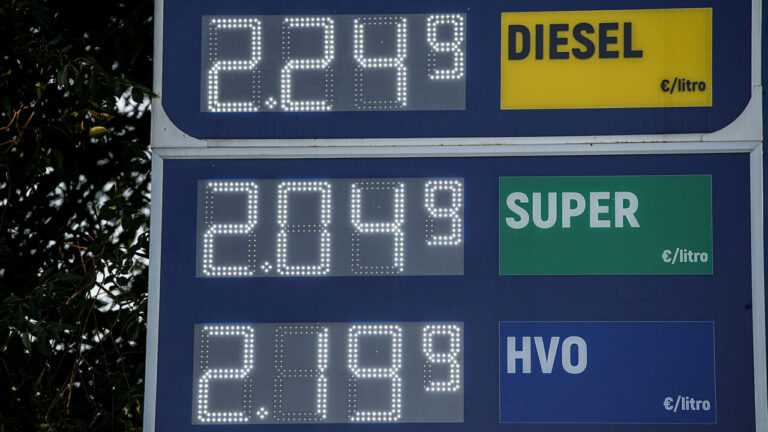
The government could still take time on the high cost of fuel. The new selective measures announced to support consumers most affected by the price increases are still being studied and may not be ready for the Council of Ministers scheduled for Wednesday 16 September. Thus the hypothesis already used in recent weeks is back on the table: once again extending the cut in excise duties on diesel, currently set to expire on Thursday 17 September.
The hypotheses on Meloni’s table
The hypothesis taken into consideration would be to extend the discount for another seven days, using the extension as a bridge measure while waiting to define the new aid system.
The intervention currently in force was approved by the Council of Ministers on 10 September and is valid until 17 September: it involves a cut of 14 cents per liter in excise duty, which also considering VAT produces a discount at the pump of around 17 cents per litre. The seven-day extension decided last week costs around 86 million euros.
The targeted aid promised by Meloni
However, the government’s declared intention was to progressively overcome generalized interventions. Prime Minister Giorgia Meloni had announced a change in strategy.
After the extension of the excise duties, the Prime Minister explained that she wanted “a more targeted measure aimed at consumers and users who have the greatest need”, adding that the objective was to build an “easy, immediate tool for citizens, which does not create confusion”. Meloni had said she was “very optimistic” about the possibility of arriving at the new provision within this week.
However, times could take longer. Within the majority there are those who continue to consider the approval of the new measures possible already in the next Council of Ministers and those who instead believe another extension of the excise duties to gain a few days is more likely.
The problem does not only concern the definition of the audience of beneficiaries, but also the resources necessary to finance the interventions.
Because September 22nd is an important date
A new one-week extension would allow the government to reach another date considered important for public finances: September 22nd. On that day, Istat will publish the new update of the data on GDP and public administration debt. In the estimate released on March 2, the Italian deficit for 2025 was calculated at 3.1% of GDP, an improvement compared to 3.4% in 2024.
Meloni extends discounts on excise duties while the price of oil flares up: new record
According to the assessments circulating in the majority, a possible revision of the ratio between deficit and GDP below the 3% threshold would significantly strengthen the path for Italy’s exit from the European procedure for excessive deficit.
To formally close a procedure it is not enough to go below 3% once: the reduction must be considered successful and long-lasting and must follow the procedure established at European level.
The Chamber’s technicians ask for clarification on the coverage
However, there is also another problem on the table. Parliamentary technicians have raised a series of questions on the quantifications and financial coverage used in the decrees with which the cut in excise duties has been extended in recent months.
Fuels towards 2.5 euros per litre, the “invisible” cost of closed refineries: this is how Italy got into trouble
In the document prepared to verify the quantifications, difficulties in precisely reconstructing all the effects of the tax reductions are first highlighted. According to the technicians, on the basis of the reports presented it was possible to reconstruct only some of the main effects, while “it was not possible to verify in a timely manner” the impact on revenues and expenses related to excise duties, VAT, IRES and IRAP.
The problem also arises from the fact that the technical reports indicate the overall volumes of diesel fuel, without all the elements necessary to retrace the individual quantifications.