

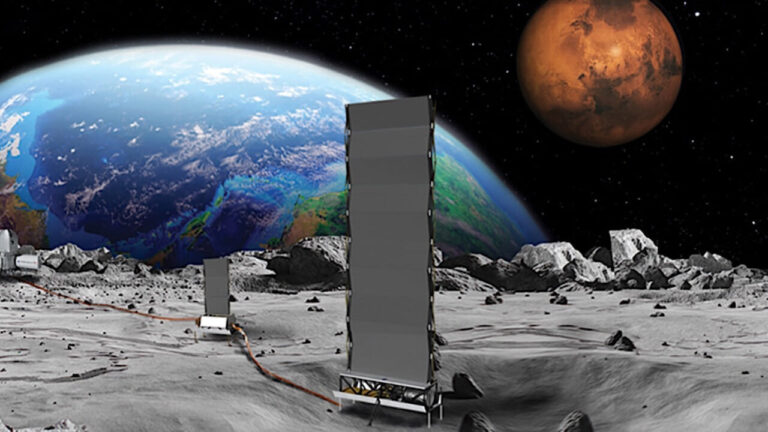
Soon the moon could host its first nuclear reactor. In fact, NASA has recently accelerated its “Lunar Fission Surface Power” program, announcing the opening of a race addressed to the private industries in the sector, with the aim of designing and building the first fiscal reactor on the soil of the satellite by 2030. A move that would allow the United States to plant a symbolic (but not only) on the lunar soil before the Chinese rivals, construction site a similar project for 2035. And which would represent a fundamental starting point for the construction of a human presence on the moon, and for the planning of the long journey in the direction of Mars. Always, of course, if the US space agency this time will be able to carry out the project in the established times.
The race to the moon
In fact, the historical return of man to lunar soil, announced by the USA in 2017 with the launch of the Artemis program, has now transformed into a two -way race: the American mission is scheduled for 2027, while China has announced the arrival of its “taikonauts” on the satellite in 2030 Starship, and without certainties on the status of development of the rocket that should transport American astronauts, the landing on the moon on scheduled times begins to seem impossible.
On the other hand, China continues to grind one success after another, and few doubt that it will be able to respect the time schedule for its first mission with a crew on the satellite. Also for this reason, the NASA administration has probably felt the need to accelerate its satellite colonization program, announcing the call for the conception, creation and implementation of a small nuclear reactor to be placed by 2030 in the southern pole of the Moon, where the first permanent lunar habitat should arise for the astronauts of the Artemis program.
It is not just a matter of prestige
In this case, the prestige of being the first (albeit not negligible) is not the only motivation that pushes NASA to press the accelerator. Artemis Accords, the international treaty that regulates the spatial operations signed in 2020 by over 56 nations, in fact grants the countries engaged in lunar soil missions the right to a “safety zone” in the area in which they carry on their operations. And even if neither Russia nor China have signed the Treaty, the United States hopes to preclude access to the South Pole, considered the best place for the creation of a human settlement, with the construction and implementation of a nuclear reactor on the spot. And at the same time – probably – they fear that Chinese and Russian (who announced a joint project for 2035) can try to do the same, in the event that they came first.
“We are competing with China for the Moon, and to have a base on the moon we need energy,” explained Sean Duffy, current director of Intermin della Nasa in August during a press conference. “This fission technology is of critical importance … There is a certain part of the moon that everyone knows better. Where ice is there. There is sunlight. And we want to get there first, and to claim it for America”.
The American reactor
Currently, the NASA call is in the initial stages, in which the companies concerned must subject their projects to the space agency, which will therefore select the most promising and finance the development of its own pocket. The request is to design a fission reactor that does not exceed 15 tons of weight (the limit so that it can be transported by the NASA lands) and capable of producing around 100 energy kilowatt.
A small reactor, therefore, with a power comparable to that of the engine of a car, but capable of operating for at least 10 years on lunar soil, without the need for fuel spare parts or light sources (as would instead understand by relying on solar generators or more traditional fuel). With such a reactor, NASA believes that he can feed the energy needs of the Base Campo Artemis Mission, the Artemis Base Camp, and in case of success, he hopes to be able to climb the technology to use it in the future missions directed towards the red planet.