

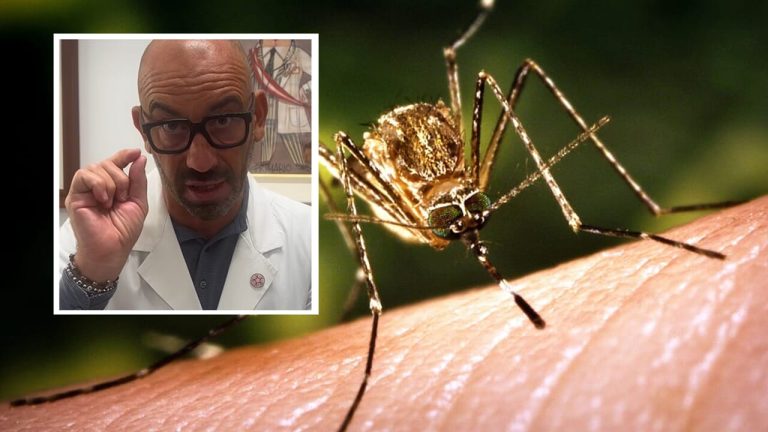
It is the turn of the West Nile: the virus is overwhelming the summer, with hundreds of cases, 13 deaths, and an increasing attention in the newspapers. The main novelty, to be honest, is precisely this: the media obsession with a disease that has actually been present in our country for decades and that in the past – even recent – has seen much worse vintages.
Not that the risk must be diminished: prevention, also in this case, is essential to avoid – few – serious cases and deaths that periodically causes in the summer months. But watch out for flooding: it is a virus with a minimum impact on the health service, which causes almost mild infections or (even more often) asymptomatic, and which is dangerous mainly for the elderly and people made fragile by serious chronic pathologies, in a way no different from the many fluvials that circulate in the winter months.
Given numbers
On the internet we read a bit of everything: 10 thousand estimated cases. 455 confirmed cases. 22 deaths. To look at the official numbers of the monitoring of the Istituto Superiore di Sanità, there is a much more reassuring situation. The cases of West Nile confirmed in Italy are in fact 89, concentrated mainly between Lazio and Campania where the most sustained transmission is currently underway. Of these, 40 are serious forms, neuroinvasive. And eight deaths, updated to 30 July. In the meantime, the count of the dead has climbed to 13, but also so, are numbers that describe an absolutely normal year: in 2022, for example, the cases confirmed at the beginning of August were 94, and seven deaths.
This was also confirmed by the Ministry of Health: “We are not faced with a health emergency, the data on the circulation of the West Nile virus are in line with the previous years, with currently only a different geographical distribution”, is the message entrusted in a note from the Ministry to Maria Rosaria Campitiello, head of prevention, research and health emergency. The novelty is therefore not in the numbers of the epidemic, in line with those of the past years, but at most in the areas in which it is concentrating: Lazio and Campania, instead of the more traditional Veneto and Emilia Romagna.
The disease
On the other hand, the West Nile has been an endemic virus in our country for almost 20 years now. Since 2008 there have been regularly cases of seasonal transmission in different regions of the peninsula, in the wake of migratory birds that return from the areas of greatest endemic, in the African continent, and are aimed at local mosquitoes, contributing to circulation on our territory. The virus tank in this case are common mosquitoes, mosquitoes of the Culex genre active at night, and not tiger mosquitoes associated with many other infectious diseases of tropical origin. The transmission also occurs only starting from the birds: men and many other animals represent a terminal guest for the virus because it normally cannot replicate in our body at levels sufficiently high to allow secondary infections through other mosquito stings.
West Nile virus: what are the symptoms
Looking at symptoms, in 80 percent of infections are not present. In the remaining 20 percent they are mild flu symptoms, and absolutely nonspecific. And in less than a percent of cases the disease takes a neuroinvasive, more serious form. However, the deaths remain a rarity, and usually take place as a complication of pre-existing pathologies in elderly people, over 70-80 years, or in transplanted and other types of fragile patients.
Prevention
Specific therapies against the West Nile virus currently does not exist. Just as no vaccines are available. This makes prevention fundamental, which is carried out in the first instance with disinfestations, which must be carried out in April, in areas where mosquito surveillance (which carry out regional prevention networks with specific traps) reports the presence of the virus. In this way it is possible to break the transmission in the local avian fauna in time, and to prevent the tank of infected birds in summer from being wide enough to create consistent epidemics also in the human population. This is what evidently has been done this year in regions such as Veneto and Emilia Romagna, traditionally marred by the virus and where for now there are very few cases. And to which evidently the necessary attention has not been paid in the lower Lazio and Campania, where in recent weeks the peak of the new cases and the deaths has been recorded.
West Nile and Chikungunya compared: how to transmit, the symptoms and treatments available
“Unfortunately in our country prevention is not done as it should be done, because almost everything is missing from an organizational point of view. They lack guidelines: who must do it, in what moments, municipalities, regions? It takes directives”, reported Matteo Bassetti a few days ago, in a video relief entrusted to social networks. To then add: “We try to improve ourselves given this terrible July that the West Nile is making us pass. Let’s organize ourselves in time: prevention is done from the months of March, April, May. We must no longer be in July, or even in August, in the middle of an emergency”.
In August, therefore, it is now late for public health. All that remains is to rely on good individual prevention practices, valid to avoid any disease transmitted by mosquitoes: avoid too humid places or that we know be particularly infested with these insects, use repellents, rely on long sleeves and trousers, covered shoes, and any other precaution that reduces the risk of being points.
This is nice to pic.twitter.com/rafsx0zs97
– Matteo Bassetti (@Profmbassetti) August 3, 2025