

In April 2026, Russia’s revenues from fossil fuel exports increased by 4% on a monthly basis, bringing approximately 733 million euros per day into Putin’s coffers, a level never reached in the last two and a half years. Growth recorded despite a 7% drop in exported volumes. The confirmation comes from the latest report from the Crea study center (Center for research on energy and clean air), the Kremlin’s revenue from the tax on mining will reach 7.8 billion euros in the month, calculated on a price of crude oil at 93 dollars a barrel. But who buys Russian oil and gas? In addition to China, India and Japan, there are also many European countries, such as France, Hungary, Belgium, Slovakia and Spain. Let’s see in detail what the data says.
Russian oil revenues
Crude oil revenues fell 9% monthly to 374 million euros per day due to a 24% reduction in seaborne volumes. A reduction mainly due to Ukrainian drone attacks on Russian infrastructure, such as the Tuapse refinery, which collapsed by 65% on an annual basis in the four-month period. Despite this, oil revenues remain 68% higher than in February 2026 and 44% higher than in April 2025. Exports via pipeline instead grew by 36% thanks to the restart of the Druzhba to Hungary and Slovakia (27 million euros per day), while revenues from refined products by sea jumped by 32% to 173 million per day.
Gas and coal
Revenues from the gas pipeline, however, increased: +15% (equal to 82 million euros per day), net of a 7% drop in volumes. An increase which in this case was stimulated by high prices in Europe (+24% on an annual basis) triggered by the war in Iran and the closure of the Strait of Hormuz. LNG revenues grew by 25% to 58 million per day; total volumes remained stable as the shares lost in the European Union were absorbed by China (+32%) and Japan (+57%). Coal recorded an increase of 5% in revenues (45 million per day) and 3% in volumes.
The “shadow fleet”
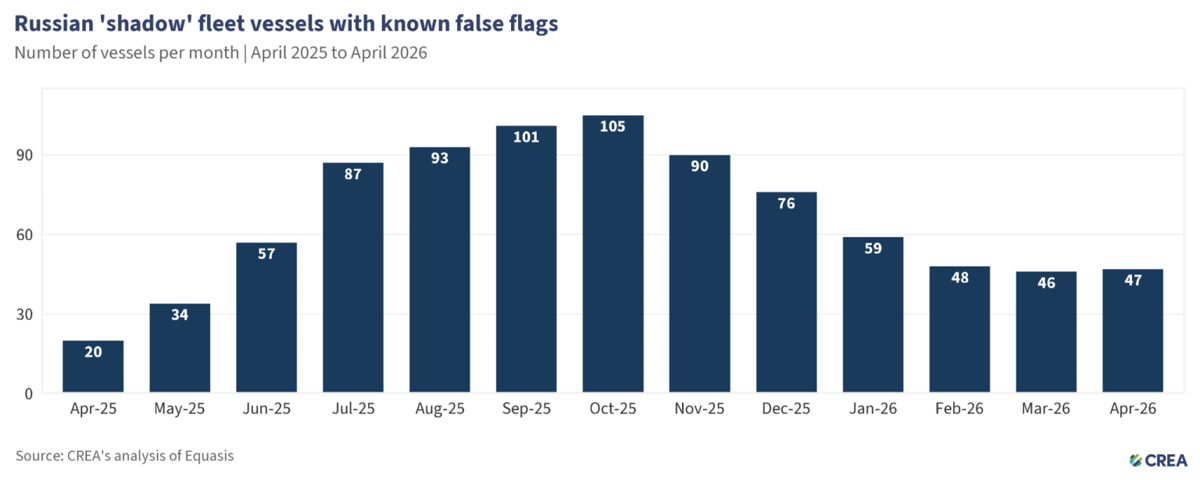
Also according to the report, last month the so-called “shadow fleet”, made up of sanctioned oil tankers, transported a record 54% of Russian fuel exports. At the end of the month there were 47 shadow ships under false flags: 16 had been inactive for over six months, while five active units delivered Russian crude oil and refined products for a total value of 236 million euros.
Markets and renewables
The conflict between Israel, the USA and Iran at the end of February 2026 caused Dutch TTF gas to soar by 68% in two days (52.8 euros/MWh) due to the blocking of flows from Qatar. However, the EU is less vulnerable than in 2022 thanks to a 14% increase in the share of renewables in the energy mix, which will generate an estimated saving of 5.8 billion euros in 2026. The benefits are not homogeneous: the cleanest markets (Denmark, Finland, France, Sweden and Slovakia) will save up to 8.5 billion, 58% more than fossil-dependent countries (Poland, Italy, Greece, Estonia and Netherlands). Spain and Portugal have halved their sensitivity to gas thanks to the solar boom (+74%), while the Netherlands remains tied to gas, Poland has doubled its vulnerability (+132% gas use) and Hungary suffers from insufficient infrastructure networks.
Who are the key customers
Analysis of data between December 5, 2022 and the end of April 2026 shows how Russian exports are concentrated in a few key customers. China is the top buyer of coal (37%) and crude oil (49%), while Turkey leads in refined products (26%). Europe, on the other hand, is the main market for natural gas, capable of absorbing 49% of total Russian LNG exports and 32% of pipeline flows, followed equally by China (30%) and Turkey (30%) for the latter.
China, India and Türkiye
April data confirms China as the top global importer with 7.3 billion euros (41% of the total of the top five countries). The purchases concerned crude oil for 5.5 billion, gas pipelines for 565 million, petroleum products for 528 million, LNG for 379 million and coal for 348 million. Despite a 24% drop in Russian shipping volumes to Beijing, imports of Sokol crude rose 36%, hitting a two-year high. Additionally, the Dalian refinery resumed processing Russian crude for the first time since September 2025.
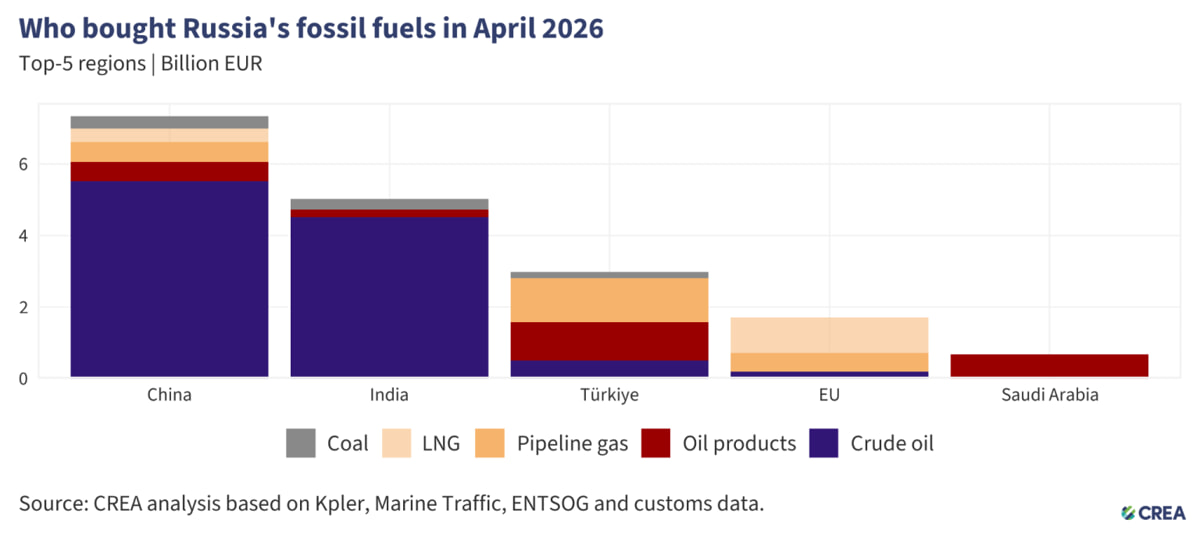
Second, however, is India, with 5 billion euros in total, of which 90% in crude oil (4.5 billion), followed by coal (297 million) and petroleum products (209 million). The monthly import of Russian crude fell by 19.4% due to maintenance at the Vadinar refinery, whose landing of Russian crude fell by 92%. Jamnagar also saw a 38% decline, while the state-run IndianOil plant in Vadinar grew 87% and refineries in New Mangalore and Visakhapatnam resumed Russian purchases. At the lowest point of the podium we find Turkey, which imported Russian fossil fuels for a total of 3 billion euros. The largest share is represented by gas with 1.2 billion (41%), followed by petroleum products with 1.1 billion, crude oil with 505 million and coal with 169 million. Turkish imports of Russian crude by sea recorded a decline of 18% on a monthly basis, in a context of a general decline of 26% in maritime flows to the country.
European buyers
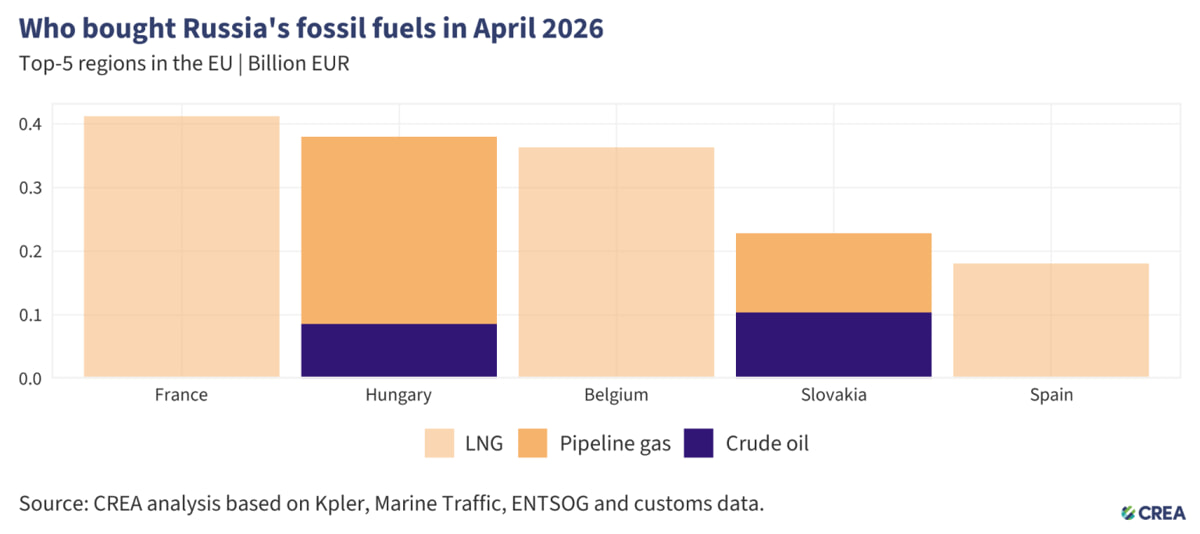
And Europe? The EU is in fourth position with 1.7 billion euros of expenditure, made up of 88% by natural gas (957 million in LNG and 419 million via pipeline) and 11% by crude oil. LNG purchases remained high despite the ban on REPowerEU spot markets, although the EU share fell by 8% due to the halving of Spanish imports. Overall, the top five EU importers paid 1.6 billion to Moscow: Slovakia imported 228 million (divided between pipeline and crude oil via Druzhba) and Spain 181 million (entirely in LNG, -56% on the previous month). Within the European bloc, Belgium positioned itself as the third largest importer overall for the month, purchasing Russian LNG worth 363 million euros, a strong growth of 33% on a monthly basis.
The Arab market
In fifth position is Saudi Arabia with 683 million euros, spent entirely on refined petroleum products of Russian origin. All fuel cargoes were unloaded at the country’s western ports, excluding any transit of Russian products headed to Saudi ports via the Strait of Hormuz.