

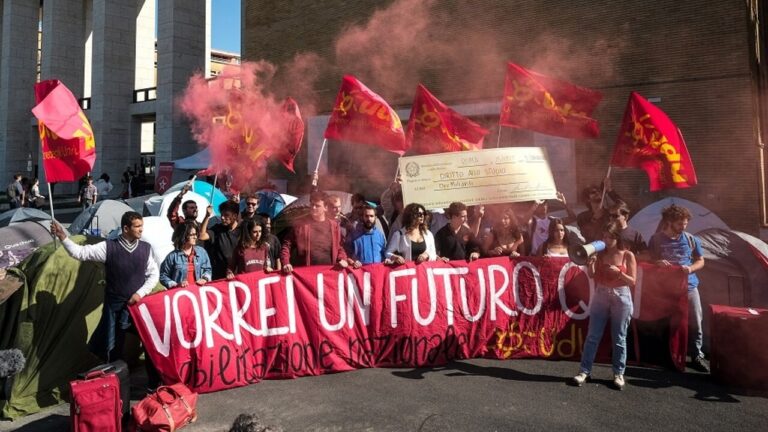
Improvised camps and a simple slogan: “I would like a future here”. With these words, the university protest against the high rents that are eroding the right to study of young Italians began again in 2023. Three years later, the same requests have become more urgent in the Italy of high prices. A protest that leads to the streets, but which arises from the daily experience of many students and their families, literally forced to bend over backwards to guarantee a higher education for their children.
From Padua to Bari: this is how rental costs have exploded in eight years
To realize this, we took into consideration the rental prices in the major Italian university cities, according to the prices prepared by Immobiliare.it. The increases per square meter are significant and (almost always) higher than the national average.
In many university cities, house prices have undergone a real explosion. This is the case of Padua, for example, a true university center in the North-East. Here the cost of rent has risen by over 56% in just eight years. Despite the evidence that most students rent a room, to get an idea of the price increases we can do a small simulation. If we rented a small 40 square meter studio apartment today, we would find ourselves paying approximately almost 2,500 euros more per year compared to 2018.
Where the rent doesn’t eat up your salary: here are the Italian cities that are still cheap. By Daniele Tempera
A phenomenon that is uniform throughout Italy, from North to South. In Bari rents increased by over 60% in the period considered, in Lecce by 53%. In Cagliari today we would pay around 2200 euros more for our 40 square meter studio apartment than eight years ago, while in Palermo we need to budget 1500.
Costs which have an impact on the expenses incurred by families and which also seem to rise due to the boom in so-called short-term rentals on platforms such as Booking and Airbnb. And both the provinces and the large centers are affected. In Perugia, a city which today has almost 30 thousand university students, the price of rent has risen by 45%. In large cities such as Rome, Naples and Milan, we have to budget over 2 thousand euros more per year for our studio apartment compared to eight years ago. Costs that convince many to enroll in online universities which are experiencing a real boom in students (+83.2% in enrollments between the academic years 2019/20 and 2024/25).
The Tolc and the uncertainty of university campuses
However, those who decide to enroll in a traditional university and choose a course with limited access may have to deal with the so-called “Tolc”, an acronym which stands for Test Online Cisia. The latter is the Interuniversity Consortium for Integrated Systems for Access, which has been organizing them since 2012. Also used in open access courses, the tests are thematic: below you see the disciplinary areas in which they are applied.
The operation involves two distinct steps: taking the test and submitting an application to the university. First, the student consults the notice of the course he is interested in, to find out which type of TOLC is required, then he registers on the Cisia portal, chooses a date and takes the test on the computer, at the university or from home, when permitted.
The result does not automatically assign a place and there is no single national TOLC ranking. However, the score can be used to apply to multiple courses or universities that accept that test, respecting the respective calls: each university establishes the validity of the result, thresholds, deadlines and selection criteria. And this is where, for some students, things get complicated. Those who submit multiple applications may find themselves waiting for rankings and scrolling with different calendars, without knowing until the very end where they will be able to get in. If the available place is far from home, choosing to accept it may mean arranging the move in a few days, looking for a room when lessons are about to start and many of the cheaper accommodations are already occupied.
Poverty, low wages and a social elevator that has been stopped for 20 years: this is how young people have paid (more than anyone else) the price of the crisis. By Daniele Tempera
On social media, for example, a girl who would like to move into a house in Turin with a friend while waiting for the admission ranking writes: “The rankings come out on September 21st and lessons start on October 1st. How can we get a three-room apartment together since she isn’t sure about returning to university?”.
“I should get my Tolc-e in about ten days. I would like to enter the University of Bologna in business economics? In addition to business economics, should I select another similar course to have a better chance of getting in? If so, which course would you recommend?” instead asks another student who has already rented a house in the Emilian capital. Because, once inside, you often encounter a problem common to many.
University students: the Italian exception and the role of large real estate funds
If the great Italian shortage is called public housing, university residences are no exception. In 2023 in Italy there was one bed in student dormitories for every 24 university students, as indicated by a report by “Scenari Immobiliari”. We are talking about 4.1% of those registered, compared to 10.4% in Germany, 12.8% in France and 24.3% in the United Kingdom. And it is precisely the lack of accommodation, combined with high rents, that has caused the student protests to explode and attract large financial and real estate funds.
According to an analysis by Colliers, a global multinational real estate services and consultancy company, in Italy investments in student residences reached approximately 520 million euros in 2025, 63% more than the previous year, absorbing more than half of the investments in the residential “living” sector monitored by the company.
The case of Aparto Giovenale in Milan shows this pattern well. The student residence, with approximately 600 beds, was developed by Hines, an international group active in real estate investments and development, in partnership with Blue Noble. In March 2023 the Antirion Global-Hotel sub-fund, managed by Colliers global investors Italy Sgr and entirely subscribed by Enpam, the social security fund for doctors and dentists, purchased all the shares of the Living 2.0 fund, owner of the structure. The management of the student residence remained with Aparto, the student housing platform of the Hines group.
An example that shows how development, real estate investment and management can be the responsibility of different subjects: the investor changes, while the specialized operator continues to manage rooms and services.
Also in Milan, the former Olympic Village built by Coima Sgr, a company specialized in investments and management of real estate assets, officially opened to students in September 2026, becoming the largest affiliated student residence in Italy, with 1,698 beds. A project presented as a model of collaboration between public and private. But affiliated does not necessarily mean cheap: in the structure’s information material, an ordinary single is offered at 1,095 euros per month, VAT and services included. There are also discounted rates, but for those who pay the ordinary rate the cost for a single exceeds 13 thousand euros per year.
From Florence to Rome: who invests in student residences
Florence and Bologna also attract large amounts of capital: the French investment company Ardian and the Dutch real estate operator Rockfield have announced the purchase of a student residence in Novoli, Florence, with 404 beds, in November 2024, and that of via Serlio, in Bologna, with over 500 places, in March 2025. The acquisitions are part of a European strategy supported by Cbre investment management, a global real estate investment management company.
In Rome, The social hub, a Dutch group specializing in hospitality and student accommodation, has transformed the area of the former Dogana di San Lorenzo into a complex with hotels, university accommodation and coworking, with a declared investment of over 114 million euros. The group’s investors include APG, a Dutch pension asset manager, and GIC, a Singaporean sovereign wealth fund. In May 2026, a single room could cost 1,482 euros per month: an expense that is difficult for many university students to afford.
These are examples that show how the demand for student accommodation attracts real estate funds, pension capital and other institutional investors. And the role of the State in some of these operations is also what makes the students’ anger explode.
Public funds, private business: where did the Pnrr money go?
The Pnrr has allocated approximately 1.2 billion euros to increasing university accommodation, with the aim of creating 60 thousand new beds. It was mainly private individuals who benefited from the funding: according to the Agnelli Foundation’s monitoring published in December 2025, 83% of the funding was attributed to them, compared to the 17% allocated to public entities. The support includes contributions of around 20 thousand euros for each new position activated, in exchange for restrictions on the use of the properties, reduced rates compared to the market and a quota reserved for less well-off students.
20% of Italian teachers for foreigners in schools have been cut: “This is how we teach with Google Translate”. By Daniele Tempera
For private operators, the public contribution is added to the fees paid by students and financially supports the activity. In exchange, the State receives housing at subsidized conditions, while the property can remain privately owned. Everything’s fine, then? Not necessarily.
Increasing financed supply does not automatically equate to creating affordable housing. The system provides for a reduction in rates compared to the average market value, calculated taking into account the location, the characteristics of the property and the services offered. But in cities where living costs more, even a discounted price can remain out of reach for many university students.
For example, to access the student residence in the Scrovegni area of Padua, managed by the Camplus Foundation, for the 2025/26 academic year it was necessary to budget up to 850 euros per month for a single room. In Rome we found prices for singles starting from 700 euros, but almost a thousand euros in the centre, where even a place in a double room can cost 700 euros per month per person. In Milan, however, a single woman in a student residence receiving Pnrr funds can exceed 900 euros a month.
Prohibitive figures for many students, even considering the benefits provided for the most disadvantaged groups. And the risk is that, in one of the countries with the fewest graduates in Europe, university education will increasingly turn into a privilege.
Dossier is the exclusive subscription investigative section of The Vermilion. If you want to support our journalistic work and subscribe, Click here.