


“We will dismantle the Fornero law.” The newly elected secretary from the stage of the extraordinary congress of the League Matteo Salvini he had promised to send the former Labor Minister’s much-hated pension reform to the attic Elsa Fornero. The objective is to “leave the possibility of retiring at 64 years old” compared to the 67 years and 1 month expected from 2027. A few days later, on 28 October, the mountain gave birth to the little mouse: the maneuver 2027 approved by the Council of Ministers provided for an early retirement fund without specifying any details. It is only the latest attempt to return to a pre-2011 crisis system, with the hope of ensuring a working future for young people.
The Fornero reform
The so-called Fornero reform was launched with decree law 201/2011 (later converted into law on 22 December of the same year) by the Monti government. A provision written in less than three weeks which provided for savings of around 88 billion euros in the decade 2012-2021. All at the cost of progressive tightening of retirement requirements with the consequence, among other things, of postponing the starting date of the pension compared to the previous situation. The measure generated hundreds of thousands of redundancies, i.e. those workers who in various ways had reached agreements to leave their jobs early, but who suddenly found themselves without salary, allowances or pensions due to the Fornero law.
Since then, governments have enacted nine safeguard measures to help specific groups of workers. According to a 2016 study by the Parliamentary Budget Office, in the seventh safeguard, the exoduses who would have had access to the “rescue” measures were 172,466. The measures, again according to the parliamentary office’s calculations, resulted in a total expense of just over 11.4 billion euros, eroding the savings expected from the Fornero reform by around 13 percent by 2021.
The proposals of the Democratic Party
From Fornero onwards there has been a flurry of legislative proposals that promised to guarantee early retirement and, in some, a generational change in the labor market. Measures passed through parliamentary commissions, approved but expiring or even just presented. The latter is the case of the proposal of the PD deputies Cesare Damiano, former labor minister, Pier Paolo Baretta, future undersecretary of the Economy, and Donata Lenzi, submitted to the Chamber for examination on 18 November 2011, just two days after Monti took office as prime minister.
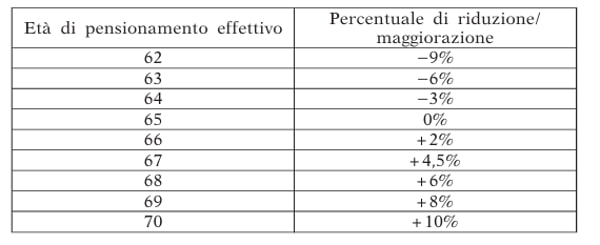
The measure allowed an exit starting from 62 years of age with the possibility of working up to 70 years of age and contextual disincentives and increases. Just a year and a half later, with Enrico Letta as prime minister, Damiano and Baretta presented a similar proposal with more detailed increases and reductions compared to the 2011 project.
The generational relay
Under the government of Matteo Renzi, from February 2014 to December 2016, the measures under discussion multiplied also due to the Jobs act. In this period, the protagonism of the then INPS president Tito Boeri (2014-2019) was also noted. It is he who rejected, in a public statement, the new device submitted by Damiano and Baretta which aimed to bring forward retirement by up to 4 years, with a cut of two percentage points for each year: “There would be an annual deficit of up to 8.5 billion”.
A similar evaluation is reserved for the 100 quota calculated, in different ways, by the Democratic Party (Damiano and Maria Luisa Gnecchi) and by the Northern League (Emanuele Prataviera). According to the INPS president it would be “the return to retirement pensions for an estimated cost of 10.6 billion in 2019”, which would burden young people.

The “generational relay” of the Minister of Labor of the Renzi government, Giuliano Poletti, will have a different fate, i.e. the attempt to accompany older workers towards retirement while simultaneously facilitating the entry of young people. Boeri opposed his “no” because he considered it a “very expensive and distorting” operation. For the INPS president it would have been better to entrust the turnover to decentralized bargaining. Poletti’s idea was to replace part of the people who retire with the entry of young people into the job market. The measure was diluted in some paragraphs of the 2016 budget law and in two articles of legislative decree 148/2015. The sector funds were given the possibility of disbursing extraordinary allowances to support the reduction in the hours of older workers in the face of new hires aimed at those under 35. The specific provision that allows the funds to finance social security contributions for those close to retirement, in connection with the hiring of workers up to 35 years of age, however, only arrived in 2022, during the Draghi government.
Quota 100 & Co.
However, before there was the 100 quota introduced with the yellow-green government of Conte I, supported by the Lega and the 5 Star Movement. The measure allowed early retirement from work to those who reached 62 years of age between 2019 and 2021 with a minimum contribution period of 38 years. The benefit, according to the 2023 INPS annual report, was exploited by 432,888 workers: almost 380 thousand left in the three-year period 2019-2021, another 51 thousand in 2022 and 2,498 in 2023. In a study by the parliamentary budget office and INPS in 2022, actual final expenditure was estimated at around 23 billion euros.
Once expired, quota 100 was replaced by a less generous version, quota 102 (64 years of age and 38 of contributions), which had an even shorter life: it was valid only for 2022. Then quota 103 was introduced in 2023, lastly renewed by the 2025 budget law. The measure allowed early retirement with 62 years of age and 41 of contributions. In all of 2023, there were 23,249 pensions paid with a quota of 103. In 2024 the executive restricted the requirements and consequently the beneficiaries decreased: just 1,153.
The last maneuver Meloni
On 28 October the government presented the 2027 budget. Compared to the plans to “dismantle the Fornero law”, the result was a fund of 850 million intended to strengthen the exit flexibility of those who access pensions with the contributory system. But the contours of the measure have yet to be defined. In particular, parliament or the government will have to establish the beneficiaries and the methods for accessing them.
The League aims to allow retirement from the age of 64 even to workers who currently cannot access the channel reserved for pure contributors. But the advance could result in a lower allowance, especially in the case of a fully contributory recalculation for those who have also accrued a salary portion. Costs complicate the picture. In September, Undersecretary of Labor Claudio Durigon had hypothesized spending of around 1.5 billion euros per year for the new flexibility. The 850 million announced by the government therefore represent only a starting point, as Durigon himself recognized after the approval of the measure.
The measure was rejected by Fornero herself in an interview with La Stampa: “It is not a structural reform, but people make people believe that it is. It is yet another short-term idea by a gentleman hunting for votes”, he declared, referring to Salvini. “So he can say he has dismantled the Fornero law, even if only for a year”, he added.
The theme of generational turnover remains in the background, which has long been used to justify early retirement proposals. The possibility of leaving work early is presented as an opportunity to encourage the entry of young people, but there is no automatic mechanism whereby every retirement produces a new hire. It is one of the issues that future regulations will have to address, together with economic sustainability and the adequacy of pensions.
Dossier is the exclusive subscription investigative section of The Vermilion. If you want to support our journalistic work and subscribe, Click here.