

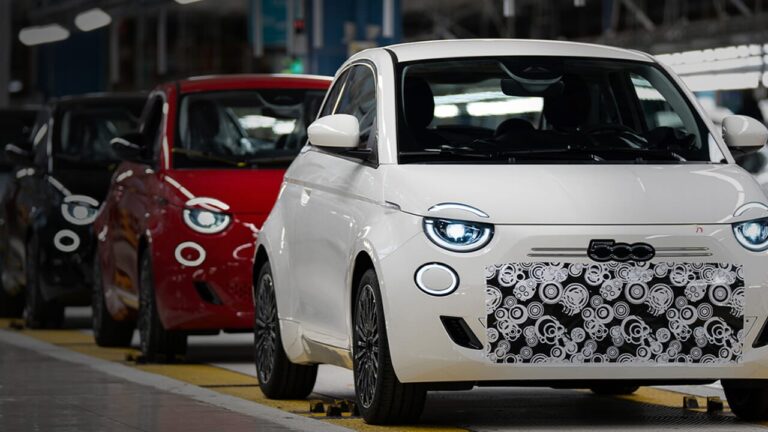
The redundancy fund returns to Mirafiori. Stellantis has communicated to the union representatives of the Turin plant a new suspension of production on the electric and hybrid Fiat 500 line, scheduled from 19 to 30 October. The measure will affect 1,074 body shop workers: 934 workers and 140 employees. The decision came after an internal meeting called to take stock of the production difficulties of the plant. A new setback despite, underlines Stellantis, the investments made and the doubling of volumes compared to last year. At Mirafiori, at the end of 2025, production of the new 500 hybrid began, alongside the electric version, and according to Stellantis, more cars left the Turin plant in the first half of 2026 alone than in the whole of 2025.
“We are facing a complex situation” explains a spokesperson for the group. Stellantis recalls that it has been engaged for over a year and a half in a plan to strengthen its industrial presence in Italy, with over twenty models produced in the country and others on the way. But the relaunch, the company claims, clashes with a European car market that is still smaller by about a fifth compared to the period before the pandemic and with pressure from non-EU producers. Among the problems indicated by the group is above all cost competitiveness. Stellantis returns in particular to point the finger at the price of energy in Italy, claiming that its reduction would also allow the costs of the cars produced in Mirafiori to be lowered.
Stellantis: “Italy must align energy costs with Spain and France”
“We are carrying out a dialogue with national and local institutions to ask for an energy cost aligned with that of other European countries such as Spain and France, but still, also due to the difficult geopolitical context, we have not seen any concrete benefits” they say from Stellatis
According to Stellantis, the increase in car prices is also weighing on demand. New cars have become less accessible, especially for middle-class families and young people. The problem particularly concerns small cars, which are most affected by both the increase in industrial costs and the so-called regulatory costs, i.e. those linked to compliance with the new requirements established by the law.
However, the return to layoffs in October signals that the recovery of volumes is not yet sufficient to guarantee full production continuity of the plant.