

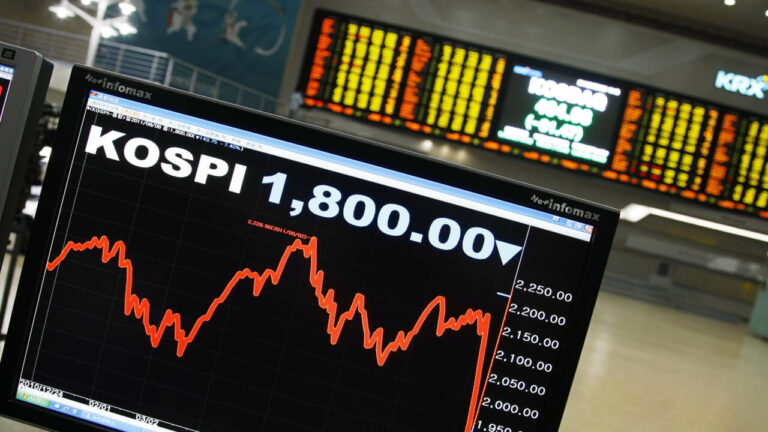
Song Mi-kyung is a 60-year-old saver who lives in Seoul. His stock portfolio had gained about 300 million won, 200 thousand dollars, riding the artificial intelligence boom. It is now at a loss of 60 percent. His is one that says a lot about the “ants”, the small Korean investors, now faced with the biggest stock market collapse in 50 years. The Kospi index has lost more than 17% and since the historic high reached in June it has burned almost 40% and around 2 trillion dollars in capitalisation: it is the worst month in its history.
Why the South Korean stock market collapsed
In Seoul, panic gripped the markets. The reason is to be found in the giants Samsung and Hynix, the two Korean champions of memories for artificial intelligence systems. Together they are worth half of the Kospi stock index. News of the limited supply of advanced chips has fueled questions about the sustainability of US technology groups’ huge investments and memory makers’ bumper margins, as well as competition from China.
Despite the extraordinary industrial results, the two stocks closed in negative territory. But the decline turned into a disastrous market collapse. Attracted by the earnings of these sectors (+75% in the last year), many savers got into debt and bought 2x leveraged ETFs “linked” to Samsung and Hynix on credit. They work like this: if the stock rises by 2 percent, the 2x leverage transforms the growth into 4 percent and so on. But the same thing happens in the opposite direction and so a loss like that of Samsung (-13 percent) turns into a -26. In one day. According to the brokerage firm Korea Investment & Securities, almost half of the 880 thousand customers who had purchased Samsung and almost 70% of the 408 thousand exposed to Hynix are now at a loss.
How the “ants” got into debt: evaporated earnings and debts
Lee Seung-ho, a 24-year-old student, had transformed the 20 million won – around 12,000 euros – saved during his military service into almost 300 million, the equivalent of over 182,000 euros. Attracted by the possibility of new earnings, the boy pressed the button in the app of his brokerage service to invest up to five times his capital.
Four weeks of market fluctuations wiped out his small fortune and also brought the account below the initial sum. “I literally couldn’t breathe,” she told Reuters during the interview carried out in a studio apartment described as “tiny”. With the new funds he wanted to buy a new apartment. For many young people, leverage seemed like a shortcut to home ownership: on average, it takes about fourteen years’ salary to buy an apartment in Seoul.
Financial gambling addiction, not just South Korea: in the USA, leveraged ETFs are now worth almost 200 billion dollars, while margin debt, i.e. the debt contracted to buy securities and amplify profits (and losses), in May was equal to 1,400 billion dollars, +54%… pic.twitter.com/RYTeIxkWqw
— Mario Seminerio (@Phastidio) June 29, 2026
The phenomenon does not end with these cases. At the end of 2025, there were over 110 million active trading accounts, approximately two for every inhabitant. Debt securities reached the figure of 38,630 billion won, approximately 23.4 billion euros. Liquid assets in portfolios went from the peak of 84.8 billion euros to the current 64.99 billion euros.
How Andrea Pignataro became the richest man in Italy (with billions in debt)
“The losses are increasing day by day. I’m really stressed. I don’t know what to do,” she told the Financial Times Song Mi-kyung, the 60-year-old saver who pocketed a profit of $200,000 thanks to leveraged instruments. “I have never seen such rapid declines, not even during the Asian financial crisis. I stand to lose all the gains I have made this year.” In broker chats, stories of losses of 70-80% are multiplying. “When will I be able to get out of this hell?” asks an investor after seeing his ETF lose 65%.
In South Korea, these savers are called “ants”: small investors compared to large national and foreign funds, but very numerous and capable of shifting the balance of the market when they move together. The nickname dates back to the stock boom of the late 1980s and only more recently has it come to symbolize massive popular participation in the Korean stock market.
What the government is doing
The Finance Minister, central bank governor and financial regulators said in a statement that investments in these funds had “amplified market volatility.” During an emergency meeting after the stock market crash, Finance Minister Koo Yun-cheol and the supervisory leaders apologized for the too hasty authorization granted to leveraged instruments.
It was worth 15 billion, now it is collapsing: the first large company overwhelmed by artificial intelligence
Now, their access is limited: starting July 31, the minimum cash deposit rises from 10 million won to 30 million won, with new listings and advertising having been suspended. It will be possible to subscribe to such instruments up to a ceiling of 20 percent of the individual portfolio. Meanwhile, the Bank of Korea has also warned of growing risks from household indebtedness. And for many analysts, the AI bubble has not yet burst.