

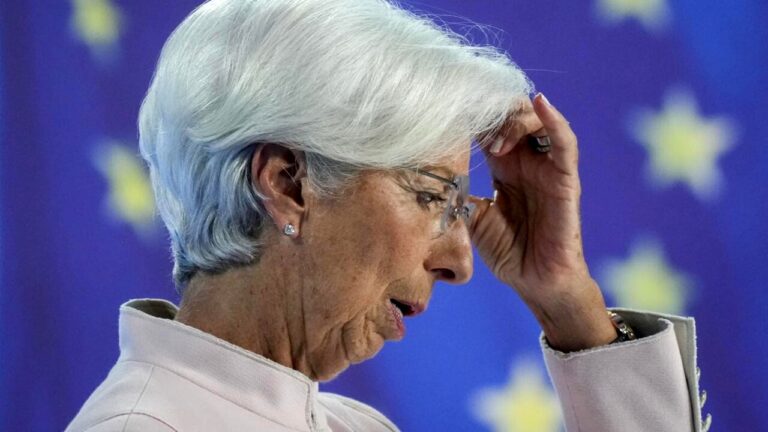
The European Central Bank is once again raising interest rates. The Governing Council decided today to raise the ECB’s three key interest rates by 25 basis points. Therefore, interest rates on deposit facilities, main refinancing operations and marginal lending operations will be raised to 2.50%, 2.65% and 2.90% respectively, with effect from 16 September 2026.
A scenario similar to that of 2022
The decision was widely anticipated by the markets, but it nevertheless marks a delicate transition. For the second time in 2026, Frankfurt chooses to make money more expensive in an attempt to contain a new acceleration in inflation. Above all, the energy crisis changed the scenario: oil returned above 100 dollars a barrel, while the price of European gas reached levels not seen since the end of 2022.
The ECB thus finds itself faced with the same dilemma that already emerged after the Russian invasion of Ukraine. What causes price growth is not excess demand, on which rates can intervene directly, but an external shock that increases the cost of energy, transport and production. Raising the cost of money does not lower the price of oil or gas. However, it can prevent increases from being transferred stably to the rest of the economy, fueling wages, price lists and inflation expectations.
However, the price of this strategy risks being paid by families and businesses, especially in a country like Italy, characterized by weak growth and a production structure largely composed of small-sized businesses.
The heavy impact on variable rate mortgages
The most immediate consequence concerns those who are repaying a variable rate mortgage. According to a simulation by Facile.it, for a standard loan of 126 thousand euros lasting 25 years, subscribed in January 2026 with an initial nominal rate of 2.70 percent, the monthly installment could increase by around 17 euros, going from the current 614 to 631 euros.
The increase may seem limited, but it adds to the increases already accumulated during the year. In January the installment of the same loan was equal to 578 euros: after the latest intervention by the ECB it would therefore cost 53 euros more per month, for an increase of over 630 euros on an annual basis.
And the race may not be over yet. The futures contracts updated to the first week of September predict that the three-month Euribor, the main reference for variable mortgages, could go from the current 2.67 to 3.10 percent by June 2027. If the scenario were to come true, the installment taken into consideration would exceed 650 euros per month.
However, the direct impact will affect a minority of new borrowers. In the first eight months of 2026, the fixed rate represented 93 percent of requests. However, the share of those who chose variable has started to grow again, going from 1 percent last year to 7 percent. Many families had probably bet on the definitive end of the monetary tightening and on a subsequent fall in the cost of money. A prediction that the new energy crisis has called into question.
In the same period, the average amount required to purchase a house rose to 139,599 euros, 1.6 percent more than in 2025. The loan covers on average 74 percent of the value of the property, equal to approximately 206 thousand euros. However, the average age of applicants has decreased, going from 40 and a half years to 39 years.
The effects of monetary tightening on small businesses
The monetary tightening risks producing even more significant consequences on the production system. Confesercenti estimates that, if the increase in rates were transferred entirely from banks to loans, the additional burden for businesses with fewer than 20 employees could reach a total of 460 million euros per year when fully operational.
The evaluation takes as reference approximately 93 billion euros of credit currently outstanding. However, the increase would come in an already very difficult situation for smaller companies, which typically pay higher interest than larger companies and face greater obstacles in obtaining new loans.
The problem, in fact, does not only concern how much the credit costs, but also how much credit is actually granted. Between January 2019 and June 2026, the stock of loans to small businesses decreased by 28 billion euros, with a contraction of 23.4 percent. In the same period, loans to all Italian companies fell by only 2.9 percent.
The reduction continued this year too. In June, loans to businesses with fewer than 20 employees were 4.1 percent lower than twelve months earlier, after the 4.8 percent decline recorded in 2025. The increase decided by the ECB could therefore accentuate a selection already underway: banks could become even more prudent and the most fragile companies could give up investing or be excluded from the credit market.
The risk is that Italy will be caught between two opposing forces. On the one hand, the rise in energy prices reduces the purchasing power of families and increases the costs of companies. On the other hand, higher rates make mortgages, loans and investments more expensive. Both phenomena have a real impact on demand and growth.