

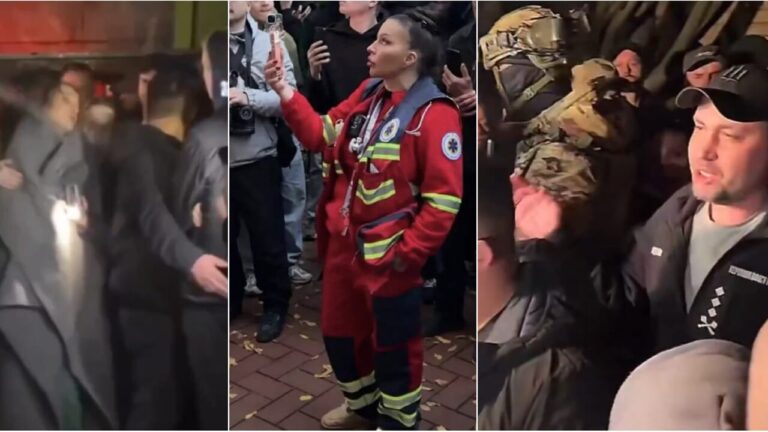
An aesthetic medicine entrepreneur who does live broadcasts on TikTok, an ambulance with the insignia of a clinic closed for three years, dozens of alleged prisoners tortured in a house on the outskirts of Kiev. And then a 14-year-old boy, wrapped in a thermal blanket, presented online as a victim of “Zelensky’s torture chambers”. It sounds like the plot of a grotesque film and the story will probably be revived as evidence of alleged prisons for Ukrainian defectors. But reconstructing the facts, the picture that emerges is very different from the one circulated on social media.
So let’s start with the facts. On November 2, in Petropavlivska Borshchahivka, a village on the outskirts of Kiev, a clash occurred between civilians who gathered near a building guarded by soldiers of the Ukrainian National Guard after rumors spread about the illegal detention of some defectors. News that would have initially been spread by a woman who introduced herself as the owner of a private ambulance company called “Med-Prestige”.
Fake news on social media
Alarming news is circulating on Telegram channels and live TikTok broadcasts: around 40 men are reportedly locked up in a private house and subjected to torture. There is talk of people beaten to death, of a man with a broken spine and even of a dead man. A private ambulance arrives on site. A woman who introduces herself as a doctor and owner of the Med-Prestige clinic reports that she cannot reach some of the injured. It claims at least four people need urgent treatment and one of them has been detained for more than a month. The complaint fuels the protest. Hundreds of messages bounce around social media and a crowd gathers in front of the building, including family members of the soldiers. But who is the woman?
The woman who claimed to run Med-Prestige was identified as Valentyna Moloda, a 49-year-old employee of a plastic surgery clinic. The ambulance itself was fake: the car had been sold by Med-Prestige as explained by its owner, Mykhailo Furman, after the company had ceased operations in 2023. The vehicle had been sold in 2024 with the requirement to remove the company logos. Which was not followed up on.
Very quick update: for those who haven’t seen, the so-called “private medic” telling all about alleged beatings inside the house is not who she says she is. She is a plastic surgeon. The company claimed to represent stopped work in 2023, and sold this ambulance the next year. https://t.co/cmY5RFPJHx
— Francis Farrell (@francisjfarrell) November 3, 2026
Law enforcement officers found evidence on the woman’s phone that suggested the incident had been pre-planned. Moloda itself was involved in a pro-peace protest in early October. The building had not been chosen by chance: it was a temporary holding point used by the National Guard and in one by the Azov battalion.
Inside there were both recently mobilized soldiers, waiting to be assigned to departments and to be sent for training, and deserter soldiers who had left their units without authorization.
The tension explodes
While the crowd called for the release of the men, the situation degenerated: police cars damaged, windows broken, a bus attacked. Gunshots were heard during the clashes. And the most manipulated video also appears: a boy who says he is 14 years old is escorted out of the building. He is wrapped in a thermal blanket, scared and disoriented. On social media the images are spread with a chilling reconstruction: he would have been found in a secret prison, detained with the men who evaded the draft and beaten with a shovel. However, other videos, prior to its release, tell another story. The boy was among the people who came to the protest. Footage reviewed by Ukrainian journalists shows him on the fence shouting insults and threats at those inside. Then it climbs over the wall and ends up in the perimeter of the structure.
The leaders of the National Guard and Kyrylo Budanov, head of the Ukrainian president’s office, intervened on site. On November 3, Human Rights Ombudsman Dmytro Lubinets asked law enforcement to investigate all aspects of the incident, to ascertain the legal basis for the presence of military personnel and members of the National Guard in the building, and to evaluate the actions of all those involved.
Budanov said the incident should not be viewed solely as the result of a provocation, adding that it revealed broader social tensions and unresolved problems. One thing is certain: in Ukraine compulsory mobilization is real, as are reports of abuse and violence against men called up to arms. But the story of the fourteen-year-old kidnapped and tortured in a secret prison is false.
Meanwhile, Russian bombs caused a new massacre in Komyshuvakha where at least 33 people died while they gathered in a school to receive humanitarian aid. Another 50 are missing.
The death toll from Russia’s massacre in Komyshuvakha continues to rise. 30 people, who had gathered at a school to receive humanitarian aid, have now been confirmed killed, a further 48 are listed as missing. https://t.co/RcpDlZ8Zub
— Jimmy Rushton (@JimmySecUK) November 3, 2026