

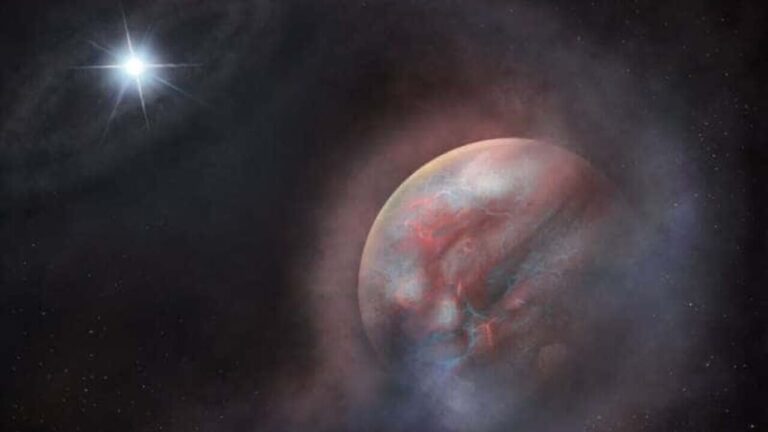
Most planets – including Earth – are destined to disappear one day, consumed by their own Star in the expansion that characterizes the last phases of its life cycle. Around HS 0209+0832, a white dwarf located 270 light years from us, something completely opposite is happening: in its last eons of life, the star has in fact given life to a new planet, fueled by the “ashes” of the dying star. A phenomenon still never observed to date, which was described by a team of researchers led by the University of Warwick, in a study just published in Nature Astronomy.
The discovery comes from an authentic stellar archeology investigation. HS 0209+0832 is what remains of a star that has consumed its nuclear fuel: a white dwarf, that is, the extremely compact core that remains after a low-mass star has expelled its outer layers into space. And it is by observing its atmosphere that astronomers have found something unusual.
What aroused their interest was its chemical composition. In the light coming from the white dwarf, in fact, there appear indications of an anomalous quantity of heavy elements such as zinc, copper and above all niobium, an element present at levels more than a thousand times higher than what occurs with the Sun. These are elements produced through the so-called s process, a series of nuclear reactions that occur in stars during the advanced stages of their evolution, when they transform into red giants.
For astronomers, this is a rather unusual chemical signature. The material that is falling on the white dwarf does not in fact resemble the normal rocky remains of a planet from the original star system, rich above all in elements such as silicon and iron. It is instead compatible with matter expelled from the same star during its expansion phase. Hence the hypothesis: a new disk of gas and dust would have formed around the white dwarf from the layers expelled from the star, which would have given rise to a planet with a unique chemical signature.
This would make the planet a true cosmic “phoenix”: not a world that survived the death of its star, but a planet born after the end of the original star system, using the very material that the star had expelled. Astronomers call these objects “second generation planets”, to distinguish them from conventional planets, which formed at the same time as their star from the primordial protoplanetary disk.
Data collected by NASA’s TESS satellite also reinforces the scenario. In fact, a periodic signal of approximately 4.4 days was identified in the photometric data of the star, compatible with a large planet in a very narrow orbit around the white dwarf. The study interprets this variation as possible thermal emission from the planet during its orbit or as the signal produced by a tail of material generated by its evaporation.
The world just identified, in fact, does not live in ideal conditions. The white dwarf is still extremely hot, with a surface temperature of around 35,800 degrees, and hits the planet with very intense radiation. The atmosphere of the gas giant would be slowly evaporating: part of the material would escape from the planet and then fall back onto the white dwarf, explaining the particular chemical composition observed by astronomers.
A suggestive hypothesis, especially considering that in about five billion years the Sun will also enter the final stages of its evolution, transforming into a white dwarf after having expelled its external layers. Earth and the other inner planets will likely not survive this transformation unscathed. But the discovery of the “phoenix” of HS 0209+0832 suggests that the history of a planetary system may not necessarily end with the death of its star. From its ashes, in conditions yet to be understood, a new generation of worlds could even begin.