

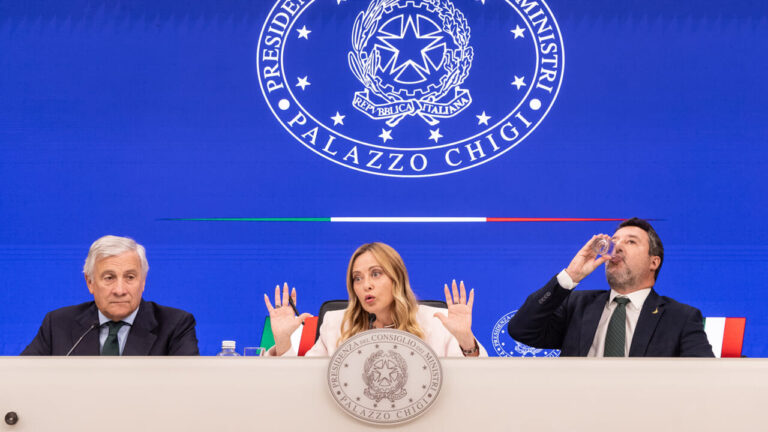
The decree is called “Urgent provisions for economic support and the containment of the effects deriving from the continuing increase in the cost of fuel, as well as in tax matters”, but there is much more inside. Inside, beyond the cut in excise duties on fuel, we find the celebrated exemption – and not abolition – of stamp duty, the filling of the budget hole of the Milano Cortina Foundation and the postponement of the tax on mini parcels. To finance all this, more than 3 billion euros are needed, a figure that makes the measure among the most expensive of the year. How did Giorgia Meloni find these funds? The answer is in an acronym: Pnrr.
The government’s catch-all decree: costs
The first measure of the decree extends the reduction – at different levels – of the excise duty on diesel until 5 October and costs the State 111.8 million euros in 2026, with further effects of 1.2 million in 2028. Another 21.2 million are instead used to extend the intervention planned for road transport until October.
Article 2 instead introduces exemption from road tax expiring between 1 January and 31 December 2027 for a single petrol or diesel car, including hybrid, with a power not exceeding 80 kW. For motorcycles and mopeds the relief operates under the conditions established by the decree. Cost: 2.2935 billion euros, to be allocated to the Regions to compensate for the lack of tax revenue.
Then there are three other measures that weigh 478 million euros: an additional 288 million for university scholarships, 150 million transferred to the Milan-Cortina 2026 Foundation to plug the budget hole and 40.8 million euros to postpone the European tax on mini parcels.
The true cost of the stamp duty: 2.293 billion to be returned to the Regions
The cut in excise duties on fuel gives the decree its name, but the car tax is the most economically significant measure of the new decree against high fuel prices. It is worth 2.29 billion euros in 2027 alone. The stamp duty is a tax whose revenue enters the regional budgets and if it suddenly leaves the accounts, the Regions must be compensated for what they will not collect.
In general, there is uncertainty about the stability of the measure, which the government would like to make structural. For example, how much goes and to whom is not yet established: it must be defined by 31 March 2027 with a decree from the Minister of Economy, after consulting the State-Regions Conference. For autonomies, the application of the exemption also passes through specific agreements. But where do the funds come from for what is among the most expensive decrees approved by the government in 2026?
Where does the money come from for stamp duty, excise duties and everything else
The decree indicates total costs of over 3 billion euros: 611.8 million in 2026, 2.362 billion in 2027 and 38 million in 2028. The bulk comes from the Pnrr, with a total of 1.698 billion in “economies”: 200 million in 2026, 1.460 billion in 2027 and 38 million in 2028.
309 million then arrive from the Ministry of Economy and Finance, 270 million from the Fund for structural economic policy interventions, 128.7 million from the special current fund, 100 million from the “Patrimonio relaunch” fund of Cassa Depositi e Prestiti, 70 million from the Fund for non-deferrable needs and 24.3 million from higher revenues and lower expenses.
What does “economies” mean: the government has emptied the fund
As mentioned, the bulk came from the Pnrr. The “economies” from which the government has drawn are sums that the various ministries have not spent within the scope of the Plan because they were deemed unnecessary to achieve the objectives agreed with the European Commission. The Ministry of Economy collected them in a fund after ascertaining that “there are no legally binding obligations”.
The dossier of the Research Services of the Chamber and Senate explains that the sums remain temporarily in the Pnrr treasury accounts and can then be reassigned to “specific initiatives and individual interventions”, also by refinancing, remodulating or reprogramming expenses already foreseen by national legislation.
The government has practically emptied the fund. Approximately 70% of the billions have been recovered from measures that still have at least one objective to be achieved located in the tenth installment of the Pnrr which will not be evaluated by the EU Commission before the end of September. In fact, the formal request for payment with the reporting of the 83 remaining objectives will only be presented on 30 September as explained by the Minister of European Affairs Foti.
The “economies” of the Pnrr as a portfolio: the measures from which the government withdraws
The main reservoir from which the government has drawn to finance the decree is digitalisation: over 865 million euros come from here. Among the items, the largest is Piano Italia 5G, the measure to bring fast connection to uncovered areas: overall the decree establishes 289.1 million euros of savings on the measure, dividing them into 49.5 million in 2026, 201.6 million in 2027 and 38 million in 2028.
The second largest item is “Digital Infrastructure – National Strategic Hub”, which brings 179 million economies, all attributed to 2027. Added to these are 26.5 million from the migration to the public administration cloud and 55.8 million from the national digital data platform.
Another 78.7 million will arrive in 2027 from the 1 Giga Italy Plan and 65.8 million from the “Connected School Plan”. The first is the program to bring ultra-broadband networks to underserved areas, while the second aims at fiber internet connections in school buildings.
But the savings do not only concern digital: in between we also find 24 million euros from the renewal of the fire brigade’s vehicle fleet, 20 million from the projects presented by young researchers and 10.8 million for connections with the smaller islands. And again, 77 million come from the “Protection of the territory and water resources” component, which allocates funds to protect the soil, forests, water resources and biodiversity.
Over 400 million between waste, tourism and energy transition
In the economies reported there are over 300 million euros attributable to measures relating to the energy transition: 118.1 million come from the Fund for the creation of an integrated system of research and innovation infrastructures, 112.9 million from the construction and modernization of waste management systems, 97.1 million from the revolving fund for tourism businesses and 80.6 million from the “Green Ports” measure, i.e. renewable energy and energy efficiency interventions in ports.
Six out of 10 Italians have bought an SUV: the shock between petrol over 2 euros, car insurance and tax, what to do now
Among other items there are 44.3 million from the strengthened program for the renewal of the private and light commercial fleet with electric vehicles, as well as 18.5 million from the measurement of hydrogen production in abandoned industrial areas, both within the perimeter of RepowerEu.
Giorgetti: “Government and Parliament dispose of the funds as they see fit”
The funds allocated to cover the decree are therefore “national money” and no longer “European resources”. Economy Minister Giancarlo Giorgetti explains it firsthand in Dublin on the sidelines of the Eurogroup and the informal Ecofin. Consequently, the Italian government and Parliament dispose of it “as they see fit”.
“As should be known, but is not known to everyone – recalls Giorgetti – a large part of the Pnrr funds were not free. They are loans (loans, ed.) paid by the state budget. On the unused sums of the loans, which evidently will not be taken by Europe, budget space is freed up”. And those, he clarifies, “are the savings compared to projects that have been implemented and on which there are savings left. Therefore, they are national money, not Pnrr resources or European resources. It is a normal coverage, like all coverages on the national budget”.
The great illusion of the PNRR’s “free money”: we will have to return 67 billion to Europe
The European Commission, he continues, “says: theoretically a State, after having asked for one hundred billion Pnrr, could also return fifty or use thirty, or use seventy and return the remainder and then make use of the savings on a national level. Part of these 2.3 billion are exactly the unused Pnrr, by virtue of the savings which could not be reallocated because, as is known, the deadline for relocating them has expired”.
For Giorgetti, those funds therefore no longer have any intended use. But they seem finished. For the next budget law, the last of the Meloni government, other “economies” are needed.
Dossier is the exclusive subscription investigative section of The Vermilion. If you want to support our journalistic work and subscribe, Click here.