

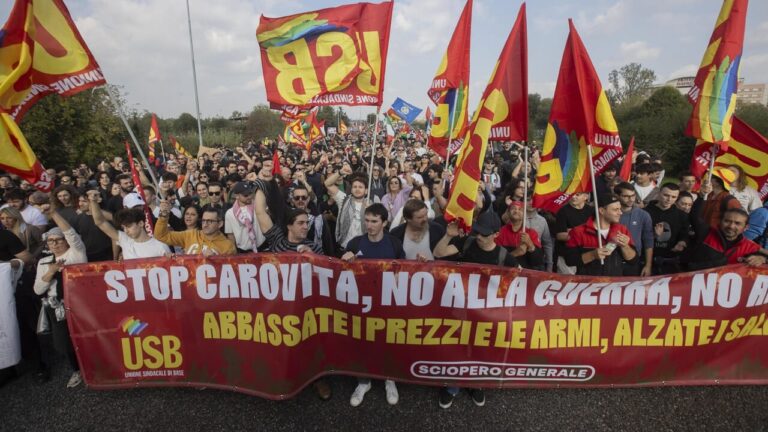
The national general strike on Friday 30 October, against the high cost of living and rearmament, which involved around sixty Italian cities, could have cost the country up to 817 million euros. If indirect costs are also considered, the overall loss could be around one billion euros. The estimate comes from the research office of the Cgia, the artisans and small businesses association of Mestre, and was drawn up while waiting to officially know the level of participation in the mobilization.
Based on initial indications, the absence of employees may have been around 20%. To arrive at its estimate, however, the CGIA took into consideration the daily added value produced in Italy, which in 2026 should amount to 5.676 billion euros, compared to a daily gross domestic product (GDP) of 6.361 billion. Assuming different levels of participation in the strike, the loss of added value would be equal to:
- 409 million euros with 10% participation;
- to 817 million with a membership of 20%;
- to 1.226 billion with a 30% stake.
In the central scenario, an absence of 20% among employees would correspond to an absence rate of 14% of the total employed, also considering self-employed workers. At a territorial level, Lombardy would be the most affected region, with an estimated loss of 193.6 million euros in the hypothesis of a 20% membership. In general, the most critical situations would be concentrated in the most industrialized areas of the country. Here is the list of regions and estimated losses:
- Lazio with 94.3 million
- Veneto with 75.3 million
- Emilia-Romagna with 74.6 million
- Piedmont with 60.2 million
- Tuscany would record a loss of 52.1 million
- Campania of 49.9 million
- Sicily of 40.2 million
- Puglia of 33.6 million
- Trentino-Alto Adige with 22.1 million
- Liguria with 21.3 million
- the Marche with 18.2 million
- Friuli-Venezia Giulia with 17.8 million
- Sardinia with 15.8 million
- Abruzzo with 14.7 million
- Calabria with 13.7 million
- Umbria with 9.9 million
- Basilicata with 5.3 million
- Molise with 2.7 million
- Valle d’Aosta with 2.1 million
How the simulation was done
The CGIA simulation is constructed by assuming an average productivity per worker equal to the national one, regardless of the economic sectors involved, which have different productivity levels. The calculation also assumes that the self-employed workers were not absent and maintained the same average productivity even in the total or partial absence of their employees. The estimate concerns the loss of daily added value and does not include indirect costs. The latter concern the effects of the strike on citizens, businesses, public finances and workers.
Even the mere announcement of a mobilization can influence the behavior of users of public services, pushing some people to give up traveling for fear of inconvenience, even when the vehicles circulate regularly. For businesses, particularly public ones, the reduction in hours worked leads to a loss of productivity and can translate into lower tax and social security revenue.
Healthcare, transport, school
The consequences of the strike may also concern healthcare, transport and schools. The national health service provides 2.5 million services every day, according to Agenas data referring to 2022, including outpatient activities, diagnostics, therapeutic services and specialist visits. Interruptions can lead to the rescheduling of appointments and the lengthening of waiting lists, with consequences especially for the most fragile patients.
In freight transport, the intermittent operation of trains and the total or partial closure of ports and interports can block containers and delay supplies. Not only that. When public transport isn’t running, private sector workers may be forced to use their own cars, incurring costs for fuel, parking and highway tolls. While the failure to open nursery and compulsory schools may force parents to ask for time off from work.
The cost for those who strike
The CGIA also reminds us that the immediate cost of the strike also falls on the workers themselves who join it. The day not worked is in fact deducted from the salary and corresponds to approximately one twentieth of the monthly salary. Furthermore, in most collective agreements, the thirteenth salary portion does not accrue for that period. The association underlines, however, that the loss of production value in one day does not necessarily coincide with a permanent loss for the economic system. Many interrupted or canceled activities, from medical visits to industrial production to the transport of goods, can in fact be recovered in the following days.
Strike fundamental right
The CGIA, however, specifies that the strike is a fundamental right enshrined in Article 40 of the Constitution and a tool through which workers can express their demands. The estimate of the economic cost of the mobilization, underlines the association’s research office, has “the objective of quantifying its effects on the country and not of questioning the legitimacy or democratic and social value of this right”.