

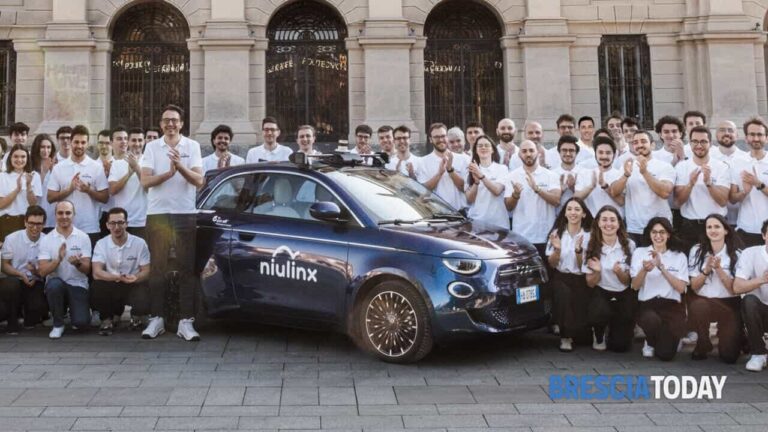
The FS group makes its debut in venture capital by participating in a 38 million euro round for Niulinx, a spin-off of the Polytechnic University of Milan specialized in autonomous driving. It is the most significant investment made so far in Italy in this area and marks the attempt to build a national operator in a market hitherto dominated almost exclusively by large US and Chinese companies.
The millionaire challenge to China and the USA: all the details of the Italian project
The investment and the new members
Niulinx is a startup born from research on artificial intelligence applied to mobility at the Polytechnic University of Milan. The financial operation was led by A2A, through A2A Life Ventures, and by Cdp Venture Capital sgr, who invested ten million euros each. In addition to the Ferrovie dello Stato group, Pirelli, Vc Partners sgr, the National Center for Sustainable Mobility (Most), the Ico Falck Foundation and several international investors also entered the capital.
Competition in the sector
The autonomous driving and robotaxis sector is currently a field of confrontation between the United States, with companies such as Alphabet’s Waymo or Amazon’s Zoox, and China, where Pony.ai and Baidu operate. The entry of large Italian industrial partners into Niulinx, led by CEO Luca Foresti and Chiara Marchesi, aims to support the growth of a European technology capable of competing on a global scale, redesigning travel habits and urban transport services.
Technical development and approval
The resources collected will be used to complete technological development and to obtain the approvals necessary to circulate in European Union countries within the next three years. The growth plan involves expanding the workforce to over one hundred professionals, including engineers and data scientists, and launching a franchising model with local operators in the main markets of the continent. The scientific base remains the Aida research group, coordinated by Professor Sergio Matteo Savaresi.
Road tests in Brescia
A first practical application of this technology was tested in Brescia in 2025, in a project that involved the A2A group and Most. The system allows an electric vehicle to reach the user autonomously; once the person has driven the vehicle to its destination, the car is able to drive itself towards a wireless charging station or towards a new customer. This model aims to integrate human and automated driving to optimize traffic flows.