

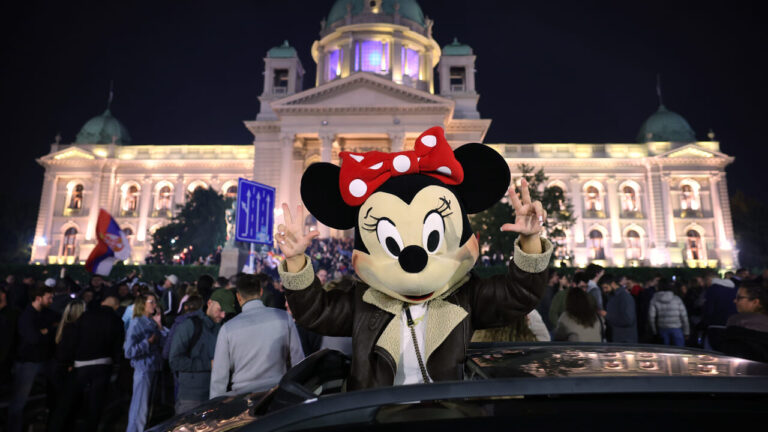
The lesson of the young Serbians changes everything (and we will have to listen to it too)
The lesson comes from our closest East: from Ukraine, which resists the Russian invasion; from Georgia, where for almost 700 days he has been demonstrating against the pro-Russian government of Georgian Dream. He comes from Hungary, where Viktor Orbán was kicked out. Finally, it comes from Serbia, where on Sunday 25 October the Student List won the elections against the United Serbia coalition, led by Aleksandar Vučić’s Party with around 52% of the votes and a parliamentary majority estimated at 138 out of 250 seats.
It is quite impressive to look at the electoral victory of the Serbian student movement in light of the youth protests in European cities. The Serbian students, after all, were the first to take to the streets in this new season of mobilizations. Yet, there is a great distance between them and their peers in the European Union: they share age, impatience and the desire to change things, but they diverge in their objectives.
The turning point
To understand this distance we need to look at where the Serbian protests started from. It all started after the collapse of the Novi Sad train station shelter in November 2024, which cost the lives of fifteen people and became the symbol of a system of systematic corruption and foreign interference. The station had in fact been renovated by a consortium of Chinese companies, CRIC and CCCC, as part of the agreements between Belgrade and Beijing. The collapse had raised the question of the transparency of contracts, often removed from European tender procedures: large investments and infrastructure works in exchange for noose agreements, reduction of controls and increased dependence on Beijing.
Students win the elections in Serbia and send Vucic home after 14 years: “Never again a tyrant”
The difference with Western youth mobilizations is at the root. Serbian students did not protest against the cost of living, the climate crisis or inequality, even though these issues also exist in Serbia. Their revolt was born from the demand for a state in which the institutions are not subordinated to a party, private interests or foreign powers.
On the other hand, in the cities of the European Union, youth struggle, due to its thematic and anti-system nature, is more exposed to exploitation. The causes are real, but when criticism of the system becomes a total criticism of liberal democracies, it ends up strengthening the powers that take advantage of their weakness.
Ultimately, authoritarian powers have learned not to present themselves as explicit ideological alternatives, but as supporters of a generic criticism of Western hypocrisy. They thus exploit the internal fractures of democracies: disinformation, polarization, mistrust in institutions and the media. Thus, a part of young people, even if unconsciously, ends up fueling narratives that favor those very powers.
The ball passes to Brussels
It should be clarified that the Serbian movement, unlike the Georgian one – with a clear pro-European imprint – does not speak out on the European Union, a divisive issue in the country. He preferred instead to focus on the demands that sparked the protests: the fight against corruption, media freedom and institutional responsibility. Yet, it was precisely Vučić’s posture, opposed by the students, that slowed down Serbia’s accession path. Democratic retreat, pressure on independent media and the failure to normalize relations with Kosovo have distanced Belgrade from the required criteria. Added to this is the lack of alignment with European foreign policy on sanctions against Russia.
Then there is the thorny legacy of the wars of the 1990s, which continues to weigh on Serbia’s relationship with the West. But young people have no direct memory of it, nor do they share the distrust of a generation that grew up in that climate. They look to the future with different priorities: transparency, justice, freedom of the press, democratic institutions. It is precisely here that the student movement, without declaring itself pro-European, expresses an ideological rapprochement with Brussels by claiming precisely those values that belong to the political culture of the European Union.
Change, if it comes, will therefore be a gradual process. The first challenge will be internal: responding to the demands for accountability that emerged from the protests. The second will concern Kosovo: without progress in the implementation of the Brussels and Ohrid agreements, no Serbian government will be able to present itself as a reliable partner. The third will be the question of sanctions against Russia, the most difficult test, because it touches the very identity of Serbia, historically close to Moscow. A tortuous road but finally at least possible.
The lesson taught by the Serbian students, then, is to remind Europe that democracy is not defended by inertia. It will now be up to Brussels to understand that it is not enough to ask to choose Europe, but it is necessary to offer a perspective. Serbia is still contested between spheres of influence, but student mobilization has opened up a new space. In order not to lose it, the Union will have to demonstrate that the European path is possible. Because time is never neutral.