

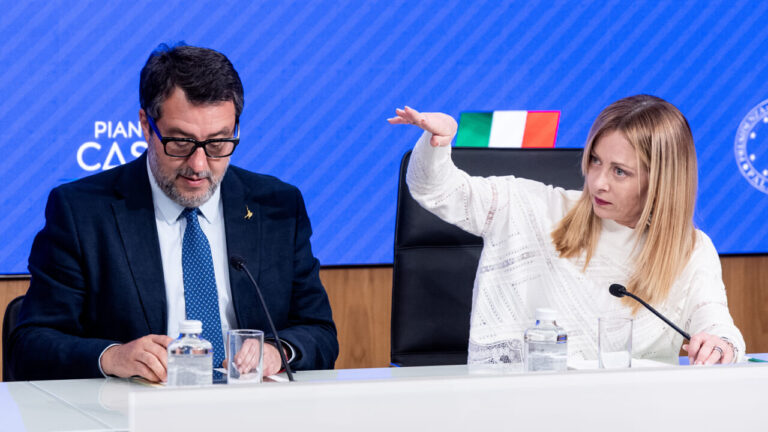
The MPS deal makes Giorgia Meloni rejoice (and puts Salvini in a corner)
It goes without saying that it is only a game of high finance, that politics remains or must remain aside, that the market decides or, as Minister Giorgetti pointed out, perhaps to affect a lack of interest that some have interpreted as disappointment, “whoever pays the most wins”. Since the beginning of the world, when there is so much money involved, when a good portion of Italians’ savings and consequently also the national interest is affected, politics has never been neutral (remember the famous “we have a bank” by Fassino to Consorte, it was 2005 and even then Unipol was involved?).
So it happens that in the very recent shock in the world of Italian finance, the most important for many years, the parties are spectators much more than interested. Especially those in the majority, partly because they are in government, partly because the Campo Largo and especially the Democratic Party appear more sensitive to what happens on the next Flotilla rather than to the fate of the country’s large financial assets (and this is another issue on which the “government” left, assuming it always exists, should ask itself a question).
The triumph of Meloni’s “sovereignist narrative”.
As far as we know, the Intesa leaders had informed both Palazzo Chigi and the Mef of their intentions regarding MPS, in homage to a good practice of cordial relations, and if only because the Treasury is still a shareholder of Siena. But we would not have gone beyond “information” and not even Giorgia Meloni would have expected or been able to expect more. This does not mean that the prime minister is not indifferent to what happened. According to the most accredited behind the scenes, the Prime Minister would have nevertheless expressed with her collaborators her approval for the Intesa-Bper-Mps operation, an operation which allows her to claim the success of the rescue of the Sienese bank which, from an ugly duckling close to bankruptcy, has now become a coveted and disputed prey to the tune of billions, and on the other hand to observe the consolidation of a large Italian banking group which, with the acquisition of Monte and everything that Rocca Salimbeni brings with it, becomes the second European banking group. It is the market that judges (and for now it has judged well, at least looking at how the stock market has moved), but certainly for Giorgia Meloni the fact that Italians’ savings (especially those of Generali) remain in Italian hands and do not end up managed, for example, by French groups (and to say that there were several at stake) is certainly a factor to be appreciated. His nationalist narrative will have other strings to its bow.
The political slap to Matteo Salvini
Then there is another aspect which, if the Intesa-Siena operation goes through, will not displease the Prime Minister too much, and it is the simultaneous stop to the other option in the field, the one which until last Sunday had shown interest in MPS on the part of the BPM, the Banca Popolare di Milano. An operation which is said to have been blessed or at least well-regarded by the League, which would have thus in some way favored the birth of the famous “third banking hub” (after Intesa and Unicredit), a third hub rooted in the north and with a main focus on the needs of the territories and small and medium-sized businesses which, until proven otherwise, are the electoral base of the Northern League.
In a phase of tension between FdI and Lega, the prime minister also obtains the result (not directly desired because it is precisely the market that moves, but…) of seeing the Northern League’s aspirations weaken, and consequently observing a new crisis fault for the Northern League secretary, Matteo Salvini who is creating more than a headache for her on other fronts: in the course of the discussion on the electoral law, in the foreign policy positions which still yearn for a certain pro-Putinism, in the somewhat disrupted by the Vannaccia offensive.
Vannacci decisive: without the general the center-right would lose the elections
The fact that Vannacci grows in the polls every week while the League declines still has a destabilizing effect on the coalition, something that Giorgia Meloni, just over a year after the vote, certainly cannot afford and which leads her to hope for a less exuberant Salvini, less on the ball, more compliant with Meloni’s requests. And perhaps the defeat suffered by the third banking hub can serve to further wet the wings of the League, at least that of Salvini. Waiting for, who knows, Zaia’s to arrive.
Who owns the banks and who really lends money to Italians